Hara & Ishikawa Lab. is a group specializing in materials, surfaces, chemistry and catalysis
A new concept to unify "Inverse catalyst (1,2)" and "Unlocked base metal catalysts (3,4)" has just given birth to a new large-sclae project leading to a paradigm shift.
Our research proposal has just been selected for XXXX project, the most prestigious in academic research in Japan (2026-2031)
1. Overview
Many of the products that sustain our daily lives—fertilizers, fuels, plastics,
and pharmaceuticals—are manufactured using the power of metals known as
catalysts. In industrial plants, raw materials and energy are fed into
reactors packed with metal catalysts, where essential chemical products
are generated on a massive scale. However, these processes consume enormous
amounts of energy. Reducing this energy demand has become a critical challenge
in order to lessen the environmental burden on our planet.
The size of a reactor is always limited. Within that confined space, how fast and how much product can be produced is determined by a key metric: the synthesis rate per catalyst volume. The higher this value, the more product can be generated in a smaller reactor with less energy input. In other words, maximizing this parameter is central to achieving dramatic energy savings.
Remarkably, in the Haber–Bosch process developed more than a century ago, classical iron particle catalysts with sizes exceeding several tens of nanometers (i.e., Mesoscale) are still in use today. Even more striking is the fact that, in terms of synthesis rate per catalyst volume, these traditional iron catalysts continue to outperform many modern supported catalysts based on precious metals. This suggests that significant untapped potential still exists within catalyst science.
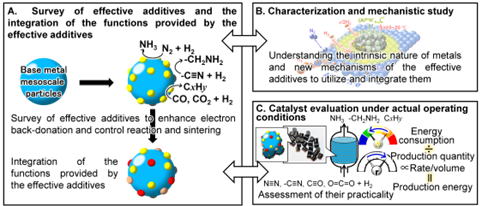
Figure 1 Our new project
2. Why Had We Failed to Notice? — The Blind Spot in
Modern Catalyst Design
The catalyst structure that dominates today was originally
proposed in the 1930s: the supported metal catalyst. In this architecture,
metal nanoparticles a few nanometers in size are immobilized on mesoscale
support particles—typically larger than several tens of nanometers—with high
specific surface area (Figure 2). Here, “high specific surface area” refers to
a large surface area per unit mass; although an individual support particle is
light in weight, this metric is unrelated to its physical volume.
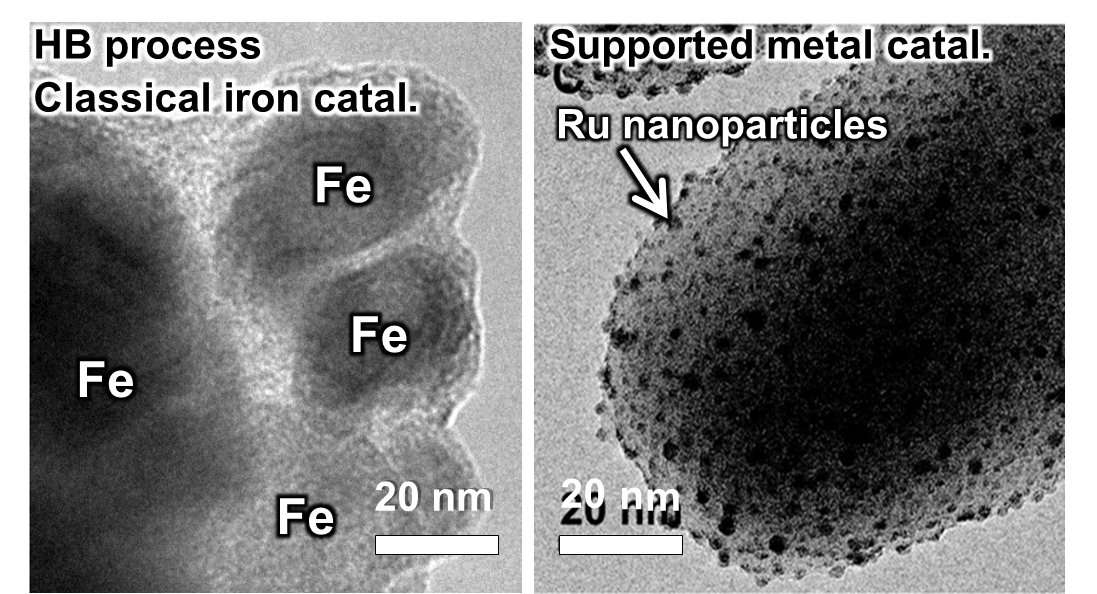
aaaaaaaaaaaaFigure 2 Microscopic images of catalysts
This supported metal catalyst structure is exceptionally effective when
precious metals are employed. By drastically reducing precious metal usage
and thereby lowering catalyst cost, it has become the standard in environmental
applications such as automotive exhaust purification. Indeed, the overwhelming
majority of such catalysts adopt the supported metal configuration.
How, then, does this design principle perform in catalytic
reactions employing inexpensive base metals such as iron? Figure 2 also
presents an electron micrograph of the classical iron catalyst, originally
designed in the early 1900s and still used today for ammonia synthesis. Both
the classical iron catalyst and modern supported metal catalysts consist of
mesoscale particles exceeding several tens of nanometers, with no substantial
difference in their overall volume. In both cases, only the darker metallic
regions are catalytically active. Which catalyst, then, contains a greater
number of surface metal atoms?
The answer is self-evident. The number of surface metal
atoms per unit catalyst volume in the classical iron catalyst surpasses that of
supported metal catalysts. In fact, in ammonia synthesis, the volumetric
performance of the classical iron catalyst readily exceeds that of
state-of-the-art supported catalysts employing precious metals. In hindsight,
this is hardly surprising. Yet why did we overlook such an obvious fact?
Frankly, it remains a mystery.
This realization suggests that, for relatively large
mesoscale base-metal particles, if the catalytic activity of surface metal
atoms can be enhanced, the synthesis rate per catalyst volume could be
dramatically increased. However, despite more than a century of research, no
answer superior to the classical iron catalyst has emerged. As a result, the
mainstream of NH₃ synthesis catalyst research shifted historically toward the
development of supported metal catalysts.
The stagnation was finally broken by the development of the
Inverse Catalyst and the Unlocked Base-Metal Catalyst. These studies
demonstrated that, within mesoscale base-metal particles, it is possible to
achieve unprecedented catalytic performance in the production of many essential
chemical resources, provided that:
・the electronic driving force
that strongly promotes the reaction is intensified,
・inhibitory factors that impede
the reaction are eliminated, and
・sintering—the high-temperature
agglomeration of particles that degrades performance—is effectively suppressed.
Recognition of these achievements by leading researchers
across diverse scientific disciplines in Japan led to the designation of this
work as a highest-tier academic research project and to its approval for
special promotion.
