Hara & Ishikawa Lab. is a group specializing in materials, surfaces, chemistry and catalysis
As the
years go by, my memory keeps getting fuzzier—I forget a lot of the fun things I
thought were cool. So I decided to start keeping a little memo series! Even
should I lose my memory, perhaps reading this memorandum will allow me to
recall it once more.
Episode 108 Funnel Cake: I Want to Taste It Again
.png)
I often come across videos of Americans visiting Japan and raving about Japanese food. As a Japanese person, I am, of course, delighted to see this. But I also believe that America has plenty of culinary treasures it should be proud to share with the world.
Let us start with the American hot dog. Americans should never forget that many Japanese visitors have been genuinely impressed by a good hot dog in the United States. In particular, a proper hot dog made with an all-beef sausage is surprisingly difficult to find in Japan.
And there is another American delicacy I would enthusiastically recommend—something just as simple as a hot dog, yet equally marvelous.
Funnel cake.
When I lived in Pennsylvania, a friend of my wife once took us to the People's Choice Festival at Grange Park.
The first thing that surprised me was that almost everyone around us was white. Everyone was perfectly friendly, of course, but it was a sight I had rarely encountered before, so it caught me somewhat by surprise.
The second surprise was how many families had been enjoying this annual festival from the same favorite spot for decades. It was clearly more than just an event. It was a deeply rooted local summer tradition, passed down from one generation to the next.
Then came my third—and greatest—surprise.
At one of the food stands, I encountered a strangely shaped fried pastry.
Its appearance is rather difficult to describe. If I had to compare it to something Japanese, I would say that it looked a little like kakiage tempura—except with absolutely nothing inside it.
It was generously dusted with powdered sugar. Fresh from the fryer, it was piping hot, wonderfully fragrant, and gently sweet. It was soft, yet its texture and flavor were completely different from those of a doughnut.
So simple, and yet so delicious.
“America is not to be underestimated.”
That was my immediate reaction.
The mysterious pastry was, of course, funnel cake.
Its history is closely associated with the Pennsylvania Dutch, a German-descended community with deep roots in Pennsylvania. Incidentally, the word “Dutch” here does not mean people from the Netherlands; it is a historical term referring to German-speaking settlers.
The way funnel cake is made is wonderfully simple. A batter similar to pancake batter is poured through a funnel into hot oil in thin streams, creating a tangled web that is then fried until golden. Hence the name: funnel cake.
Unfortunately, funnel cake remains very much a regional specialty, which makes finding an authentic one in Japan extraordinarily difficult.
“Then why not make one yourself?” you might ask.
Well, it is not quite that simple.
There is no chance that something made in my own kitchen could rival the work of the funnel-cake masters who have spent decades standing behind their fryers at Pennsylvania festivals.
It seems a terrible shame that something so simple and so delicious has not spread more widely around the world.
What a waste.
Would someone please introduce funnel cake to the rest of the world?
Actually, forget the rest of the world.
Could someone at least bring proper funnel cake to Japan?
Episode 107 A Letter from Lucifer
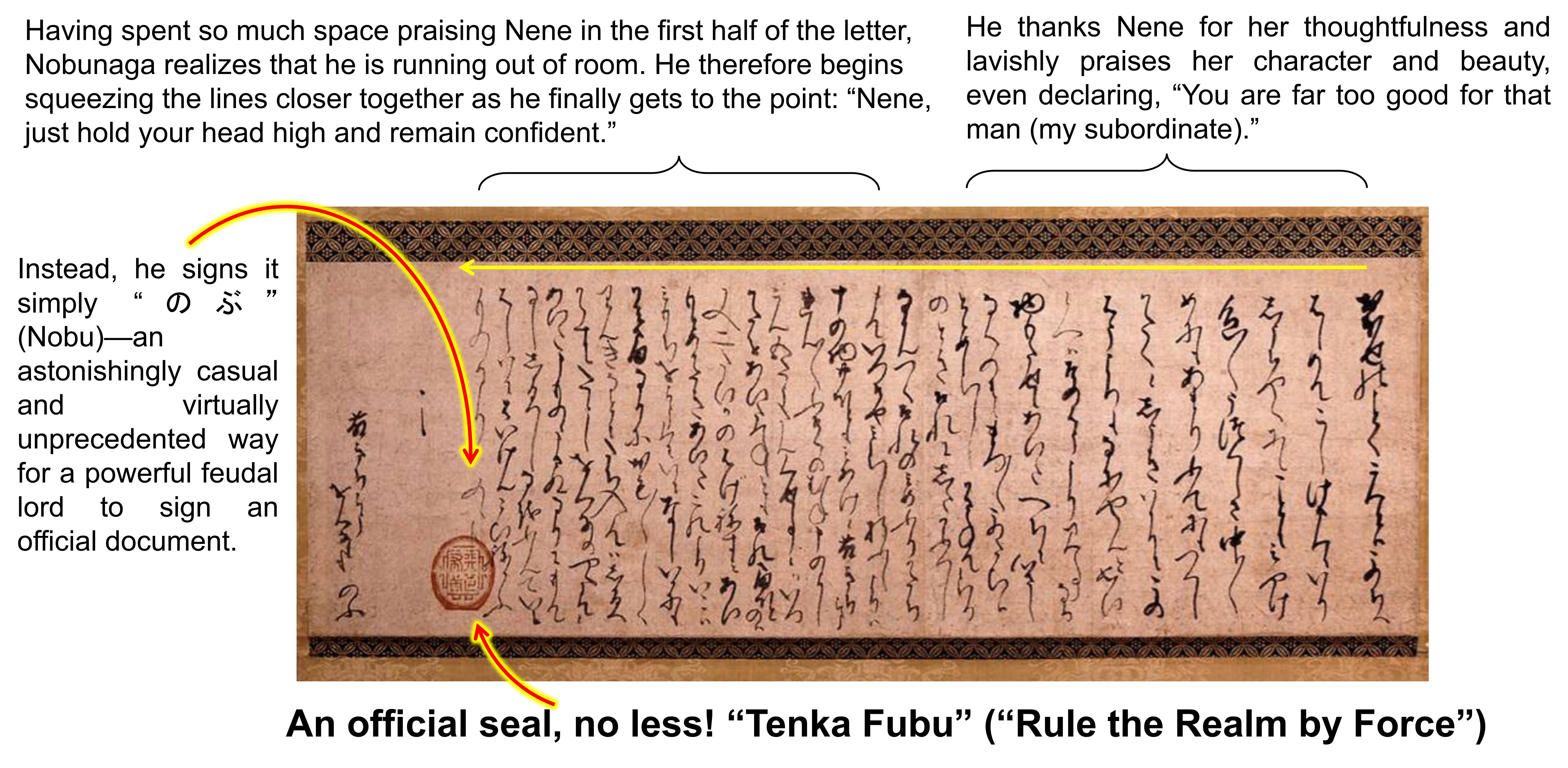
There was once a samurai in Japan who styled himself the “Demon King of the Sixth Heaven.”
His name was Oda Nobunaga.
The “Demon King of the Sixth Heaven” refers to a demonic figure associated with Māra, the tempter who obstructs Buddhist practice. If we translate the idea rather loosely into Christian terms, we are somewhere in the territory of Lucifer or Satan.
And in Nobunaga’s case, this was not merely an intimidating nickname.
He launched extraordinarily brutal attacks against Buddhist forces that opposed him, killing not only monks but large numbers of ordinary followers, including women and children. Incidentally, I myself belong to one of the Buddhist traditions that suffered severely at Nobunaga’s hands.
So, from my perspective, Nobunaga is a rather complicated historical figure.
It would be misleading, however, to describe him simply as a man who hated religion. He maintained relationships with shrines and temples, made use of Buddhist customs and ceremonies, and was relatively tolerant toward Christian missionaries. What he strongly opposed was the transformation of religious organizations into powerful political and military forces capable of interfering with his rule.
One day, this very “Demon King” received a complaint from the wife of one of his subordinates.
The subordinate was Toyotomi Hideyoshi, who would later become the ruler who completed the unification of Japan.
His wife was Nene.
As Hideyoshi climbed the ladder of success at astonishing speed, his enthusiasm for other women seems to have grown at a similarly impressive rate.
Naturally, Nene was not amused.
Eventually, she appealed directly to Nobunaga:
“Please do something about my husband.”
The letter shown above was Nobunaga’s reply.
And this is where the story becomes delightful.
The document bears Nobunaga’s official seal. In other words, this was not simply a friendly little note from “Nobu.” It was a document carrying the authority of one of the most powerful feudal lords in Japan.
One might therefore expect something terrifyingly concise:
“Hideyoshi: Stop womanizing.
That is an order.”
But that is not what Nobunaga wrote.
He begins by thanking Nene for the kindness and consideration she had always shown him.
Then he praises her.
And praises her.
And keeps praising her.
In essence, he tells her that a woman as admirable and beautiful as she is is far too good for her present husband.
Remember: this is Oda Nobunaga—the man of Tenka Fubu, the would-be conqueror of the realm—using an official-looking document to cheer up his subordinate’s angry wife.
Then Nobunaga encounters a problem.
He has spent so much space praising Nene that he is running out of paper.
You can actually see it in the letter. As he approaches the main subject, the writing becomes increasingly cramped.
You can almost hear him thinking:
“Damn. I haven’t even got to the point yet.”
So he squeezes the lines together and finally addresses the marital crisis.
Even then, however, he does not issue a direct command to Hideyoshi.
Instead, he offers Nene what amounts to marriage advice. She has every right to complain about her husband’s behavior, he suggests, but perhaps it would be better not to say absolutely everything that comes to mind and instead find a way to manage the situation wisely.
The Demon King of the Sixth Heaven has suddenly become a marriage counselor.
Then comes the masterstroke.
At the end, Nobunaga tells Nene:
“Show this letter to Hideyoshi.”
And now the official seal suddenly matters.
Hideyoshi cannot exactly say,
“That letter was addressed to my wife, so it has nothing to do with me.”
The man who wrote it is his boss.
And his boss is the Demon King of the Sixth Heaven.
There is one more wonderful detail.
At the end of the letter, Nobunaga signs himself simply in hiragana:
“Nobu.”
For a document carrying the authority of a great feudal lord, the effect is astonishingly casual and almost playful.
To put it in modern terms, suppose I were expected to sign an official document:
“Michikazu Hara, Director, Materials and Structures Laboratory, ……”
but instead wrote:
“Michi♡”
You are not supposed to do that.
Which is precisely why it is so funny.
Nobunaga himself had no children with his principal wife, Nōhime, although he fathered children with several concubines. Hideyoshi and Nene likewise had no biological children together. Their marital circumstances should not, of course, be treated as identical, but perhaps Nobunaga understood that simply roaring at Hideyoshi from above was not such a straightforward matter.
At the same time, he clearly did not want to disappoint Nene.
The result was this remarkable letter:
praise the wife extravagantly, gently rebuke the husband indirectly, and finish by ordering her to show the whole thing to him.
Whenever I think about this letter, I am reminded of how difficult it is to understand a human being from only one side of his character.
Oda Nobunaga is remembered as a ruthless pragmatist who could employ extraordinarily harsh means to achieve his objectives, while also rejecting old conventions and promoting people according to ability rather than inherited status. His brutality toward his enemies is equally impossible to ignore.
And yet novels, films, television dramas, manga, anime, and games featuring Nobunaga remain enormously popular in Japan.
Perhaps people are fascinated not only by the terrifying face of the “Demon King of the Sixth Heaven,” but also by glimpses of another Nobunaga:
a man who listened to his subordinate’s furious wife, tried very hard to cheer her up, used so much paper praising her that he nearly ran out of room for the actual message—
and then signed the whole thing,
“Nobu.”
That unexpectedly human side of the Demon King may be one reason Oda Nobunaga continues to fascinate people more than four centuries later.
Episode 106 Scáthach: She Must Have Been Quite a Character
.png)
Irish mythology features a formidable female warrior named Scáthach.
In Japan, quite a few people know her name because she appears in Fate/Grand Order as a beautiful female warrior.
The Scáthach of mythology, however, was already an extraordinary character. She was such a master of martial arts that she ran what we might today call a “military academy” in Scotland, training numerous warriors as her pupils.
At this point, many Japanese readers may wonder, “Why does Scotland appear in Irish mythology?”
The connection between Ireland and Scotland, however, is extremely old. People moved between Ireland and Scotland from very early times, and the two regions developed deep cultural ties. The sense of affinity between Ireland and Scotland today did not emerge overnight; its roots reach far back into history.
But let us return to Scáthach.
Her strength and martial achievements are celebrated in numerous tales. Curiously, however, the stories tell us remarkably little about what she looked like or what kind of personality she had.
So perhaps we may be allowed to imagine the woman behind the legend.
One thing seems clear: she liked strong people.
When the legendary hero Cú Chulainn overcame a series of formidable obstacles and finally reached her to ask for training, Scáthach took a liking to him and taught him one secret technique after another. Some of them were almost absurdly superhuman, including such bewildering feats as balancing on the tip of a spear.
And then she went even further.
She gave Cú Chulainn her own deadly weapon—the legendary spear Gáe Bolga.
As I explained in Episode 33, Cú Chulainn was normally a handsome young man. Once battle began, however, he could become so frenzied that he underwent the terrifying “warp-spasm” (ríastrad), transforming into a monstrous form and becoming even more powerful.
In other words, this was already a dangerously powerful young man.
And what did Scáthach do?
She taught him a collection of deadly secret techniques, handed him the ultimate weapon, and sent him out into the world.
She was, in effect, the woman who gave a tiger wings and then released it into the wild.
The countless enemies who would later fall before Cú Chulainn must surely have looked up to the heavens and cried:
“Scáthach! What on earth have you done?!”
The story involving Scáthach’s daughter and Cú Chulainn may also give us a glimpse—or at least allow us to imagine something—of Scáthach’s personality.
Armed with Gáe Bolga, Cú Chulainn and Scáthach’s daughter behave rather freely together. There is, however, one slight complication.
She already has a lover.
Scáthach says nothing.
Then Cú Chulainn accidentally injures her daughter.
Again, Scáthach says nothing.
The daughter’s lover, however, is considerably less relaxed about the situation. Despite her attempts to stop him, he challenges Cú Chulainn to a duel.
Cú Chulainn wins. Apparently, at least, he does not kill him.
And after all this, Cú Chulainn becomes the daughter’s lover instead.
Still, Scáthach remains unfazed.
Indeed, she even promises that if the man is Cú Chulainn, she will give him her daughter in marriage without requiring him to pay a bride-price.
Now that is a woman with a bold spirit.
Of course, this is merely the image of Scáthach that I have constructed from the scattered episodes preserved in mythology.
Still, I cannot help imagining that she must have been an extraordinarily big-hearted, larger-than-life woman who was not easily disturbed by anything.
Her pupils could run wild. Men could fight duels over her daughter. A little chaos here and there would hardly make her raise an eyebrow.
And at the end of it all, I imagine her standing with her hands on her hips and bursting into a tremendous laugh:
“HA! HA! HA! HA!”
That is Scáthach the warrior as I like to imagine her.
.jpg)
I bought an electric moped.
Until now, even when I needed to pick up something small from a shop only a short distance away, I would take out my one-box van. Needless to say, with its poor fuel economy, this was hardly a cost-effective way to run a small errand.
So I decided to buy an electric moped that anyone aged 16 or older can ride in Japan without a driver's license.
In Japan, this type of electric moped is subject to various restrictions somewhat similar to those applied to bicycles. Among other regulations, its speed on level ground must not exceed 20 km/h, and its motor output must be less than 600 W.
Restrictions or not, however, riding it is surprisingly fun.
Twenty kilometers per hour may not sound particularly fast, but when you are actually riding at that speed, it feels quite brisk. On a steep uphill slope, the speed drops by more than 25%, but the sound of the motor struggling valiantly up the hill is somehow rather cute.
I normally avoid fully charging lithium-ion batteries to 4.2 V, instead limiting the maximum charging voltage to around 4.0 V. This corresponds to roughly 70–80% state of charge. Even so, this electric moped can travel at least 15 km before the battery level falls to around 30%. That is more than enough range for getting around within an urban neighborhood.
What is even more surprising is that this electric moped costs less than 100,000 yen.
If someone handed me 100,000 yen and said, “Build an electric moped with the same capabilities as this one,” I simply couldn't do it.
Just as I was beginning to look forward to enjoying my shopping trips on it, however, we were hit by one rainy day after another.
It looks like next week I will finally get the chance to see what this little machine can really do.
Episode 104 The Mightiest and Most Fearsome Samurai — The Satsuma Hayato
.png)
Long ago, at the southern tip of Kyushu, in
present-day Kagoshima, there lived a group of samurai feared as some of the
mightiest and most terrifying warriors in Japan: the Satsuma Hayato.
They were famous for charging into battle
with their swords raised high while letting out a piercing cry—“Kiiieee!”—a
distinctive battle cry known as enkyo, or the “monkey cry.” If their
enemies lost their nerve and tried to flee, the Satsuma warriors would pursue
them relentlessly, as if shouting, “Don’t run! Leave your head behind!”
They were, in a sense, human assault machines fueled by sheer fighting
spirit and murderous intensity.
I recently visited a fortress that these
men once boasted they could capture “in just three days.”
Kumamoto Castle.
Standing before its enormous stone walls
and formidable fortifications, my immediate reaction was:
“There is no way you could take this place
by fighting spirit alone.”
How on earth could anyone look at such a
fortress and imagine that a frontal assault would bring it down easily?
And there was another problem.
The defenders of Kumamoto Castle were not
old-fashioned samurai armed merely with swords and matchlock guns. They were a
modern army equipped with rifled firearms and state-of-the-art artillery.
Yet even when confronted with such a
formidable stronghold, the Satsuma warriors apparently regarded it as something
they could overcome.
For that extraordinary courage and audacity
alone, I cannot help but respect them.
Their confidence, however, was not matched
by reality. Kumamoto Castle withstood their ferocious assaults for more than
fifty days, holding out until reinforcements finally arrived.
It must have been a brutal battle, soaked
in blood.
Today, the castle and its surroundings are
peaceful. Yet as I stood there, I found myself imagining the men who once
fought and died on that very ground.
And almost instinctively, I murmured the
famous haiku by the great poet Matsuo Bashō:
“Summer grasses—all that remainsof warriors’ dreams.”
Few places, I thought, could be more
fitting for those words.
For a while, I simply stood there, deeply
moved by the scene before me.
.png)
Japan is currently experiencing a strange contrast in its water conditions.
Eastern Japan has received so much water that some areas have suffered
flooding, while western Japan is facing drought. However, if such water
shortages are temporary and water resources can recover through rainfall
in subsequent years, they alone are unlikely to cause the collapse of a
country or society.
Meanwhile, a United Nations agency warned in January 2026 that many parts of the world are facing the risk of “water bankruptcy.”
“Water bankruptcy” is not yet a familiar term.
It describes a situation in which human water use and withdrawals continuously exceed nature’s ability to replenish water resources over a long period of time. As a result, groundwater, lakes, wetlands, and other water resources are depleted to such an extent that there is no longer enough water available—not only for the present generation, but also for future generations. In other words, water bankruptcy occurs when water resources themselves lose their long-term sustainability.
An important point is that human activity must be a major cause.
A shortage or disappearance of usable water caused solely by natural phenomena, such as long-term climatic changes or shifts in river courses, is not generally described as water bankruptcy. For example, even if a once-green landscape gradually became an arid region like today’s Sahara Desert because of long-term climatic change, this would be different from water bankruptcy.
What, then, happens when water bankruptcy occurs?
The water system supporting an entire region can cease to function. The consequences are not limited to damage to food production and industry. Ultimately, the foundations of human life—and even society itself—may become impossible to sustain.
Even a small-scale case of water bankruptcy, such as “the village well has dried up,” can make a community uninhabitable if no alternative water source exists. If another source of water can be secured nearby, however, there may still be a way to save the community.
The far more serious problem now emerging is the “bankruptcy” of entire lakes or vast underground aquifers that have supported extensive regions for generations. Once water resources of this scale are depleted, finding alternatives becomes extremely difficult, and the options for rescue are likely to be severely limited.
Japan is a country with relatively abundant rainfall. Even if we suffer from drought in one year, we may expect plentiful rain to restore our water resources in the following year. For this reason, some people may believe that Japan has little to fear from water bankruptcy.
But that would be a serious mistake.
Japan imports a large proportion of its food from overseas. Producing that food requires enormous amounts of water. In this sense, importing food also means indirectly importing vast quantities of “water from other countries”—the water used to produce what we eat.
What would happen if the countries and regions producing that food were to go water-bankrupt...?
Water bankruptcy is by no means a distant problem for Japan.
Episode 102 Izumi Gargen Tower
.jpg)
Just east of the Tanimachi Junction on the Shuto Expressway lies Izumi Garden in Roppongi 1-chome. It is a quiet hill dotted with places bearing the name Izumi, including Izumi Garden Tower and the Sen-Oku Hakukokan Museum Tokyo. Walking up the hill leads to beautiful streets lined with foreign embassies and even the nostalgic Nomura Apartments. I love this part of Tokyo so much that, if I were not there for work, I could happily spend hours simply wandering around.
The name Izumi (“spring” or “fountain”) also brings to mind water wells. The kanji character 井 (i, “well”) is said to have originated as a pictograph representing the wooden lattice, or igeta, traditionally constructed over a well as seen from above. There is, in fact, a major Japanese business group that uses this igeta design as its symbol: the Sumitomo Group.
Sumitomo has a history stretching back more than four centuries. Its old trade name was Izumiya, and the igeta has long served as its emblem. Today, the Sen-Oku Hakukokan Museum Tokyo stands on the former site of the Sumitomo family’s Azabu residence. The Sumitomo Kaikan is also located in this area, occupying the upper floors of Izumi Garden Tower from the 42nd floor upward. Seen in this light, one begins to understand how deeply this district—and the name Izumi itself—is connected with the history of Sumitomo.
Izumi Garden Tower, incidentally, strikes me as a beautiful labyrinth. I am told that without special authorization, one cannot even make one’s way to the entrance of the Sumitomo Kaikan.
Having the opportunity to enter places such as this, and to admire a district where centuries of history are woven into the most modern urban landscape—a place that is somehow “older than anything, yet entirely new”—may be one of the small privileges of being a university professor.
Episode 101 Traffic Offender Course: A Gathering of Seasoned Veterans
.png)
In Japan, most people can renew their driver’s licenses at a nearby police station or other local facility. There are, however, some people who must make their way, in the middle of a weekday, to a driver’s license center far from home just to renew their licenses.
They are traffic offenders.
In the hierarchy of driver classifications, there are “excellent drivers,” “general drivers,” and “first-time renewal drivers.” And then, beneath them all, at the very bottom, are the “traffic offenders.” To renew their licenses, they must attend a special traffic-offender course at a driver’s license center.
That does not mean they are inexperienced drivers. Quite the opposite. Many have spent countless hours behind the wheel and traveled enormous distances. They are, in a sense, seasoned veterans of the road. There are a few drivers in their late teens and early twenties, but they are distinctly in the minority.
And the people who gather for this course in the middle of a weekday are quite a sight.
There is a tall, powerfully built older gentleman. He is dressed head to toe in a bright red tracksuit, with flip-flops on his feet and a gold chain around his neck.
There is also an elegant lady. Everything she is wearing, from head to toe, is unmistakably designer. She must surely be someone of distinction.
Then there is an ageless bald man in a black leather jacket. He is staring intently at his tablet. What could he possibly be reading?
It is the Journal of the American Chemical Society, one of the world’s premier journals in chemistry.
Who on earth is this man?
Naturally, the instructors entrusted with this gathering of seasoned veterans are veterans themselves. Some spent many years as police officers before taking up teaching at the license center.
As the course begins, the instructor opens with a simple statement:
“You would all do well to remember the basics.”
Then he continues.
“A green light does not mean ‘GO!’ It merely means that you may proceed.”
A shock wave passes through the classroom.
“What...?”
Murmurs ripple among the participants.
The instructor continues.
“The same applies to stop signs and stop lines. You must not forget the basics. Think back to when you first learned to drive. Why is the stop line sometimes placed so far back from the intersection?”
The room falls silent.
“The stop line is telling you to bring your vehicle to a complete stop before entering the intersection.”
Then he carefully explains what comes next.
“From there, you creep forward—slowly, very slowly—checking carefully to the left and right as you enter the intersection. By doing this, you are more likely to notice cars, bicycles, or pedestrians approaching from either side. And even if you fail to notice them, your slow approach gives them time to see you entering the intersection and react.”
I see.
As if the scales have suddenly fallen from their eyes, several of the seasoned veterans hurriedly begin taking notes.
After this excellent lecture has returned us all to the fundamentals of driving, the course comes to an end. Our new driver’s licenses are then handed to us on the spot.
They had been preparing them while we were sitting in the classroom.
Not a moment wasted.
And so ends the license-renewal ritual for Japan’s traffic offenders.
By the time we leave the driver’s license center, the building is bathed in the glow of the setting sun.
As the seasoned veterans walk away, the center itself seems to call out after us:
Next time, aim for the next rank up.
Episode 100 Zweites Deutsches Fernsehen: Timeless Animation Born from German–Japanese Collaboration
.png)
Vicky the Viking, Maya the Bee, and Heidi, Girl of the Alps. Produced and broadcast in 1974 and 1975, these animated series remain widely known and highly regarded in Europe even today, more than half a century later.
Vicky and Maya, in particular, have enjoyed remarkable longevity. New adaptations have continued to appear in the form of live-action films and 3D animation, turning them into characters loved across generations. Incidentally, Vicky the Viking is also known as one of the works that had a major influence on Eiichiro Oda, the creator of ONE PIECE.
Behind the creation of these works was cooperation between Germany’s public broadcaster Zweites Deutsches Fernsehen (ZDF, “Second German Television”) and Japanese animation studios.
Through this German–Japanese collaboration, European children’s literature, landscapes, lifestyles, and customs—which had previously been relatively unfamiliar to many people in Japan—became much more accessible to Japanese audiences through animation. At the same time, Japanese animation techniques helped introduce new approaches to character design and visual storytelling to Germany and other parts of Europe.
Let us take Maya the Bee as an example.
More than fifty years ago, I read a Japanese translation of The Adventures of Maya the Bee by the German writer Waldemar Bonsels. In the illustrations, Maya looked exactly like what she was supposed to be: a honeybee. Naturally, the other insects in the story were also depicted much like real insects. Seeing these insects standing on their hind legs and talking to one another like human beings struck me, even as a child, as somewhat surreal.
The animated adaptation, however, dramatically transformed the appearance of Maya and her companions.
Consider Maya herself. Her body retains the yellow-and-black stripes of a bee, but she has humanlike arms and legs. Her head resembles that of an energetic little girl, with short blond hair and a pair of antennae. At the heart of Maya’s personality is her boundless curiosity, and her animated design seems almost to be a visual embodiment of that defining trait.
Then there is her companion, Willy. He has a body and limbs similar to Maya’s, but he is a laid-back boy with a slightly absent-minded expression who prefers to take life at his own pace. Interestingly, Willy does not appear in Bonsels’s original story; he was created for the animated adaptation.
In this way, the insects were transformed through animation into charming and approachable characters. The villains, of course, were treated somewhat differently: although often comical in appearance, their unpleasant and menacing qualities were deliberately emphasized.
The animated works produced through cooperation between ZDF and its Japanese partners thus brought together European stories and culture with distinctive Japanese approaches to animation, creating a visual world unlike anything that had existed before.
Meanwhile, the German and Japanese people who participated in these projects are gradually disappearing with the passage of half a century. Hayao Miyazaki, in his younger years, was one of the Japanese creators who contributed to this era of collaboration between Japan and Europe.
But why did such an international project come into existence in the first place?
The answer may sound somewhat less romantic: market forces.
On the German side, Josef Göhlen and others responsible for children’s and youth programming at ZDF wanted to secure high-quality animated programs for children at an affordable production cost. On the Japanese side, animation studios were eager to expand beyond their domestic market and establish themselves overseas.
Their interests coincided.
Yet an international partnership that began for perfectly rational business reasons ultimately created works that have remained in people’s hearts for more than half a century and continue to be loved across generations.
A business venture driven by the logic of the marketplace can, somewhere along the way, become a culture that transcends national borders.
Perhaps
that, too, is one of the fascinating ways in which culture is created.
Folge 100
Zweites Deutsches Fernsehen: Zeitlose
Animationsklassiker aus deutsch-japanischer Zusammenarbeit
Wickie und die starken Männer, Die Biene Maja und Heidi.
Diese Animationsserien, die 1974 und 1975 produziert und ausgestrahlt wurden,
sind auch heute, mehr als ein halbes Jahrhundert später, in Europa weithin
bekannt und hoch geschätzt.
Vor allem Wickie und Maja erfreuen sich
einer bemerkenswert anhaltenden Beliebtheit. Immer wieder entstanden neue
Adaptionen als Realfilme und 3D-Animationsproduktionen, sodass beide zu Figuren
geworden sind, die über Generationen hinweg geliebt werden. Bemerkenswert ist
auch, dass Wickie und die starken Männer zu den Werken zählt, die
Eiichiro Oda, den Schöpfer von ONE PIECE, maßgeblich beeinflusst haben.
Hinter der Entstehung dieser Werke stand
die Zusammenarbeit zwischen dem deutschen öffentlich-rechtlichen Fernsehsender
Zweites Deutsches Fernsehen (ZDF) und japanischen Animationsstudios.
Durch diese deutsch-japanische
Zusammenarbeit wurden europäische Kinderliteratur, Landschaften, Lebensweisen
und Bräuche, die vielen Menschen in Japan zuvor noch relativ fremd gewesen
waren, einem japanischen Publikum durch Animation nähergebracht. Gleichzeitig
trugen japanische Animationstechniken dazu bei, neue Formen der
Figurengestaltung und des visuellen Erzählens in Deutschland und anderen Teilen
Europas bekannt zu machen.
Nehmen wir Die Biene Maja als
Beispiel.
Vor mehr als fünfzig Jahren las ich eine
japanische Übersetzung von Die Biene Maja und ihre Abenteuer des
deutschen Schriftstellers Waldemar Bonsels. In den Illustrationen sah Maja
genau so aus, wie man es erwarten würde: wie eine echte Honigbiene. Natürlich
wurden auch die anderen Insekten der Geschichte weitgehend naturgetreu
dargestellt. Diese Insekten auf ihren Hinterbeinen stehen und wie Menschen
miteinander sprechen zu sehen, erschien mir schon als Kind irgendwie surreal.
Die Zeichentrickadaption veränderte jedoch
das Erscheinungsbild von Maja und ihren Gefährten grundlegend.
Betrachten wir zunächst Maja selbst. Ihr
Körper trägt weiterhin die gelb-schwarzen Streifen einer Biene, doch sie
besitzt menschenähnliche Arme und Beine. Ihr Kopf erinnert mit den kurzen
blonden Haaren und den beiden Fühlern an ein lebhaftes kleines Mädchen. Im
Zentrum von Majas Persönlichkeit steht ihre grenzenlose Neugier, und ihre
Gestaltung in der Zeichentrickserie wirkt beinahe wie die bildliche
Verkörperung genau dieser Eigenschaft.
Dann ist da ihr Gefährte Willi. Körper und
Gliedmaßen ähneln denen von Maja, doch er ist ein gemütlicher, etwas verträumt
wirkender Junge, der das Leben gern in seinem eigenen Tempo angeht.
Interessanterweise kommt Willi in Bonsels’ ursprünglicher Geschichte nicht vor;
er wurde für die Zeichentrickadaption geschaffen.
Auf diese Weise verwandelte die Animation
die Insekten in liebenswerte und zugängliche Figuren. Bei den Bösewichten
verhielt es sich natürlich etwas anders: Obwohl sie häufig komisch dargestellt
wurden, betonte man bewusst ihre unangenehmen und bedrohlichen Eigenschaften.
Die Animationswerke, die aus der
Zusammenarbeit zwischen dem ZDF und seinen japanischen Partnern hervorgingen,
verbanden somit europäische Geschichten und Kultur mit charakteristischen
japanischen Formen der Animation und schufen dadurch eine Bilderwelt, wie es
sie zuvor in dieser Form nicht gegeben hatte.
Inzwischen sind seit diesen Projekten mehr
als fünfzig Jahre vergangen, und die deutschen und japanischen Beteiligten
jener Zeit werden allmählich immer weniger. Auch der junge Hayao Miyazaki
gehörte zu den japanischen Kreativen, die zu dieser Epoche der Zusammenarbeit
zwischen Japan und Europa beitrugen.
Doch warum entstand ein solches
internationales Projekt überhaupt?
Die Antwort mag etwas weniger romantisch
klingen: Es waren die Kräfte des Marktes.
Auf deutscher Seite wollten Josef Göhlen
und andere Verantwortliche für das Kinder- und Jugendprogramm des ZDF
qualitativ hochwertige Animationsprogramme für Kinder zu vertretbaren
Produktionskosten sichern. Auf japanischer Seite wiederum waren die Animationsstudios
daran interessiert, über ihren heimischen Markt hinauszugehen und sich auch
international zu etablieren.
Die Interessen beider Seiten trafen sich.
Doch aus einer internationalen
Partnerschaft, die aus durchaus rationalen wirtschaftlichen Gründen begann,
entstanden schließlich Werke, die seit mehr als einem halben Jahrhundert in den
Herzen vieler Menschen weiterleben und über Generationen hinweg geliebt werden.
Ein Geschäft, das zunächst der Logik des
Marktes folgt, kann irgendwann zu einer Kultur werden, die nationale Grenzen
überwindet.
Vielleicht ist auch das eine der
faszinierenden Arten, wie Kultur entsteht.
Episode 99 Indonesia Raya! — A National Anthem I Can’t Get Out of My Head
.png)
I once gave a presentation at an academic conference in Indonesia. There is something remarkably comfortable about being in this country.
Whenever someone does something for me, I say, “Terima kasih” (“Thank you”). Sometimes, to my surprise, they even reply in Japanese with “Arigatou gozaimasu” or “Dou itashimashite”—“Thank you” or “You’re welcome.” So many people there respond to courtesy with courtesy that I find Indonesia an unusually stress-free place to be.
There are, however, some Indonesian customs that can catch a first-time visitor by surprise.
On the first day of the conference, just before the opening ceremony began, a female student wearing a jilbab stepped to the front of the hall. She said something that I assumed meant, “We will now sing the national anthem,” and began conducting the audience. Everyone immediately joined in.
Apparently, this is a standard part of the protocol at formal events in Indonesia. I had done quite a bit of research online before traveling there, but this was one custom I had somehow missed.
Fortunately, the lyrics to Indonesia’s national anthem, “Indonesia Raya,” were printed inside the cover of the conference program. Following the words as best I could, I began singing along somewhat awkwardly.
But as the song went on, I gradually found myself getting into it.
I was particularly stirred by the lines repeated toward the end of each verse:
“Indonesia
Raya, merdeka, merdeka!
Hiduplah Indonesia Raya!”
Even though I am not Indonesian, I could not help getting excited.
There is no doubt about it: “Indonesia Raya” is a national anthem that energizes people.
I had heard and sung solemn national anthems before, and I had experienced national anthems sung with great passion. But this was the first time I had sung one that actually made me feel more energetic as I sang it.
There was just one problem: once I had sung it, I could not get the melody out of my head.
Today, alongside “The 365-Step March” and “Lili Marleen,” “Indonesia Raya” has become one of the songs I find myself humming whenever I am struggling with a difficult task.
Repairing
a burst water pipe in pouring rain.
Making emergency repairs to a fence that looks ready to blow away in a typhoon.
At moments like these, I suddenly catch myself singing:
“Indonesia Raya, merdeka, merdeka!”
Somehow, for me, “Indonesia Raya” has become not only a national anthem, but also my own personal marching song for taking on difficult jobs.
.png)
Because of the nature of my work, I often have opportunities to talk with geneticists. I must admit that I rather enjoy the occasions when what they tell me completely overturns my previous understanding of history. I was astonished by what I previously learned about the origins of the Huns, but recently I encountered an even more fascinating story, which I would like to record here.
The Yamnaya culture flourished mainly between approximately 3300 and 2600 BCE across the Pontic-Caspian steppe, stretching from present-day Ukraine into southern Russia. Recent studies of ancient DNA have increasingly revealed that the Yamnaya and related steppe pastoralists played an extraordinarily important role in the formation of European populations, the spread of Indo-European languages, and the later development of equestrian cultures across Eurasia.
Particularly striking is the enormous population movement that occurred during the third millennium BCE. Steppe populations closely related to the Yamnaya expanded westward, and their genetic influence spread rapidly across central and northern Europe. People associated with the Corded Ware culture carried a substantial proportion of steppe ancestry, and many present-day Europeans retain this genetic legacy to varying degrees.
Moreover, the hypothesis that people of the Pontic-Caspian steppe spoke Proto-Indo-European, or an important ancestral stage of it, has become one of the leading models linking archaeology, historical linguistics, and ancient-DNA research. Their use of horses and wheeled vehicles, which provided them with remarkable mobility, is also considered important in understanding their rapid expansion. Whether the Yamnaya themselves can be described as the world's first true horseback riders, however, remains a matter of debate.
In any case, it seems increasingly likely that highly mobile steppe populations migrated westward on a massive scale and profoundly influenced the genetic composition, cultures, and languages of Europe. In that sense, part of the foundation of the European world as we know it today may ultimately be traced back to the grasslands north of the Black Sea.
The influence of steppe populations also spread eastward. This does not mean, of course, that the Yamnaya themselves simply migrated as a single population all the way to India. Rather, through later steppe societies such as the Sintashta and Andronovo cultures, and through repeated interaction and intermarriage with numerous other populations, their genetic, cultural, and linguistic influence eventually spread through Central Asia and into South Asia.
Over the course of many centuries, Indo-European languages thus came to occupy an enormous geographical area extending from Europe in the west to Iran and India in the east. One important point must be emphasized, however: a language family is not the same thing as an ethnic group. The spread of languages and the movement of human populations can certainly be closely related, but the two should never be regarded as identical.
Equally fascinating is what happened as steppe and equestrian cultures spread farther east across Eurasia and underwent their own distinctive development. In Central Eurasia, peoples of many different ethnic and linguistic backgrounds interacted and mixed over long periods, eventually producing sophisticated traditions of mounted pastoral nomadism. These developments became part of the long history of the Eurasian steppe that would later give rise to powerful nomadic confederations and empires, including the Xiongnu and, in later periods, the Huns and Mongols.
Many centuries later, the Huns emerged from the eastern steppe world and advanced into the region north of the Black Sea before shaking Europe to its foundations. Roughly eight centuries later, Mongol armies likewise crossed the steppes north of the Black Sea and advanced into Eastern Europe, bringing another enormous shock to the European world.
There is something remarkable about this historical symmetry. Steppe peoples once moved westward from the lands north of the Black Sea and played a major role in shaping Europe. Thousands of years later, mounted powers that had developed within that same vast Eurasian steppe world came sweeping back from the east, again passing through the northern Black Sea region on their way into Europe.
People, languages, cultures, and horses moved back and forth across the Eurasian continent over thousands of years. It is a story that makes one appreciate the truly immense scale of human history.
.png)
I once gave a plenary lecture at an international academic conference held at a university in India.
At a typical international conference, the program begins with an opening ceremony, during which the organizers welcome the participants. This is usually followed by plenary lectures attended by everyone, after which the regular scientific sessions begin in separate rooms.
At this particular conference, however, things were a little different. Before the opening ceremony, there was another ritual: the lighting of a ceremonial lamp accompanied by a hymn to the goddess Sarasvatī.
I had never encountered anything like it in a travel guide. I was astonished.
In Hindu tradition, Sarasvatī is the goddess of wisdom, learning, the arts, and music. Interestingly, she also traveled across cultures and eventually came to be worshipped in Japan as Benzaiten, the only female member of the Seven Gods of Fortune. In Japan, Benzaiten is associated with music, learning, good fortune, and the arts, and she has also acquired aspects of a deity of victory. Affectionately known to Japanese people as “Benten-sama,” her iconography—particularly her association with a musical instrument—still clearly reflects her connection with the Indian goddess Sarasvatī.
As a Japanese person, therefore, I feel little discomfort in paying my respects to Sarasvatī. But I wonder how participants from other countries feel about it.
Sarasvatī is not merely a “religious deity” in the narrow sense. She presides over vidyā (learning and scholarship), jñāna (knowledge), the arts, language, music, and education. She therefore has a particularly close association with universities, schools, and academic gatherings.
Paying respect to the goddess at the beginning of a conference can thus be understood as expressing a wish that “the scholarly endeavor we are about to begin may be fruitful.” In India, I learned, this is regarded as one of the traditional ways of inaugurating an academic occasion.
Before beginning an academic conference, people in India may honor a goddess. In Indonesia, everyone may stand together and sing the national anthem, Indonesia Raya (“Great Indonesia”).
These are customs that rarely appear in ordinary travel guidebooks. They are cultural encounters that one experiences only by actually visiting a country and being present on such occasions. That is precisely what makes them so refreshing and memorable.
The truth is, I hate traveling abroad. On the day before an overseas trip, I repeatedly complain, “I don’t want to go, I don’t want to go,” until everyone around me gets tired of hearing it.
And yet, even someone like me can unexpectedly encounter customs and traditions that I never knew existed.
At moments like that, I find myself thinking,
“Well, I suppose I’m glad I came after all.”
.png)
In Japan, there is a rather curious linguistic tradition in which a morally depraved person—someone who has strayed from the path of humanity—is described as hinin or ninpinin, literally suggesting “one who is not human.” Strangely enough, this idea has sometimes been associated with the Sanskrit term Kiṃnara.
Yet the original Kiṃnara is nothing of the sort. In Hindu and Buddhist traditions, Kiṃnaras are sacred celestial beings closely associated with music. Throughout South and Southeast Asia and elsewhere beyond Japan, they are generally regarded as graceful and exalted beings. Why, then, have they received such dreadful treatment only in Japan?
The answer seems to lie in a misunderstanding of Sanskrit.
To begin with, Kiṃnaras assume a remarkable variety of forms. They may appear as beautiful celestial maidens, as beings with a human upper body and the lower body of a bird, or, depending on the tradition, as human-headed horses, horse-headed humans, or creatures that are half human and half horse. Whatever their appearance, however, they belong to a realm beyond ordinary humanity and are mystical beings renowned for their music.
Imagine a human encountering one of these extraordinary creatures and exclaiming:
“Is this really a human being?”
The Sanskrit expression kiṃ nara?, roughly meaning “Is this a human?” or “What sort of human is this?”, is traditionally associated with the origin of the name Kiṃnara.
Here lies the amusing divergence. In many regions outside Japan, this “apparently non-human being” came to be understood as something above ordinary humans—a sacred and celestial being. In Japan, however, a similar idea of “not being human” somehow took the opposite direction and became associated with someone who had fallen below humanity by abandoning basic human decency.
Thus, in Japanese, the expression came to describe scoundrels who squeeze even more money from the poor, harass those in weaker positions, or make money by exploiting others through false professions of love.
Surely all the Kiṃnaras in the universe would be entitled to lodge a complaint about this outrageous treatment.
Then again, being far nobler creatures than ourselves, perhaps they could not care less about such petty misunderstandings among us mere mortals.
Episode 95 The Earth Is Having a Terrible Year- Extreme Phenomena Beyond Anything Previously Recorded; Torrential rain of 115 mm/h hits near the capital
.png)
The Earth is having a very difficult year.
Europe and North America have been ravaged by heat waves, drought, extreme dryness, and massive fires. Major earthquakes have struck Central and South America, while the Far East has experienced repeated heat waves, torrential rains, and severe flooding.
Japan, too, has experienced an extraordinary event in the form of Typhoon No. 15, with torrential rain continuing even after the typhoon itself dissipated. On August 13 and 14, Chiba, near the capital, was hit by torrential rain of 115 mm/h, resulting in many casualties. My deepest condolences go out to the victims. Japan's annual average precipitation is around 1,600 to 1,700 mm, meaning about 7% of its yearly rainfall fell in just a single hour. It is no wonder this led to a disaster. To begin with, the anomaly of Typhoon No. 15, which triggered this catastrophe, is clearly reflected in its path.
What makes Typhoon No. 15 particularly unusual is its track.
Typhoons, those recurring scourges of the Far East, normally move northward or north-northwestward before eventually coming under the influence of the prevailing westerlies and turning toward the northeast. Of course, not every typhoon follows exactly the same route. Some make landfall in China before they have a chance to turn northeast, causing serious damage there. Others are caught by the westerlies somewhat later and make landfall on the Korean Peninsula.
However, since systematic observations began, there had reportedly never been a typhoon that moved northward and then turned westward. Typhoon No. 15 was the first on record to follow such an extraordinary westward track before making landfall in Japan.
We are told that several factors happened to coincide, producing this highly unusual trajectory. No doubt there are scientific explanations for each of these individual phenomena.
Yet the more I think about it in those terms, the more it seems that this year has brought an extraordinary number of unfortunate coincidences and abnormal events, occurring simultaneously across the world.
There is something I call “the problem of prophecy.”
Suppose a prophet has a vision of a disaster or tragedy that will occur at a particular place in the future and writes it down. People living centuries later may read the prophecy and mistakenly interpret a catastrophe originally foreseen for one particular place as a vision of events that will engulf the entire world.
This year, however, the disasters really do seem to be global.
Wildfires, forest fires, torrential rains, and floods have grown to such enormous scales that many are rewriting the observational records of the past.
Let us hope that the second half of this year passes without further calamity.
Episode 94 Denmark, 1943: A Nation United to Rescue Its Jewish Citizens
.png)
Oskar Schindler of Germany, Chiune Sugihara of Japan, and Raoul Wallenberg of Sweden are remembered around the world as Righteous Among the Nations. Among them, Wallenberg's courage was extraordinary. Even after surviving an assassination attempt and being threatened that "we will keep trying until you are dead," he continued issuing protective passports to Jews.
The title Righteous Among the Nations is normally awarded to individuals for their acts of courage. There is, however, one remarkable exception: the people of Denmark.
In 1943, when news spread that Denmark's Jewish population was about to be deported to Nazi concentration camps, an unprecedented nationwide rescue effort began.
Government offices reportedly used telephone directories to contact families with recognizably Jewish surnames, warning them that they were in imminent danger. Schoolteachers quietly told Jewish children to return home immediately so they could escape before arrests began.
Citizens guided Jewish families to the coast, where fishermen, fully aware that discovery could cost them—and their own families—their lives, ferried them across the sea to neutral Sweden.
What moved me most was the sight of the Danish men and women who organized the escape, together with the fishermen's families who watched the boats depart. As the vessels slipped away from the shore, they clasped their hands in prayer and looked toward the heavens, hoping for the refugees' safe passage. It is a scene whose beauty is beyond words.
As a result of this extraordinary national effort, more than 90 percent of Denmark's Jewish population successfully escaped to Sweden. One can only imagine the astonishment of the Nazi authorities when they realized that so many of those they intended to deport had simply vanished.
Many factors contributed to this remarkable success. Above all, however, I believe it was the Danish people's profound sense of justice and moral responsibility that made it possible.
This inspiring episode became known throughout the world through Lois Lowry's classic children's novel Number the Stars. I sometimes regret not having encountered this remarkable book when I was a child.
Episode 93 Mother Danube in Peril
.png)
Many people were likely surprised to hear that the Romanian military had to carry out emergency construction along the banks of the Danube to secure cooling water for a nuclear power plant.
The "Mother Danube"—the great river that rises in southern Germany and has sustained Central, Eastern, and Southeastern Europe for centuries—is now facing a serious threat from drought.
This is far from someone else's problem. Curious about the situation, I looked into recent changes in water levels throughout the Danube Basin.
The good news comes from the river's source region in southern Germany, where water levels have begun to recover in recent weeks. It is reassuring that the upper reaches are not facing the catastrophic prospect of drying up completely. Rainfall in Austria has also provided some relief. Although it is far from sufficient to restore the entire river system, every bit of water helps.
Further downstream, however, the situation becomes increasingly severe. Water levels in the middle and lower reaches remain critically low. Since nature ultimately dictates the outcome, there is little we can do for now except wait patiently for more rain.
The more important question is whether such droughts will become the new normal.
Historical records suggest that drought along the Danube is by no means a recent phenomenon. Long before global warming became a subject of international concern, severe droughts had already been reported repeatedly, even before the 1950s. The drought of 1947 was particularly devastating, and records from the nineteenth century and earlier describe periods when parts of the riverbed were exposed.
Of course, discussions about the relationship between global warming and extreme weather require careful and objective analysis. Even so, it is somewhat reassuring to know that droughts on the Danube are not an entirely new phenomenon.
Some years ago, my own family experienced the inconvenience of a damaged sewer system. Drinking water and cooking water could still be purchased, but the experience taught me an important lesson: without functioning water infrastructure—including sewage systems—modern life quickly becomes unsustainable.
All living organisms depend on water to survive. Likewise, humanity depends on reliable water infrastructure to maintain the efficient and hygienic civilization we often take for granted.
I sincerely hope that the widespread drying trends now observed around the world are only temporary. If they are not, then I hope humanity will once again draw upon its ingenuity and technology to overcome this challenge.
Episode 92 Commuting Before Dawn: Seeing What Most People Never Do
.png)
Because of my work, I often leave home long before sunrise. As a result, I frequently witness sights that most people never get to see.
A single skyscraper glowing brightly while every other building remains dark. The Landmark Tower disappearing into dense fog, with only its lower floors visible. Scenes like these give the city an almost dreamlike atmosphere.
But those are only the beginning.
Elegant foreign women enthusiastically finishing bowls of gyudon at an early-morning restaurant. A woman in an extravagant, dazzling costume speeding past on a bicycle. Middle-aged men strolling through the streets in elaborate cosplay. And, on one memorable morning, a mysterious figure standing firmly in the middle of a wide avenue with a fist raised triumphantly toward the sky.
These are the kinds of scenes that I would never encounter during the day. They often surprise me, sometimes make me smile, and always make my commute a little more interesting.
At the same time, the streets before dawn often remind me of the fleeting nature of life.
For years, I frequently saw someone walking two enormous Samoyeds. Then, one day, there was only one. As the years passed, even that dog grew old, eventually walking with the slow, heavy gait of an ox.
There was also an elderly woman who gently supported a man with a cane as they walked together. Eventually, the man was no longer there, and only the woman continued her morning walks. Then, before long, she too disappeared from the streets.
The unexpected encounters of an early-morning commute are often amusing, but it is the gradual changes in the familiar faces I see every day that leave the deepest impression.
Perhaps, to the people who pass me each morning, I too have become one of those familiar figures who seems to grow a little older with each passing year.
Episode 91 The Huns: The Origins of the Horse-Riding People Who Helped Shape Modern Europe
.png)
Recent advances in DNA analysis have been truly remarkable. Mysteries once thought impossible to solve are now being unraveled one after another. One study that particularly impressed me was the recent research into the origins of the Huns.
The Huns first appeared north of the Black Sea, in what are now Ukraine and southern Russia, during the fourth century. Expanding their power through repeated westward and southward migrations, they set in motion the great Migration Period in Europe. This massive movement of peoples ultimately contributed to the fall of the Western Roman Empire and helped shape the foundations of modern Europe.
There is one country that regards the Huns as an important part of its historical identity: Hungary. A popular belief claims that the name Hungary derives from Hun, meaning "the land of the Huns." Although this explanation is linguistically incorrect, many Hungarians nevertheless feel a strong historical connection with the Huns.
But where did the Huns actually come from? Since the eighteenth century, this question has been one of history's enduring debates. After suffering defeat at the hands of the Former Han dynasty, the Xiongnu disappeared from historical records around the middle of the second century in what is now Kazakhstan and Kyrgyzstan. Some scholars argued, based on linguistic, historical, and ethnological evidence, that the Huns were descendants of the Xiongnu. Yet no conclusive proof existed.
The greatest obstacle was a simple but profound question: could a defeated people really have traveled some 3,500 kilometers over roughly two centuries without being absorbed or disappearing among other populations? Without decisive archaeological or historical evidence, the mystery seemed destined to remain unsolved.
That picture changed dramatically in 2025, when a landmark study was published in the Proceedings of the National Academy of Sciences of the United States of America (PNAS). By analyzing ancient DNA, researchers demonstrated that some elite members of the European Huns shared close genetic ties with elite individuals from the Xiongnu Empire.
This discovery does more than advance a centuries-old debate. It suggests that at least part of the Xiongnu population did not simply vanish after their defeat. Instead, they may have survived, migrated westward over the course of approximately two centuries, and eventually re-emerged in Europe as a powerful new force in history.
Seen in this light, it is not difficult to understand why many Hungarians take pride in their historical association with the Huns. I also look forward to seeing how advances in DNA analysis will continue to illuminate many other mysteries from humanity's distant past.
Episode 90 A Distinguished Historic Building Growing Out of a Skyscraper:
The Japan Industrial Club Building
.png)
I recently visited the Japan Industrial
Club Building to attend the presentation ceremony for a prestigious award. To
be clear, I was not one of the recipients.
Built during the Taishō era, this elegant
historic building stands just a short walk from Tokyo Station. At first glance,
however, it appears as though the old structure is literally growing out of the
first floor of a modern skyscraper. The sight is so unusual that it immediately
catches one's attention.
After serving Japan's industrial community
for many decades, the building eventually faced the inevitable challenges of
aging and the need for improved earthquake resistance as the twentieth century
drew to a close. Rather than replacing it, the architects chose an ingenious
solution: they integrated part of the historic structure into a newly
constructed high-rise building while reinforcing it structurally. The result is
the present-day Japan Industrial Club Building, where historical dignity and
modern engineering coexist in remarkable harmony.
Take a moment to admire the main entrance.
Amid the forest of skyscrapers surrounding Tokyo Station stands an entrance of
timeless elegance, as though it belongs to another era.
The interior is even more captivating.
Beautifully preserved vintage décor fills the rooms, while genuine maids
quietly arrange bottled drinks for guests. What is simply part of their
everyday routine becomes an unexpectedly beautiful scene for an occasional
visitor.
I was first drawn to this building because
of its extraordinary appearance. Yet the more I learned about the philosophy
behind its preservation and the respect shown for its history, the more I came
to admire the building itself. If you have never visited, I highly recommend
seeing this architectural masterpiece in person at least once.
Episode 89 Skogsrå: A Swedish Forest Spirit Untouched by Anime Culture?
.png)
Lately, I have found myself developing an unusual hobby: searching for monsters and spirits that have escaped the influence of Japanese anime culture. My wife would probably say, "What a pointless and ridiculously niche hobby!" But perhaps that is exactly what a hobby is supposed to be.
As I reflected on folklore from around the world, relying mostly on my memory, I began to wonder whether the Swedish forest spirit Skogsrå might be one of the few mythical beings that has remained largely untouched by anime.
Many Japanese people tend to assume that all Nordic spirits belong to a single shared mythology. In reality, however, that view does a disservice to the individual Nordic countries. Just as the Vikings of each nation had their own distinct histories and traditions, each country also possesses its own unique folklore. In that sense, it would not be an exaggeration to regard the Skogsrå as one of Sweden's most distinctive supernatural beings.
The Skogsrå is said to appear as a beautiful young woman. However, her back is hollow, resembling the cavity of an old tree trunk. For that reason, she is believed to approach people while carefully concealing her back. In some depictions, branches even grow out from the hollow.
For a brief moment, I was delighted, thinking I had discovered a truly unique spirit unlike any other. Then I remembered that certain traditions also describe elves as having hollow backs.
Curious, I began searching for spirits with the same characteristic throughout the world. To my surprise, they appear in many different cultures. Examples include the Mavka (мавка) and Nyavka (нявка) of Ukraine, Russia, and the Czech lands, as well as the Kuntilanak of Indonesia, Malaysia, and Singapore. All of them are described as possessing a hollow back and as spirits that prey upon people in forests.
This made me wonder whether the image of a beautiful female spirit with a hollow back is, in fact, a remarkably widespread motif in world folklore.
Why did so many different cultures arrive at such a similar idea? That question strikes me as a surprisingly important subject worthy of serious study.
As I found myself wishing that someone would write a book—or at least a scholarly paper—on this fascinating theme, I eventually came across the works of the great Russian literary scholar and folklorist Vladimir Propp.
I am now genuinely looking forward to collecting and reading his books.
Episode 88 Longing for Irish Stew with Marinated Red Cabbage
.png)
When I was a child, an Irish family lived in my neighborhood. Whenever I was invited to their home, they would serve mutton stew with marinated red cabbage. I still remember it vividly.
The combination was extraordinarily delicious. Before long, I began to look forward eagerly to every invitation to their house. That was my first encounter with Irish stew, and ever since then, I have longed to taste that particular combination once again.
However, I eventually discovered that it is surprisingly difficult to find traditional mutton Irish stew served with red cabbage.
In Japan, there are a few restaurants where one can enjoy Guinness stew accompanied by red cabbage. Yet I have still been unable to find a restaurant that serves both Irish stew and red cabbage together.
Guinness stew is made by slowly simmering beef and vegetables in Guinness, Ireland’s famous dark stout. Its deep richness and full-bodied flavor are so irresistible that once you become fond of it, there is no turning back. It is undoubtedly one of the great dishes of which Ireland can be proud.
I love Guinness stew, of course. However, what I truly crave is that simple Irish stew made with mutton, potatoes, carrots, and onions, accompanied by marinated red cabbage.
Despite longing for it so intensely, I have
still not had the chance to taste that wonderful combination again.
Ba Mhaith Liom Stobhach Éireannach a Ithe
le Cabáiste Dearg Maranaithe
Nuair a bhí mé i mo pháiste, bhí teaghlach
Éireannach ina gcónaí inár gcomharsanacht. Nuair a thugtaí cuireadh dom chuig a
dteach, chuireadh siad stobhach caoireola agus cabáiste dearg maranaithe os mo
chomhair. Is cuimhin liom go soiléir é go fóill.
Bhí an meascán sin thar a bheith blasta.
Níorbh fhada gur thosaigh mé ag tnúth go mór le gach cuireadh chuig a dteach.
Ba é sin an chéad uair a bhuail mé le stobhach Éireannach, agus ó shin i leith
tá mé ag iarraidh an meascán áirithe sin a bhlaiseadh arís.
Fuair mé amach, áfach, go bhfuil sé iontach
deacair stobhach traidisiúnta Éireannach déanta as caoireoil a fháil agus
cabáiste dearg mar mhias tionlacain leis.
Sa tSeapáin, tá cúpla bialann ann ina
bhféadtar stobhach Guinness agus cabáiste dearg a ithe. Mar sin féin, níor
éirigh liom go fóill teacht ar bhialann a chuireann stobhach Éireannach agus
cabáiste dearg ar fáil le chéile.
Is éard atá i stobhach Guinness ná
mairteoil agus glasraí a chócaráiltear go mall i Guinness, beoir dhubh
cháiliúil na hÉireann. Tá blas domhain saibhir air, agus nuair a thiteann duine
i ngrá leis, is deacair éalú uaidh. Gan dabht, tá sé ar cheann de na miasa ar
féidir le hÉirinn a bheith bródúil astu.
Is breá liom stobhach Guinness, ar ndóigh.
Ach is é an rud atá uaim i ndáiríre ná an stobhach simplí Éireannach sin,
déanta as caoireoil, prátaí, cairéid agus oinniúin, agus cabáiste dearg
maranaithe in éineacht leis.
Cé go bhfuil mé ag tnúth leis chomh mór
sin, níor éirigh liom fós an meascán iontach sin a bhlaiseadh arís.
Episode 87 An Exhaust Fan as an Emergency Alternative to an Electric Fan: For Those Living in Heatwave-Stricken Regions Where Fans Are Sold Out
.png)
My thoughts are with the people suffering through extreme heatwaves in Europe, North America, and other parts of the world. In many places, not only are air conditioners unavailable, but even electric fans have sold out, leading to shortages and fierce competition to buy them.
Based on my own experience, I would like to share a possible alternative. Even when electric fans are impossible to find, exhaust fans are often still available. They are usually priced similarly to electric fans. While they cannot adjust airflow direction or speed and typically lack a timer, they are capable of producing a sufficiently strong airflow.
As illustrated, placing a frozen plastic bottle in front of the fan allows the airflow to be cooled by the ice. As long as the ice remains, moisture in the air also condenses on the bottle's surface, which can help reduce humidity to some extent. The resulting stream of air can feel even colder than the air coming directly from an air conditioner.
So, if you cannot buy an electric fan, an exhaust fan may be a practical alternative. That said, it requires greater attention to safety than a conventional fan, and once it is no longer needed, it is bulkier and less convenient to store.
Episode 86 The Mamertine Prison: A Prison That Has Survived for More Than 2,600 Years
.png)
Because of my work, I travel to Italy quite often. Strangely enough, however, I have never actually stayed in Rome. To be precise, I have passed through the city many times, but I have never spent a night there or explored it as a tourist. I find that rather disappointing.
One place I would especially like to visit in Rome is the Mamertine Prison, also known as the Tullianum.
Standing at a three-way intersection in the heart of ancient Rome is an elegant stone building. Its ground floor contains the prison constructed during the Roman Republic, while the church above it was built centuries later.
On the prison's first basement is a vertical opening leading the 2nd basement. Prisoners were lowered through this shaft into a tiny, dark chamber on the second underground level, where they were confined.
This underground chamber was less a prison cell than a pit. It is believed to have originally been constructed as a water cistern, making it damp and almost completely enclosed. The carbon dioxide exhaled by prisoners must have accumulated quickly in such a confined space. Fresh air could enter only through the small vertical shaft connecting the chamber to the level above. It is difficult not to wonder whether many prisoners suffered from chronic breathing difficulties. Yet, in ancient Rome, confining prisoners in such conditions—keeping them alive while forcing them to endure immense suffering—was not regarded as punishment in itself.
Why would such a prison exist?
The answer is that it was never intended to function as an ordinary prison. Rather, it served as a holding facility for prisoners who had already been condemned to death and were awaiting execution. No one is known to have escaped from the Mamertine Prison, and no prisoner confined there is known to have left it alive.
Among those said to have been imprisoned there were Gaius Gracchus, the younger of the Gracchi brothers; Vercingetorix, who led the Gallic resistance against Rome; Simon bar Giora, a leader of the First Jewish–Roman War; and, according to Christian tradition, Saints Peter and Paul. Every one of them ultimately met execution.
The thoroughness of the Roman system is astonishing. By contrast, Queen Elizabeth I of England, who entered the Tower of London through the famous Traitors' Gate, was one of the rare prisoners who eventually walked out alive.
Not everyone who rebelled against Rome was sent to the Mamertine Prison. Those whom the Romans did not intend to execute were usually confined elsewhere. Cleopatra's sister Arsinoe IV and the young heir to the Kingdom of Numidia, for example, were kept under house arrest in noble residences and later detained in relatively comfortable surroundings, allowing Rome to demonstrate clemency in response to public sympathy.
What amazes me most is that this prison, which once held so many famous figures from history, still exists more than 2,600 years after it was built. It may not be a cheerful tourist destination, but it is certainly one of the places I hope to visit before I die.
Finally, the French hero Vercingetorix survived in this prison for an astonishing five years. That alone was a remarkable feat. Yet perhaps it was precisely because he remained such a powerful symbol that Rome ultimately could not allow him to live.
Episode 85 My Favorite Website
.png)
Since the beginning of this year, Japan has faced a nationwide threat of drought. As a result, I found myself visiting one particular website again and again. It is the Kanagawa Prefectural Government's reservoir information page, which reports the water levels of the prefecture's major dams. Along with the storage levels of the four reservoirs that supply Kanagawa's water, the site continuously updates the inflow and discharge rates without interruption.
I introduced these reservoirs in Episode 74 of this series. I sincerely salute everyone who contributed to creating and maintaining this remarkable water management system.
At first glance, the website appears rather plain. Yet the numbers displayed there affect the daily lives of roughly ten million people, including residents of Kanagawa Prefecture and neighboring areas of Tokyo.
In the middle of March, when Lake Tsukui's reservoir level fell into the ten-percent range, I was genuinely heartbroken. A red warning banner at the top of the page announced the ongoing water shortage, and every visit to the site filled me with anxiety.
Then, in early June, the storage levels of all four reservoirs, including Lake Tsukui, finally began to recover. Watching the numbers climb day after day, I found myself cheering them on, raising my fist and shouting, "Go! Go!! Go!!!" When the Kanagawa Prefectural Government dissolved its drought response headquarters and the red warning banner disappeared from the website, I experienced an overwhelming sense of accomplishment—even though I had done absolutely nothing myself. I felt like celebrating with three hearty cheers.
At the same time, I gained a renewed appreciation for the people who keep this system running. We tend to take infrastructure for granted, assuming that it simply works on its own. In reality, it functions reliably only because countless dedicated professionals maintain and operate it around the clock. Our water supply and sewer systems continue to serve us every day because someone is always working behind the scenes.
This website is nothing more than a collection of numbers, yet it reminds me of the people whose quiet efforts sustain our everyday lives. For that reason, I am certain it will remain one of the websites I visit most often in the years to come.
Episode 84 Old Delhi, Washington D.C.'s Roundabouts, and the Lost Nishi-Ginza Expressway Entrance — Noob trap
.png)
I drive in cities quite often, but there are still a few roads around the world that make me hesitate before getting behind the wheel.
The first is every single road in Old Delhi, India.
The traffic is a torrent of cars, motorcycles, pedestrians, and even animals. I honestly have no idea how I would move a car through that chaos. I wouldn't even know when I'm supposed to honk the horn. I've been told that most Japanese visitors wisely leave the driving to a local chauffeur.
Compared with Delhi, driving in Hyderabad feels surprisingly manageable, and Jaipur is comfortable enough that I almost enjoyed it.
Another nemesis of mine is the roundabout.
Miss the correct exit once, and before long you're circling endlessly, completely disoriented. Then, after finally escaping, another roundabout appears just ahead.
I lived through that nightmare in Washington, D.C.
Yet there is one road in Japan that I consider every bit as intimidating as those overseas challenges.
It was the Nishi-Ginza Entrance to the Tokyo Metropolitan Expressway.
Located near the intersection of Sakura-dori and Namiki-dori in Ginza 1-chome, it is the very place depicted in the illustration. The navigation system calmly instructed me to "turn right, then immediately left to enter the expressway."
The problem was that I couldn't see the entrance at all.
And this was Ginza during the evening rush hour.
There was no opportunity to stop and look around. Even giving up and continuing straight ahead was difficult because of the heavy traffic and the unsignalized intersection.
The truth is that the Nishi-Ginza Entrance was indeed there—hidden exactly where the arrow in the illustration points.
Sadly, the entrance was permanently closed in 2025.
For me, it was one of Tokyo's memorable landmarks, so I couldn't help feeling disappointed.
In fact, only recently I drove there intending to use the entrance, only to discover on arrival that it had already disappeared. I ended up wandering through Ginza at dusk, searching for an entrance that no longer existed.
Even after its closure, the Nishi-Ginza Entrance still manages to lead me astray.
That road, even in its absence, remains remarkably formidable.
Episode 83 The Blue Men of the Minch: A Truly One-of-a-Kind Legend
.png)
Among all the legends I enjoy from around the world, the Blue Men of the Minch easily rank among my personal top ten.
Incidentally, the Blue Men of the Minch have absolutely nothing to do with the performance group known as the Blue Man Group. Aside from being blue-skinned men with a fondness for music, they share very little in common.
According to Scottish folklore, the leader of the Blue Men appears in the Minch, the strait off Scotland's northwestern coast, and sings to passing ships. His verses describe, in rhyme, how he and his companions will sink the vessel and send its crew to their deaths.
The crew must immediately answer with verses of their own, maintaining the rhyme while singing about how they will escape the Blue Men's deadly fate.
The contest continues until one side can no longer continue the song. If the leader of the Blue Men falters first, he and his companions quietly retreat beneath the waves.
If, however, the crew runs out of verses... well, no one who has ever lost the contest is said to have survived, so the ending can hardly have been a pleasant one.
Most legends about doomed ships feature ghostly vessels such as the Flying Dutchman or monstrous creatures like the Kraken. The Blue Men, however, are considered a unique type of water spirit known as storm kelpies, and some traditions even claim that they are descendants of angels.
Interestingly, water spirits around the world are often both beautiful and merciless. Enchanting beings such as the Rusalka, Melusine, the Sirens, and the Lorelei typically lure people into the water, where death inevitably awaits them.
The Blue Men, however, are surprisingly different. If they win the singing contest, they take your life. If they lose, they simply accept defeat and leave. They are, in other words, remarkably polite, bearded middle-aged fairy gentlemen.
That is precisely why I consider this legend to be truly one of a kind.
Even so, if given the choice, I would still rather be dragged beneath the waves by a beautiful, classic water fairy than challenged to a fatal singing duel with the one-of-a-kind Blue Men.
Episode 82 Heat Waves.png)
Recent news has been filled with reports of
heat waves sweeping across the globe. From India and the Arabian Peninsula to
Eastern Europe, the United Kingdom, much of continental Europe, and North
America, record-breaking temperatures have become almost routine. Tragically,
these extreme conditions are claiming many lives.
For the moment, the Far East has been
spared the worst of these heat waves. Yet what is happening elsewhere today
could easily happen here tomorrow. Japan will almost certainly face the same
kind of extreme heat in the future. We can no longer afford to view these
events as someone else's problem. Even if Japan escapes the direct impact,
soaring prices of European agricultural products—such as meat, dairy products,
and olive oil—will inevitably affect both our economy and our dining tables.
Looking back, it becomes clear just how
much the climate has changed. When I was a student, classrooms had neither air
conditioning nor even electric fans, yet classes continued normally until late
July. I also remember that snowfall in the Kanto region was much more common
than it is today. Remarkably, between 1965 and 1974, Tokyo did not record a
single day with temperatures reaching 35°C or higher. Like the days when
passengers were allowed to smoke on airplanes, it is something that seems
almost unimaginable today.
There is little doubt that our planet is
getting hotter.
In the grand scheme of things, however, a
scorched Earth is ultimately part of our planet's destiny. The Sun will
continue to expand over billions of years, and astronomers predict that its
outer layers will eventually extend beyond Earth's present orbit. Long before
that happens, our planet will have become far too hot to sustain life as we
know it.
That future lies unimaginably far away, of
course. Still, it raises an interesting question: which is worse—extreme heat
or extreme cold?
In general, cold weather is far more likely
to take human lives. Shivering is merely the first stage of hypothermia. As
body temperature continues to fall, motor function deteriorates, judgment
becomes impaired, and eventually consciousness fades into coma. One bodily
function after another shuts down until life itself comes to a halt. It is, in
essence, a gradual slowing and cessation of the body's vital activities.
Extreme heat follows a different path. It
is generally less likely to kill quickly than severe cold, but it often begins
with thirst and dizziness before progressing to intense headaches, nausea,
vomiting, and confusion. Eventually, widespread cellular damage overwhelms the
body's organs, bringing life to an end. Rather than shutting down from slowing
metabolism, the body fails because it is progressively damaged.
If the statement that "heat is less
likely to kill" simply means that it takes longer to do so, then it also
means that the suffering lasts longer.
Which would you choose—a fate that comes
quickly but is more difficult to escape, or one that offers a greater chance of
survival at the cost of prolonged suffering?
As for me,
I would rather choose neither.
Episode 81 Goddesses with Astonishing Appearances
.png)
There is one goddess whose appearance initially made me recoil, yet whom I deeply admire: the Hindu goddess Kali.
The name of Kolkata (formerly Calcutta) is said to derive from Kalikshetra, meaning "the land of Goddess Kali." Even today, she is revered by countless devotees.
Kali is commonly depicted dancing upon a fallen man, with multiple arms and her tongue protruding. In those hands she carries freshly severed heads, around her neck hangs a garland of human heads, and around her waist she wears a skirt made from severed arms.
It is certainly an image capable of shocking anyone at first glance.
Yet the story behind it is even more astonishing.
After defeating the greatest and most terrifying enemy threatening the universe, Kali became so overjoyed that she began to dance. At first, the gods applauded her victory. But her ecstatic dance grew increasingly wild until its vibrations alone threatened to destroy the entire world.
"This cannot continue!"
Realizing the danger, her husband, Shiva, threw himself beneath her feet. Ironically, Shiva himself is the god of destruction.
After dancing upon him for a while, Kali finally regained her composure. Her excitement subsided, the dance ended, and peace returned to the world.
Thus, the iconic image of Kali originates from a remarkably chaotic scene: the goddess who saved the world nearly destroyed it for reasons unrelated to good or evil, and the god of destruction ultimately became the one who saved creation.
I have always found this wonderfully chaotic story rather endearing.
Recently, however, I discovered two goddesses whose appearances may be even more astonishing than Kali's: the Aztec earth goddess Coatlicue and the goddess of paradise and warfare, Itzpapalotl.
Coatlicue's head consists of two intertwined serpents, representing the blood that gushed forth when she was beheaded. Around her neck hangs a necklace made of human hearts, hands, and skulls. Sharp talons extend from both her hands and feet, she is said to devour the raw flesh of all living creatures—including humans—and even her skirt is woven entirely from serpents.
Judging only from her appearance and diet, she seems to embody nothing but death and destruction.
Yet she is the great earth mother who governs life, death, and rebirth.
Why?
Itzpapalotl is no less extraordinary.
She appears as a skeletal goddess with razor-sharp claws. Butterfly-like wings spread from her back, yet those wings are made entirely of obsidian blades. She, too, is said to consume human beings.
And yet she also presides over death and rebirth. According to tradition, those born on her sacred festival day are blessed with perfect health and long, prosperous lives.
Why?
Kali's story is certainly chaotic, but one can still understand it in human terms: a wife becomes overwhelmed with excitement after defeating a terrible enemy, and her husband risks himself to calm her down. In its own peculiar way, it is almost heartwarming.
The Aztec goddesses, on the other hand, seem to exist beyond human comprehension.
Perhaps they remind us that the true nature of gods lies forever beyond the limits of human understanding.
Indeed, many Aztec deities possess appearances and attributes filled with striking contradictions. Quetzalcoatl, for example, is the "Feathered Serpent," yet is often portrayed with distinctly human, even European, features. He is remembered as a benefactor who brought civilization to humanity and opposed human sacrifice, yet the civilization that worshipped him famously practiced it.
So why am I writing all this?
Because a few nights ago I dreamed that these three goddesses were happily performing a folk dance together.
As I watched, thinking, "They seem to be having a wonderful time," they suddenly noticed me.
Still holding hands, the three of them smiled...
...and began dancing straight toward me.
I wasn't frightened.
But I can say with certainty—
it was one unforgettable dream.
Episode 80 Captain Drake
.png)
There is something
that Richard I of England, Vlad III, and Attila all have in common.
They remain
celebrated as national heroes in their own countries, yet are remembered with
fear and hatred by those who once stood against them. That is hardly
surprising. A hero who fights for one nation is, inevitably, an enemy to
another.
I believe that
England's famous Captain Francis Drake belongs in this same category.
It is rather
unfair to place Drake in the same class as outlaws such as Edward Teach,
Bartholomew Roberts, Anne Bonny, or Mary Read. Drake held an official letter of
marque issued by the English Crown, authorizing him to attack the ships and
colonies of England's enemies, Spain and Portugal. In modern terms, he was
something like the CEO of a state-sanctioned private military company.
From the Spanish
perspective, however, he was a monster. They called him El Draque—"The
Dragon"—a name loaded with hatred. In Christian symbolism, the dragon
represents evil. Nor is Drake fondly remembered in Ireland, where his campaigns
claimed many civilian lives.
To England,
however, he was a national hero.
He became the
first man to complete a circumnavigation that had been planned, financed,
manned, and successfully concluded entirely under the English flag.
Some might object,
"What about Magellan?"
Indeed, Ferdinand
Magellan conceived the idea of sailing around the world. However, after
Portugal rejected his proposal, he brought it to Spain instead. The expedition
was financed and manned by Spain, not his homeland. Tragically, Magellan was
killed in the Philippines before the voyage was completed. The commander who
finally returned to Spain after circumnavigating the globe was the Spaniard
Juan Sebastián Elcano.
None of this
diminishes Magellan's greatness. Yet one cannot help imagining how deeply he
must have wished to accomplish the voyage under the Portuguese flag and return
home in triumph.
That, however, was
the achievement of Francis Drake.
After reaching
South America, Drake sailed south while raiding Spanish and Portuguese ships
and settlements. Interestingly, he appears to have maintained friendly
relations with several Indigenous peoples before passing through the Strait of
Magellan into the Pacific Ocean.
He then turned
north, continuing his attacks on Spanish shipping. After reaching the coast of
present-day California, he crossed the Pacific, purchased an enormous cargo of
valuable spices in Indonesia, continued his profitable voyage, and eventually
returned to England.
The combined value
of the captured treasure and the spice cargo exceeded an entire year's revenue
of the English Crown. Investors reportedly received a return approaching 4,700
percent. Compared with the long-term annual return of roughly 10–16 percent for
the modern S&P 500, the scale of the profits is almost unimaginable.
Elizabeth I used
this extraordinary windfall to pay off England's national debts and finance new
ventures.
Spain,
unsurprisingly, was furious.
King Philip
demanded Drake's execution.
Soon afterward,
during the celebrations aboard Drake's ship, Queen Elizabeth herself appeared
before the assembled sailors, guests, and spectators. Drawing her sword, she
declared,
"The King of
Spain demands your head."
Drake knelt. The
crowd fell silent.
Then, instead of
striking, the Queen handed her sword to the French ambassador beside her.
Realizing her intention, he gently rested the flat of the blade upon Drake's
shoulder.
The Queen smiled.
"Rise, Sir
Francis Drake."
The ship erupted
in cheers.
If anyone deserved
to be called the finest dramatist present that day, it may well have been
Elizabeth herself. One cannot help thinking, "Was it really acceptable to
stage such a breathtaking performance?" It was, after all, the age of
Shakespeare.
It is even said
that the Queen refrained from touching Drake with the sword herself as a small
diplomatic courtesy toward the King of Spain.
Needless to say,
the gesture did little to calm Spanish anger.
Soon afterward
came the launch of the Spanish Armada—and the outcome is known to history.
Magellan, who
committed no piracy, met a tragic end before completing his voyage. Drake, who
raided enemy ships with remarkable audacity under royal authority, returned
home to glory and a knighthood.
History is not
always fair.
The lives of these
two great navigators remind us of that enduring truth.
Episode 79 A Common Japanese Sweet That Isn't So Easy to Find in Its Homeland?
.png)
I wonder how
Germans would react to this. Would they be offended, or would they simply laugh
and forgive us?
Anyone who has
studied German has probably had a moment of realization when learning that the
name Baumkuchen literally means “tree cake.” In Japan, it is one of the
most familiar and beloved sweets.
Baumkuchen can be
found not only in pastry shops but also in supermarkets, drugstores,
convenience stores, and even vending machines. It is available 24 hours a day,
365 days a year, almost anywhere in the country. Some products are even sold as
small individually packaged portions cut into bite-sized pieces.
I was therefore
quite surprised to learn that, in Germany, Baumkuchen is not a confection that
can be enjoyed so casually.
One reason is that
traditional Baumkuchen is subject to strict standards established by German
confectionery organizations. Authentic Baumkuchen must be made using butter and
may not contain baking powder, among other requirements. As a result, producing
it demands considerable skill, time, and craftsmanship.
The phrase “German
confectionery association” may sound cheerful and lighthearted, but in reality
it belongs to the rigorous world of Germany’s traditional Meister system.
Yes—the genuine Meister craftsmen.
For this reason,
Baumkuchen in Germany is not something that can be purchased just anywhere. It
is typically found only in specialized Konditoreien (pastry shops) and
high-end department stores.
Food is important
to many people, so it is only natural that they care about whether traditional
methods are respected.
After all, can a
cheesesteak really be called authentic if it is not made with an Amoroso’s
hoagie roll? Is a carbonara made without guanciale truly carbonara? And what
would a Chicago-style hot dog be without an S. Rosen’s poppy-seed bun?
Such culinary
devotion is not mere stubbornness—it is a form of respect for cultural
heritage.
And so, I can only
hope that Germany’s Meister bakers will look kindly upon the Japanese version
of Baumkuchen and forgive us for making their cherished specialty into one of
our everyday snacks.
Episode 78 Midsummer Festival
.png)
The summer solstice is approaching. In Japan, however, this season coincides
with the rainy season, making it surprisingly difficult to enjoy the sun
despite it being the longest day of the year.
There is one
festival that I have always wanted to witness at least once: the Midsummer
Festival of Northern Europe.
The summer
solstice marks the day when the sun shines for the longest time in the Northern
Hemisphere. For peoples who have long cherished the sun, it has always been a
special occasion. After the spread of Christianity, this traditional
celebration became associated with the birth of John the Baptist, the man who
baptized Jesus Christ, and evolved into the midsummer festivals celebrated
today.
The exact date of
Jesus Christ's birth is unknown. Nevertheless, the Church chose the winter
solstice season to commemorate it. According to Christian tradition, when the
angel Gabriel announced to the Virgin Mary that she would conceive Jesus around
the time of the spring equinox, John was already six months old in his mother
Elizabeth's womb. Consequently, the summer solstice—about three months after
the spring equinox—came to be celebrated as John's birthday. I understand the
logic, though I cannot help feeling that it is somewhat convenient.
The Nordic
midsummer celebrations are said to be particularly impressive. A distinctive
pole, known as a maypole, is erected in a public square and decorated with
flowers and leafy branches. People gather around it to sing, dance, eat, and
drink. It sounds wonderfully festive, and I would very much like to see it with
my own eyes someday.
Unfortunately, the
summer solstice falls right in the middle of the academic term at Japanese
universities. Few people have the luxury of traveling abroad at that time. In
contrast, many universities in Europe and North America have long summer breaks
extending from June through September. One cannot help but feel a little
envious.
But how is the
summer solstice treated in Japan?
As suggested by
both the country's name and its national flag, ancient Japanese people revered
the sun. Yet surprisingly few major celebrations are associated with the summer
solstice. One notable exception is the Summer Solstice Festival held at Futami Okitama
Shrine. Otherwise, the most significant observances are the Great Purification
rituals conducted solemnly at the Imperial Court and certain Shinto shrines.
Why is that?
The answer likely
lies in Japan's climate. June is the season of tsuyu, the annual rainy season,
when opportunities to see the sun become remarkably scarce. At the same time,
it is one of the busiest periods for rice farmers, occupied with planting and tending
their fields. There was simply little time available for grand celebrations.
Thus, although
ancient Japanese people revered the sun, they may never have developed an
extensive summer solstice tradition. It is difficult to celebrate something
that is hidden behind rain clouds, and even more difficult when everyone is
occupied with agricultural work.
In the end, there
seem to be only two ways to fully experience the excitement of the summer
solstice: travel to Europe or visit Futami Okitama Shrine.
Considering the
time and expense involved, Futami Okitama Shrine is clearly the more practical
option. Yet for those of us living in the Kanto region, even the shrine in Mie
Prefecture feels rather far away.
So this year, as
in many years before, I will probably spend the summer solstice gazing at the
rainy sky and imagining the joyful midsummer celebrations of Northern Europe.
Episode 77 Japanese Kindness
.png)
Recently, I have often seen foreign travelers expressing their delight at the kindness of Japanese people.
When I hear someone say, “They actually escorted us all the way to our destination!”, I feel proud as a fellow Japanese. At the same time, however, I sometimes wonder whether two other factors contribute to this impression of kindness: first, Japan’s railway and subway systems are extraordinarily complicated; and second, many Japanese people are not particularly comfortable giving detailed directions in English.
For some reason, I seem to attract requests for directions from foreign visitors whenever I ride the subway. Most often, it is either couples or groups of elderly ladies who approach me.
It usually begins with eye contact. I happen to glance at one member of a couple, or one lady in a group, and immediately think, “Uh-oh, this looks dangerous.” I quickly look away, but then I sense someone approaching. A moment later comes the inevitable question:
“Could you...?”
And the questions are usually difficult ones.
For example, someone once asked how to get from the Fukutoshin Line to Kaminarimon after getting off at Shibuya. That means transferring to the Ginza Line, of course. As anyone familiar with Tokyo knows, transferring to the Ginza Line at Shibuya is a high-level quest involving a journey from the fifth basement floor to the third floor above ground—a combination of underground labyrinth and towering fortress.
Since I often happen to be getting off at Shibuya myself, I end up escorting them part of the way. To be honest, explaining that route in English would be difficult for me. Explaining it in Japanese is not much easier.
Naturally, I cannot escort people in complete silence. I would hate for someone to conclude that Japanese people are unfriendly because of me. So I make conversation, and that is usually when things become even more complicated.
“I used to teach at a high school in Pennsylvania.”
“Where in Pennsylvania?”
“Lemont.”
“Really? I used to live in neighboring State College.”
At that point, excitement erupts. Everyone gets animated, and nearby passengers begin to stare. I desperately want to escape. Then another lady announces that she is also from State College and joins the celebration. By then, I wish I could simply disappear. After all, there I am—a somewhat scruffy middle-aged man surrounded by excited foreign ladies in the middle of a subway station.
Eventually, we reach the escalator on the first floor.
“Just keep going up. This is the platform for the Ginza Line you’re looking for.”
After saying goodbye there, I always feel a tremendous sense of relief.
When you travel by train in Japan, situations like this become surprisingly common. I once helped a foreign couple at Otemachi with a particularly complicated transfer. The girlfriend and I did not share the same taste in anime, but her boyfriend and I got along splendidly. Before I knew it, I had escorted them all the way to the ticket gates.
If only I possessed the English skills necessary to explain the intricacies of the Tokyo subway system clearly, I might be able to avoid these troublesome—and admittedly rather amusing—adventures.
Episode 76 A Guinness Lover
.png)
Although
I rarely drink alcohol, Guinness is a different story.
Ever
since I discovered Guinness, I may occasionally enjoy a pilsner, but I seldom
drink any stout other than Guinness.
In
Japan, Guinness is distributed by a major brewing company that was also the
first to produce beer domestically. That seems fitting. Even so, Guinness is
not commonly found in Japanese pubs and bars. As for Guinness Foreign Extra
Stout and Guinness Special Export Stout, they are so rare that one hardly ever
sees them on store shelves. For me, they remain an occasional luxury purchased
through online retailers.
Whenever
I think about this beer, my thoughts naturally drift to its homeland, Ireland.
Unfortunately,
no major international conference in my field has ever brought me there, and I
have never had the opportunity to visit. Nevertheless, Ireland is a country
that contains many things I admire, Guinness being only one of them.
Take
the gods of Irish Celtic mythology, for example. They possess a character
unlike that of any other pantheon. Their emotions—joy, anger, sorrow, and
delight—are expressed in ways that are easily understood even by ordinary
mortals, making them approachable even to a foreigner like me. At the same
time, they are not excessively cruel. The gods of Greek mythology also display
very human emotions, but their occasional cruelty makes them feel more distant
to me.
I
am equally drawn to what might be called the Irish spirit: the determination to
rise again and again from desperate circumstances, including famine, while
preserving a unique cultural identity.
Some
people say that Ireland and Japan share a common trait as island nations that
have maintained distinctive cultures over the centuries. There is certainly
some truth in that observation, but I would enjoy discussing it further. To
reach such a conclusion without considering the severity and frequency of the
hardships faced by each nation may actually do Ireland a disservice.
Japan
was fortunate enough to repel the Mongol invasions launched by the descendants
of Genghis Khan. As a result, it was able to continue developing its own
culture. Historians often say that there is no “what if” in history, yet one
cannot help wondering how different Japan might be today had those invasions
succeeded.
In
Irish Celtic mythology, successive divine peoples arrive upon the island, while
invasions and plagues repeatedly threaten them with extinction. Strangely
enough, real Irish history often seems to echo these mythological themes.
Yet
despite all this, the Irish people have continued to cherish and preserve their
culture. That, I believe, is something worthy of admiration.
And
so, while I find myself contemplating mythology, history, and the spirit of a
people, I eventually return to a simpler thought: Ireland is the homeland of
delicious Guinness.
It
is a country I hope to visit at least once before I die.
Grá don Guinness
Ní ólaim mórán alcóil de ghnáth, ach
nuair a thagann sé go Guinness, is scéal eile ar fad é.
Ó chuir mé aithne ar Guinness den chéad
uair, ólaim pilsner anois is arís, ach is annamh a ólaim aon stout eile. Is é
Guinness an tomhas a úsáidim do gach beoir dhorcha.
Sa tSeapáin, díoltar Guinness ag
cuideachta mhór a raibh an chéad ghrúdlann bheorach sa tír aici tráth. Is
cosúil go bhfuil sin oiriúnach. Mar sin féin, ní fheictear Guinness go minic i
dtithe tábhairne ná i mbeáir na Seapáine. Maidir le Guinness Foreign Extra
Stout nó Guinness Special Export Stout, is annamh a fheictear iad fiú i siopaí.
Domsa, is sólás beag iad a ordaím ar líne ó am go chéile.
Nuair a smaoiním ar an mbeoir seo,
tagann Éire chun cuimhne go nádúrtha.
Ní raibh deis agam cuairt a thabhairt
ar Éirinn riamh, mar níor tionóladh mórchomhdháil idirnáisiúnta i mo réimse ann
go fóill. Mar sin féin, tá go leor rudaí ann a mheallann mé, agus ní hé
Guinness an t-aon cheann acu.
Mar shampla, is mór agam déithe
mhiotaseolaíocht Cheilteach na hÉireann. Tá siad éagsúil ó dhéithe cultúr eile.
Tá a gcuid mothúchán – áthas, fearg, brón agus gean – furasta a thuiscint, rud
a fhágann go mbraitheann siad níos gaire dom, fiú mar dhuine ó thír i bhfad i
gcéin. Ag an am céanna, ní bhíonn an chruálacht chéanna iontu a fheictear go
minic i miotaseolaíochtaí eile. Cé go léiríonn déithe na Gréige mothúcháin
dhaonna freisin, is minic a chuireann a gcruálacht iad i bhfad uaim.
Tá meas agam freisin ar an spiorad
Éireannach. In ainneoin gortaí, cruatan agus tréimhsí éadóchais eile, d'éirigh
leis na hÉireannaigh seasamh suas arís agus arís eile agus a gcultúr féin a
chosaint.
Deirtear go minic go bhfuil Éire agus
an tSeapáin cosúil lena chéile mar oileáin a choinnigh a gcultúir uathúla féin.
Tá fírinne áirithe sa tuairim sin, ach ba mhaith liom an plé sin a dhoimhniú.
Mura gcuirtear san áireamh méid agus minicíocht na gcruatan a d'fhulaing gach
tír, d'fhéadfadh sé sin a bheith éagórach d'Éirinn.
Bhí an tSeapáin ádhúil go leor ionradh
na Mongólach a chur ar gcúl. Dá mbeadh an t-ionradh sin rathúil, b'fhéidir go
mbeadh cultúr agus stair na Seapáine an-difriúil inniu.
I miotaseolaíocht na hÉireann, tagann
pobail nua go hÉirinn arís agus arís eile, agus bíonn ionróirí agus pláanna ag
bagairt a ndíothaithe. Is ait an rud é go bhfeictear macallaí de na scéalta sin
i stair fhíor na tíre.
Agus fós féin, choinnigh muintir na
hÉireann greim ar a gcultúr. Is éacht é sin atá tuillte ag moladh.
Ag deireadh an lae, áfach, filleann mo
smaointe ar rud níos simplí. Is í Éire baile Guinness.
Agus is tír í ba mhaith liom cuairt a thabhairt uirthi uair
amháin ar a laghad sula bhfaighidh mé bás.
Episode 75 The Laboratory Trip and My Duel with a Crow
.jpg)
One of the more enjoyable traditions in our laboratory is the annual lab trip.
In the old days, faculty members and students would provide several cars and drive long distances together. It was, above all, inexpensive. I still fondly remember overnight trips to places such as Zao and Ise. Admittedly, there was some criticism that we spent most of the trip sitting in cars rather than enjoying the destination.
Naturally, mishaps occurred.
On one occasion, seven cars set out together, yet two somehow became separated and never reached the destination. Another time, a car full of students driving ahead transmitted the mysterious message, “Goodbye,” over the radio before exiting the expressway at an unscheduled interchange and disappearing onto local roads. On yet another trip, we were certain we were heading toward the Tohoku Expressway, only to realize we had somehow ended up at Shibuya’s famous Scramble Crossing.
At the time, these incidents felt rather serious. Fortunately, no accidents occurred, and that is why they have become amusing memories.
More than a decade ago, however, the university issued a campus-wide directive requesting that such trips cease. Presumably, the decision was based on concerns regarding liability and safety in the event of an accident. Looking back, I believe it was a wise decision.
As a result, our laboratory trips are now conducted on a “meet there, leave there” basis.
During this spring’s lab trip, I arrived at the designated meeting point well ahead of schedule. The place was so deserted that I began to wonder whether I had come to the wrong location.
Then it happened.
Without warning, I felt a sharp impact on my scalp.
A crow had launched an aerial attack.
From May through June, when young crows are leaving the nest, their protective instincts reach their peak. They are well known for intimidating or even attacking people by swooping from behind and kicking the backs of their heads. Nevertheless, retaliating against wild birds is strictly forbidden.
The situation felt particularly unfair because I distinctly remembered having written before that crows were manifestations of Valkyries from Norse mythology or of the Irish Celtic goddess Morrígan. I had, in my own way, shown them considerable respect.
But was that really enough?
Must humanity simply endure violence without resistance?
I looked up at the crow glaring at me from atop a streetlamp and returned the stare.
The standoff lasted for more than five minutes.
Eventually, the duel between man and bird was interrupted by laboratory staff and students who began arriving at the meeting point. For educational reasons, I could hardly allow them to witness their professor engaged in a serious staring contest with a crow.
The crow then flew away, cawing loudly as though proclaiming its victory.
I found this deeply irritating.
Later, as I passed near the meeting point on my way home, I heard the unmistakable sound of wings cutting through the air behind me.
I turned around.
A crow was approaching from the rear with its wings spread wide, apparently preparing another attack.
The moment I faced it, the bird calmly landed on a nearby pine branch, as if to say, “Is there a problem?”
Crows are intelligent creatures. I have heard that they can recognize and remember human faces and even clothing.
If this was the same crow, then the matter could not be ignored.
To pursue and harass an opponent after already defeating him is the behavior of a beast.
Then again, a crow is, by definition, a beast.
And thus, the bell rang for Round Two of our staring contest.
Episode 74 Thoughts After the Typhoon
.jpg)
When I was a child, it seemed that
Yokohama’s public elementary schools made a conscious effort to nurture a love
for the city. Such education is only natural for a municipality. We learned
about Yokohama’s unique place in Japanese history: the opening of its port to
the world, the birth of Japan’s modern water supply system, and the first
production of domestically brewed beer. Even today, June 2, the anniversary of
the port’s opening, remains a holiday for Yokohama municipal schools, except
for universities.
Incidentally, the habits often
associated with Yokohama residents—and sometimes viewed unfavorably by people
from other prefectures—such as saying “I’m from Yokohama” instead of “I’m from
Kanagawa Prefecture,” or writing “Yokohama City” without first mentioning
Kanagawa, were certainly not taught in school. We were properly instructed to
say and write “Kanagawa Prefecture.”
Among the many lessons intended to
foster civic pride, one message was repeated again and again: “Yokohama’s water
is exceptional.” According to a story often told, ships departing from Yokohama
could reach the equator without the water loaded in the city becoming foul.
This was attributed both to Yokohama’s pioneering role in Japan’s modern
waterworks and to the remarkable purity of the Doshi River, the city’s primary
water source.
Yet the pride associated with water in
Yokohama and Kanagawa extends beyond quality to quantity. Throughout its
history, Kanagawa Prefecture has imposed water-use restrictions due to drought
only once, in 1996. This resilience is made possible by an integrated water
management system linking four major reservoirs—Lake Sagami, Lake Miyagase,
Lake Tsukui, and Lake Tanzawa. The system supplies not only Kanagawa but also
parts of western Tokyo, including districts such as Setagaya and Ota.
In 2026, however, the unusually low
rainfall that has troubled many regions of Japan began to threaten even this
robust network. Reservoir levels fell significantly, to the point where
restrictions on water supplied to Tokyo were being considered. Had the dry
conditions continued, the prospect of Kanagawa’s second-ever water-use
restriction would have become very real.
Then came Typhoon No. 6.
The storm brought rising rivers,
flooding, and considerable damage. Yet, at least so far, it passed without
claiming any lives. More importantly for Kanagawa, it delivered a tremendous
amount of rain to the region’s reservoirs. Water storage levels have now risen
above 60 percent, and officials say that if the coming rainy season is close to
normal, the immediate crisis will likely be averted.
As I looked at the rainbow stretching
across the sky after the storm had passed, I found myself thinking about the
people who made this possible: the individual who first conceived the water
management system, the supervisors who approved the idea, those who worked
tirelessly across multiple municipalities to bring it into existence, and the
residents who were forced to leave lands they had long called home so that
reservoirs and dams could be built.
We continue to benefit from the
achievements of people who lived more than half a century ago—people whose
energy and ambition were extraordinary.
I
tried to find their names, but most of them have all but vanished from the
modern Internet. Looking at the rainbow overhead, however, I realized that
their accomplishments remain. Their work, together with their names, deserves
to be remembered and passed down across generations as one of the great
achievements of their age.
Episode 73 The Man Accused of “Crying Death”
.png)
Among my family and colleagues, I am known as “the man who keeps crying
death.”
Longevity does not run in my family.
My grandfather died around 1935, when my father was still in elementary
school—some twenty years before I was even born.
My father himself passed away in 1990, ten years before my own son was
born.
In other words, in our family, dying before ever seeing one’s grandchildren
had become almost a tradition. Surviving beyond sixty was considered unlikely.
Because of this, I designed my entire life around the assumption that I
would die by the age of sixty, and I openly told people so.
To be clear, however, I have never once wished for death. On the contrary,
I have thoroughly enjoyed being alive.
And yet—I am now sixty-one.
It feels rather like a man who has already bid farewell to everyone gathered
around his deathbed, only to discover that he stubbornly refuses to die
afterward, leaving nothing but awkwardness behind.
Thus I acquired the nickname: “the man crying death.”
It is outrageously cruel.
Frankly, “the one who somehow survived” would still be preferable. I do
not ask to be called immortal. But at least “Die Hard” would be appreciated.
If I may defend myself, I would say this:
“I truly did come close to death many times. I simply survived every single one of them.”
The best example is my aortic dissection. For details, please refer to the biography.
I collapsed at work and was rushed to the emergency room, where I underwent a contrast-enhanced CT scan. Incidentally, I rather like contrast CT scans. The moment the contrast agent enters the bloodstream, one can feel a wave of heat racing throughout the body. While doctors and nurses hurried frantically around the tense atmosphere of the ER, I found myself lying there thinking, strangely enough, “This is fascinating.”
In any case, that CT scan unexpectedly revealed kidney cancer.
Kidney cancer is notoriously difficult to detect. Often, by the time someone says, “My abdomen feels swollen lately. I should probably see a doctor,” it is already too late.
In other words, my aortic dissection may actually have saved me from the far deadlier threat of undetected kidney cancer.
The traffic accident described in Episode 52 was much the same. My car was utterly destroyed at high speed, and yet I escaped completely unharmed.
The same happened when I was struck by a car. The same happened during other major accidents.
It is almost as though some unseen force keeps transforming tragedy into
comedy.
And perhaps, only when that force finally ceases to work, will I at last
be freed from the nickname “the man who keeps crying death.”
Episode 72 Tiny and Adorable
.jpg)
.jpg)
I
arrived at work just before sunrise. Even in this region, where late May
afternoons already feel like midsummer, the hours before dawn are still
surprisingly cold.
The
moment I stepped out of the car, the first rays of sunlight struck the body of
the vehicle. Almost immediately, a swarm of flies gathered on the sunlit
surface. Not just a few—there were dozens of them.
I
tried to brush them away and touched one of them, but it would not move at all.
What on earth was wrong with these creatures?
Then,
one by one, they began stretching their legs as if in complete comfort. Nearly
all the flies sitting there looked as though they were lazily waking up in the
warmth.
Ah…
they had simply been cold.
The
sight reminded me of winter camping trips, where strange insects and spiders
would stubbornly crawl toward the campfire no matter how many times I chased
them away.
Normally,
hairy flies are creatures people instinctively dislike. Yet seeing them basking
so contentedly in the warmth somehow made them seem oddly adorable. I could no
longer bring myself to drive them away.
The
Japanese haiku poet Kobayashi Issa once wrote:
“Don’t
swat it—
the fly rubs its hands,
rubs its feet.”
I
found myself once again admiring the gentle genius who could capture such a
feeling in only a few words.
— The Emperor Who Chose Such an Epitaph
.png)
Japan has a famous fictional series called Abarenbō Shōgun (“The Unfettered
Shogun”).
In it, the shogun disguises himself as a common townsman, mingles with ordinary
people, and punishes corrupt villains. The character is based on the historical
Tokugawa Yoshimune and remains one of Japan’s most beloved folk heroes.
Rulers who willingly mix with common people often become
popular figures.
Even the Roman emperor Nero fits this image to some extent. He wandered taverns
and inns at night, and among the common people he was said to be surprisingly
popular. Those who condemned Nero most fiercely were senators and aristocrats,
and naturally, it was largely their accounts that survived as “official
history.”
Yet history also gives us a ruler who lived among his
people, sought to understand their suffering, struggled earnestly for
reform—and still remained deeply unpopular.
That ruler was Joseph II.
Today, Joseph II is often remembered less for his policies than as “the
son of Maria Theresa,” “the brother of Marie Antoinette,” or “the patron
of Mozart and Beethoven.” His appearance in the film Amadeus has perhaps
made that image even stronger.
Why, then, was he so disliked?
Joseph II attempted reforms that today seem entirely
reasonable: the abolition of serfdom, protection of peasants, religious
tolerance, and administrative modernization. Yet to many of his contemporaries,
these ideas appeared radical and threatening, and he faced fierce resistance
throughout his reign.
Unlike rulers who mingled with the people merely for
amusement, Joseph II traveled across Europe in disguise to observe society
firsthand. Records even describe him working alongside peasants in the fields.
Perhaps he was one of the very few aristocrats of his age who genuinely tried
to understand the hardships of ordinary farmers.
Eventually, still unpopular, he fell ill and approached
death.
It was he himself who chose his epitaph:
“Here lies a ruler who, despite his best intentions,
failed in all his undertakings.”
Joseph II had two daughters, but both died young. In the
very same month that he lost his younger daughter, his beloved wife also died.
He remarried two years later, only to lose his second wife to smallpox less
than two years afterward.
A man who lost every wife and every daughter he loved
chose those words for his own grave.
At the burial site, his extremely
simple bronze coffin lies before the lavish coffins in which his father and
mother rest together. This, too, was something he had strictly ordered before
his death.
When I learned this, I found myself deeply drawn to this
emperor—an emperor overshadowed in fame by Maria Theresa, Marie Antoinette,
Mozart, and Beethoven, and remembered more for his unpopularity than for his
ideals.
AI informed me that there has apparently been only a
single documentary devoted primarily to him:
Joseph II – Kaiser und Rebell (“Joseph II – Emperor and Rebel”).
Am I the only one who wishes more people knew about this
lonely emperor of good intentions?
Though, if Joseph II himself heard that sentiment, he
would probably reply coldly:
“I do not desire it.”
Episode 70 The Q Document — The Phantom Ancient Manuscript I Hope Is Found
Before I Die
.png)
My father was a man of endless curiosity.
He would lean over the hedge and debate biblical contradictions with the missionary next door, only to suddenly launch into a passionate explanation of the greatness of Shinran, founder of Jōdo Shinshū Buddhism. A Buddhist proselytizing to missionaries was apparently his preferred hobby.
And yet, despite all that, he sent all of his children to Protestant middle and high schools.
Perhaps he secretly thought, “Well… the missionaries do make a few good points.”
At this school, we had chapel services twice a week.
The structure never changed:
Hymn → Bible reading → Sermon → Hymn.
Repeat this for six years, and something strange happens to the human body.
You evolve into a creature capable of loudly singing Hymns No. 106, 121, 312, and 380 entirely from memory.
Moreover, we were taught that “a hymn praising God must never be sung timidly.” As a result, at weddings and funerals, I inevitably become “the guy singing far too enthusiastically.” This fate can no longer be avoided.
Naturally, one also becomes suspiciously familiar with the Bible.
For beginners, I recommend Genesis, Exodus, Judges, and Revelation. They contain action, disasters, wars, and monsters — excellent entertainment value.
However, the unavoidable core texts of Christianity are the Four Gospels: Matthew, Mark, Luke, and John, which describe the life and teachings of Jesus Christ.
The problem is that these books are… surprisingly inconsistent.
The same event appears with different interpretations.
One story appears in Gospel A but is completely absent in Gospel B.
Even the details feel oddly different.
At times, one wants to shout:
“Could you people at least coordinate your testimonies?!”
This is where the legendary hypothetical manuscript known as the “Q Document” enters the stage.
“Q” comes from the German word Quelle, meaning “source.”
Scholars speculate that this lost document was essentially a collection of Jesus’ sayings — perhaps notes recorded by someone who had actually been close to him.
The theory goes like this:
First, there was the Q Document.
↓
Then the Gospels were written using it.
↓
Then later Gospels borrowed from earlier Gospels.
Remarkably, this hypothesis explains an astonishing number of “Why is this written differently?” mysteries in the New Testament.
Naturally, critics object.
“If such an important text existed, surely somebody would have mentioned it!”
The counterargument is equally straightforward:
“Well… maybe it vanished during the chaotic early years of Christianity.”
Interestingly, Buddhism has a similar case.
It is called the Sutta Nipāta.
This ancient collection of the Buddha’s sayings, dialogues, and stories is thought to preserve extremely early oral traditions and became the foundation of many later scriptures. Fortunately, it survived long enough to be written down.
In other words, Buddhism successfully preserved something very much like a “Q Document.”
And so I dream.
I dream that the Q Document will be discovered before I die.
In ancient times, sacred texts were often not burned when discarded, because destroying holy writings by fire was considered irreverent. Instead, they were left in caves or dry places to decay naturally.
Thanks to this custom, even the supposedly lost Gnostic Gospel of Judas was eventually rediscovered.
Which means there is still a non-zero chance.
Somewhere in a dry cave, buried beneath dust and sand, the Q Document may still exist.
And if it were found, it would surpass the Dead Sea Scrolls and the Gospel of Thomas as an archaeological discovery of historic, perhaps civilization-level significance.
…At least, that was my passionate argument.
To which my wife calmly replied:
“Isn’t this the kind of thing only you get excited about?”
I am therefore seeking comrades.
Episode 69 Masterpieces I Missed: Florence and Venice
.png)
Because of my work, I often travel abroad. Yet rather than visiting famous tourist attractions, I tend to spend my time wandering through downtown streets and local markets near my hotel. As a result, I frequently neglect sightseeing altogether.
Then, after returning to Japan, I realize with horror that a priceless treasure of humanity had been sitting practically next door to where I stayed. I have repeated this mistake for more than thirty years.
Among my greatest regrets are two masterpieces of the Annunciation: one by Fra Angelico in Florence, and the other by Tintoretto in Venice.
The former is the solemn fresco in which the angel Gabriel kneels before Mary and announces that she has conceived Christ. While walking through Florence, I once noticed an absurdly long line in front of what looked like a church, despite it being a weekday afternoon.
“What on earth are these people lining up for? Italians really are devout Catholics,” I thought, as I casually walked past.
Only long after returning to Japan did I discover, through a documentary program, that the building had been the San Marco Museum, home to Fra Angelico’s celebrated masterpiece.
As for Venice, the first thing that comes to my mind is the gigantic war galley known as the Venetian Galleass. Consequently, when I visited the city, I became completely absorbed in storming through the Naval History Museum, and entirely forgot that Tintoretto’s Annunciation was there.
I regret it deeply.
Tintoretto—known by the nickname meaning “the dyer’s son” rather than by his real name—created an Annunciation unlike anything else in art history.
Led by the Holy Spirit, Gabriel and an entire army of angels burst dramatically through the window toward Mary. And Mary’s reaction is unmistakable: she is utterly overwhelmed.
Which, frankly, is understandable.
Meanwhile, her husband Joseph remains outside, completely oblivious to the supernatural invasion occurring inside the house, quietly continuing his carpentry work. He is entirely excluded from the event, which is strangely pitiable.
Tintoretto was a genius who shattered conventional composition. One only needs to look at his Last Supper. Even Leonardo da Vinci adhered to the traditional frontal composition for that scene.
Tintoretto, however, succeeded in portraying the Last Supper from a dramatic diagonal perspective, using powerful contrasts of light and shadow.
His Annunciation is one of the treasures I have long wished to see with my own eyes before I die.
That is precisely why missing it still pains me so deeply.
Episode 68 "Fools Never Catch Colds" — A Terrible Yet Uniquely Japanese Proverb
.png)
Every culture has proverbs that share similar meanings.
At the same time, some expressions are so deeply rooted in local history and
culture that they remain unique to a particular country.
One example in Japan is the proverb, “To jump off the
stage of Kiyomizu.” It refers to the famous stage of Kiyomizu-dera in Kyoto and
means making a bold or life-changing decision with great determination. Every
Japanese person has heard the phrase at least once. However, unless one knows
how high and iconic the temple stage is, the metaphor loses much of its impact.
In that sense, it is a distinctly Japanese expression.
Still, the underlying idea itself is universal. English
has phrases such as “Jump off a cliff” or “Leap in the dark,” which convey a
similar sense of taking a major risk.
Yet Japanese also has a proverb built entirely from
universally understood concepts, while the way those concepts are combined
feels uniquely Japanese in a rather awful way:
There are several theories about the origin of the word baka (“fool”),
one of which links it to the Sanskrit word moha, meaning ignorance or delusion.
Over time, the characters 馬 (“horse”) and 鹿 (“deer”) came to represent
the sound of the word. Regardless of its origin, baka is remarkably versatile.
It can be used affectionately between lovers, jokingly among friends, or
as a serious insult. Words with similarly broad emotional range exist in
many languages. Likewise, “catching a cold” is obviously a universal human
experience.
So why does Japan have such a strangely mean-spirited
proverb?
Apparently, it was created by the people of Edo during
the Edo period. In many ways, the Edokko—the townspeople of old Edo, now
Tokyo—were practically people from another world.
- “An Edokko never keeps money overnight.”
- “Eat the season’s first bonito even if you must pawn your wife.”
- “Fires and fights are the flowers of Edo.”
Traits that would now be considered reckless or negative
were treated by them as virtues of style and spirit. They admired impulsive
boldness, pride, swagger, and emotional generosity, while despising dishonesty,
gossip, and anything considered “uncool” or unsophisticated.
Most astonishingly, they could describe devastating urban
fires—fires that destroyed lives and livelihoods in densely packed wooden
neighborhoods—as “the pride of Edo.” Few urban cultures in world history were
quite so eccentric.
So when such people declared, “Fools never catch colds,”
there was probably no stopping them. They were simply built differently.
One can easily imagine a sick Edokko, wrapped in blankets and feeling miserable,
grumbling enviously at his perfectly healthy friend: “Well, fools never
catch colds.” The friend would likely shoot back, “What, a demon getting
sick for once?”—a reference to another Edo-era expression, oni no kakuran,
meaning that even someone seemingly invincible can fall ill. Both would
then burst into laughter.
In the end, “Fools never catch colds” is undeniably a
terrible proverb. But considering that it was created by the people of Edo,
perhaps we should simply accept it as part of their wonderfully chaotic
worldview.
Episode 67 Waffle Day: The Curious International Holiday Born in Sweden
.png)
People from overseas may be surprised when they encounter
what is called a “waffle” in Japan.
Japanese-style waffles are soft oval sponge cakes filled with custard cream or
similar fillings, quite different from internationally familiar Belgian
waffles.
Of course, both share the characteristic grid pattern on the surface. However, their texture and flavor are entirely different. Perhaps their only true similarity is that both are delicious.
Even their commemorative days are completely different.
Japan’s “Waffle Day” falls on December 1st and was created through Japanese wordplay. As a result, it has little international recognition, and even many Japanese people are probably unaware of it.
By contrast, the international “Waffle Day” is celebrated on March 25th and is apparently recognized around the world. According to online explanations, its origin lies in Sweden. Even AI identifies Waffle Day as an internationally celebrated occasion.
Naturally, this raises a question:
How did a holiday devoted to a pastry become an international celebration?
The answer turns out to involve one of the strangest chains of events imaginable.
In the early fourth century, the Pope designated December 25th as the day commemorating the birth of Jesus Christ. Importantly, this was not intended as His actual birthday, but rather as a symbolic commemorative date. The choice was influenced by the importance of the winter solstice in ancient European traditions. After the solstice, the hours of sunlight gradually increase again, bringing renewed life to the earth. Incidentally, the real birthday of Jesus Christ remains unknown, and many scholars believe it was not in December at all.
From this boldly chosen commemorative date, people then
counted backward nine months and concluded that March 25th must have been the
date of the Virgin Mary’s conception of Christ. Thus, March 25th became the
Feast of the Annunciation.
Why nine months rather than the ten months traditionally
counted in some cultures? Apparently because aligning the date with the spring
equinox was more aesthetically pleasing. One can almost imagine sixth-century
theologians in the Eastern Church casually deciding, “Well, it’s only a
commemorative date anyway—nine months should be fine.”
To this day, the Feast of the Annunciation remains an
important Christian holiday for many denominations outside Protestantism. In
other words, the globally recognized holiday originally was not “Waffle Day,”
but the Annunciation itself.
And this is where Sweden unexpectedly enters the story.
In Swedish, Vårfrudagen means “Our Lady’s Day,” referring to the Feast
of the Annunciation. However, when pronounced quickly, it sounds remarkably
similar to våffeldagen—literally, “Waffle Day.”
As a result, Swedes gradually began referring to the
Annunciation as “Waffle Day” and celebrating it by eating waffles.
What on earth happened there?
Perhaps even the Virgin Mary herself would smile
awkwardly at such a development.
Thus, Waffle Day was not originally a holiday about
waffles at all.
It emerged from a curious sequence of events: a papal commemorative date, a
backward calculation of the Annunciation, and finally a Swedish linguistic
misunderstanding.
And today, people across many countries celebrate this peculiar holiday
simply by enjoying delicious waffles.
Episode 66 Guy Fawkes Night: Britain’s Official National Festival of Controlled Chaos
.png)
Once, I arrived in England on
the night of November 5th and genuinely thought I had walked into the beginning
of a revolution.
Flames were rising across the city, crowds marched through the streets carrying
blazing torches, and explosions echoed endlessly through the night sky. Even
worse, everyone seemed to be enjoying it.
To a Japanese person—coming from a country that has experienced virtually no nationwide riots since 1918—the combination of “fire,” “crowds,” and “explosions” feels less like a festival and more like the opening scene of societal collapse.
But then I noticed children
eating cotton candy, food stalls selling hot dogs, and fire engines calmly
waiting nearby as if this were all perfectly normal.
Apparently, this was not a riot at all. It was a beloved annual celebration.
This, of course, was the famous English tradition known as Guy Fawkes Night.
Its origin story is
extraordinary enough on its own.
The festival began as a celebration of the failure of a plot to blow up the
King and Parliament by hiding massive amounts of gunpowder beneath the Palace
of Westminster.
When you think about it carefully, the British essentially created a nationwide
“Festival of Failed Terrorism.”
One must admire the uniqueness of the national character.
Even today, however, many aspects of the celebration remain deeply mysterious to outsiders.
First of all: why celebrate a
failed explosion plot with even larger explosions and enormous fires?
The logic appears to be: “Thank goodness Parliament was not blown up. Anyway,
let us now set off thousands of explosions ourselves.”
Then there is the matter of
what gets burned.
Search online and you will find towering replicas of Big Ben engulfed in flames.
One cannot help but ask: did people secretly want to burn it all along?
Considering that Big Ben stands right next to the original target, the Palace
of Westminster, the symbolism becomes increasingly difficult for foreigners to
interpret.
More broadly, festivals
celebrating the failure of a rebellion
are extremely rare worldwide.
Most countries celebrate revolutions that succeeded.
Britain, however, celebrates one that failed spectacularly.
Such a festival would
probably be impossible in Japan.
Japanese culture tends to sympathize with the defeated side—a tradition known
as hōgan-biiki. We romanticize noble
failure, admire the beauty of falling like cherry blossoms, and maintain a
lingering fear that angry spirits may return to haunt the living.
If Japan attempted to hold a “Failed Rebellion Festival,” public debate would
likely begin with:
“Wouldn’t this anger the ghosts?”
Viewed this way, Guy Fawkes Night may truly be one of the world’s most unusual cultural experiences: strange, theatrical, slightly alarming, and unmistakably British.
After all, there are not many places on Earth where an entire city can appear to be on fire—and everyone is somehow having a wonderful time.
Episode 65 Freyja: A Radically Unconventional Goddess
.png)
In Norse mythology, Freyja
stands out as a goddess possessing a remarkable combination of
attributes—fertility, beauty, love, and even the domain of the slain. I would
argue that such a multidimensional deity is unparalleled across mythological
traditions worldwide.
To begin with, Freyja belongs to the Vanir, a group of gods historically in conflict with the Aesir, which includes prominent figures such as Odin, Thor, and Loki. This origin alone marks her as an exceptional figure. Furthermore, Freyja is said to travel in a chariot drawn by two cats—an image that is virtually without parallel in other mythological traditions.
While her association with fertility is relatively accessible and widely appreciated, her embodiment of beauty and love appears to deviate significantly from established patterns in earlier European mythologies.
Freyja is described as possessing a beauty beyond human comprehension. Yet her approach to love can be characterized, at best, as innocent and uninhibited, and at worst, as openly unrestrained. She does not hesitate to employ her beauty when it serves her purposes.
Indeed, even Loki—renowned as a trickster and libertine—goes so far as to denounce her as “shameless.”
There is also a telling episode in which a powerful giant, an enemy of the Aesir, coerced Loki into arranging a meeting with Freyja, hoping to win her favor. When Loki relayed this proposal, Freyja reacted with fury, reportedly declaring that accepting such a suitor would make her appear wanton. Loki seems to have harbored resentment from this encounter, which may partly explain his later criticisms of her—despite his own notoriously unrestrained behavior.
Up to this point, her character remains within the bounds of interpretation. However, what is truly striking is her role in the fate of the slain. The Valkyries are said to bring fallen warriors first to Freyja, who claims half of their souls. The remaining souls are then taken by Odin to become the Einherjar, warriors destined to fight in Ragnarök. In other words, Freyja’s preference takes precedence over Odin’s selection of warriors for the final battle—yet no clear explanation for this arrangement is preserved.
Moreover, Freyja is also associated with instigating the legendary battle known as Hjaðningavíg, in which two human kings are doomed to fight eternally. Here again, the details remain obscure.
Such multifaceted and often enigmatic characteristics may originate from traditions that have since been lost. Nevertheless, it is difficult to find another deity—across any culture—who combines so many attributes while remaining so resistant to coherent interpretation.
Even gods associated with curses, vengeance, or destruction typically act according to principles that are intelligible within human emotional frameworks. Even in Aztec mythology, where deities may embody contradictory aspects, narratives are constructed in ways that reconcile these dualities.
In contrast, Freyja’s actions seem to elude such
interpretive clarity. The available information is simply too limited to form a
coherent understanding.
If anyone can offer insight into this extraordinary goddess, I would welcome
it.
Episode 64 The Shrine, Once Again
.png)
On New Year’s Day of 2026, I
visited Samukawa Shrine, which is believed
to protect people from misfortunes coming from all directions.
Not long after, I was involved in an accident that could have easily been
fatal—yet I escaped without injury. Convinced that this must have been the
protection of the shrine’s deity, and urged by those around me, I set out
before dawn to offer my gratitude.
From my home near Yokohama Port, there is no direct route to the shrine. One must leave the main roads at some point and pass through several waypoints—a simple yet somewhat unintuitive journey.
Normally, my wife, who is familiar with the area, either drives or guides me as I drive. On this day, however, I was alone. At one of the waypoints, I made an incorrect turn and deviated sharply from the intended route.
Despite the early hour on a holiday, several cars followed behind me, preventing a U-turn. The road stretched on as a narrow, uninterrupted path with no intersections, leaving no opportunity to turn left or right.
After driving for quite some time, I muttered to myself, “This is not good.”
Yet, before I realized it, the cars behind me had disappeared, and an intersection appeared ahead. I turned left, followed a road that gradually narrowed, and suddenly found myself on a broad avenue. Continuing straight, I soon saw the familiar entrance to Samukawa Shrine, as if nothing had happened.
Later, when I checked the route, I discovered that it had been a considerable shortcut. Perhaps it was the guidance of the deity, ensuring that my visit would not be hindered.
My usual impression of the shrine is that of a lively festival, overflowing with visitors—queues, laughter, and the resonant cadence of ritual prayers filling the air.
However, on that day, the shrine presented itself in a solemn and dignified stillness. Despite it being only six in the morning, the stone pavement before the main hall had already been carefully swept, and worshippers stood quietly with their hands clasped in prayer.
I found myself deeply moved by this authentic atomosphere of the shrine. Perhaps shrines possess something that speaks directly to the very essence of being Japanese.
After performing the customary two bows, two claps, and one final
bow, I prayed for my family’s health and turned to leave.
Only then did I remember—I had come to give thanks.
Episode 63 The Ominous Names of the Valkyries
.png)
Many Japanese people feel a strong sense of admiration for Western culture.
When encountering a cross in an old European town square, one might remark,
“How impressive—there are crosses everywhere,” and experience a certain
romantic sentiment. Yet, of course, such symbols are never placed there
without reason.
The Japanese proverb “Ignorance is bliss” seems to reflect how Western
cultural names are often received in Japan. For instance, Valkyrja is commonly
translated as “battle maiden.” However, for Europeans, it is quite obvious
that these beings are anything but gentle.
Consider Brynhildr, one of the Valkyries and a central figure in The Song
of the Nibelungs. Her name itself is a combination of “conflict” and “armor,”
already hinting at a far more severe nature.
The names of her fellow Valkyries further reinforce this impression. Among
them are Hrist (“the trembling one”), Skögul (“the shaker”), Randgríðr
(“shield-breaker”), Skuld (“future” or “debt”), Skeggjöld (“axe-age”),
Hlökk (“the one who clashes weapons”), Gǫll (“tumult”), Herja (“devastator”),
Ráðgríðr (“plan-destroyer”), Sanngríðr (“very cruel”), and Tanngníðr (“tooth-grinder”).
In fact, Valkyries with gentle-sounding names are the exception rather
than the rule.
In
Ride of the Valkyries, these ominously named figures descend from above on
horseback, carrying away the souls of fallen warriors from the battlefield.
Accompanied by the exhilarating cries of “Hojotoho!”, they appear less like
“maidens” and more like female reapers of death.
The Norse and Germanic warriors who longed above all else to be carried
by such beings to Valhalla, where they would be served drink, must indeed
have been formidable fighters—men who did not fear death in the slightest.
Episode 62 Pleasant Hallucinations
.png)
I have been close to death more times than I care to admit, but there was
one occasion when I thought, this might actually be the end. I fell into
a truly critical condition and was admitted to the ICU.
Beforehand,
the ICU physician explained to me,
“If you develop delirium, we will take appropriate measures.”
And
I remember thinking:
—Ah, so this is it. Delirium, at last.
What kind of hallucinations will I see?
What sedatives will they use?
What about the restraints—comfortable or not?
I
was essentially waiting for the event to begin.
But
it never came.
No delirium.
Frankly, I was a bit disappointed.
And
then, one night—it finally started.
When
the nurse entered the ICU, I noticed that in the corridor beyond the door, a
lively poster session was underway. A large crowd of researchers was
enthusiastically discussing their work.
I
said to the nurse,
“This hospital is amazing. I’ve never seen a conference being held in the
hallway at night.”
She
replied,
“…Excuse me?”
From
that moment on, my ICU entered a completely different dimension.
On
the other side of the door, hallucinations began to appear—boldly, without the
slightest hesitation.
At
one point, it was the Rio Carnival.
A massive crowd of dancers was in full, ecstatic motion, feathers and colors
swirling everywhere. One particularly dazzling passista noticed me and
seemed about to burst into the ICU—
—and then, whoosh—the automatic door closed.
So
close. Painfully close.
Another
time, a group of dwarves in robes appeared.
For reasons unknown, they proceeded to expertly replace the arterial line in my
left wrist.
I was left wondering whether this was high-level medicine or something else
entirely.
On
yet another occasion, a large group of doctors and nurses appeared, joyfully
participating in the San Fermín festival, running through the corridor with
astonishing enthusiasm—far beyond what one expects from medical professionals.
And
then came the grand finale.
Beyond
the door, a moss-covered waterfall suddenly appeared.
Crystal-clear water cascaded down, radiating a quiet, sacred beauty.
“…So
the ICU even provides spiritual healing,” I thought, deeply moved despite being
on the verge of death.
And
at that very moment—
I
was transferred to the HCU.
Abruptly.
Unceremoniously.
And
just like that, the hallucinations were gone.
It
was over.
That extravagant, genre-defying, medical entertainment experience had ended.
A
place that not only saves lives, but also offers conferences, festivals,
fantasy, and even moments of profound beauty—
That
is my impression of the ICU.
Episode 61 Saint Patrick — The Irish Saint Whose Feast Day Is Celebrated
Worldwide
.png)
More than fifty years ago, from as early as I can
remember, our family table often featured dishes that were uncommon in Japan at
the time: porridge, corned beef and cabbage, sausage rolls, and Scotch eggs.
These meals reflected my father’s deep fondness for British culture, shaped by
his stay in London shortly after World War II.
When I was in junior high school, I learned that corned
beef and cabbage is associated with Ireland and is traditionally eaten on Saint
Patrick’s Day. I also came to understand that Saint Patrick is an
internationally recognized patron saint of Ireland, and I was struck by the
breadth of his influence.
One of Saint Patrick’s symbols is the red saltire, which,
together with the flags of England and Scotland, forms part of the Union Jack.
There is also the well-known legend that Ireland has no snakes thanks to Saint
Patrick.
Much of what we know about Patrick comes from a small
number of Latin texts attributed to him, later chronicles written more than two
centuries afterward, and numerous oral traditions. Born in Wales, Patrick was
kidnapped as a child by Irish raiders and sold into slavery. After escaping, he
lived a tumultuous life and eventually resolved to return to Ireland—the very
land of his captivity—to spread Christianity. Despite strong opposition from
his family, he carried out his decision.
I believe that Saint Patrick was a man of great kindness.
Rather than rejecting Irish Celtic mythology, he introduced Christianity in a
way that allowed the existing culture to coexist. As a result, Celtic culture
remains vibrant in Ireland today and continues to be appreciated worldwide.
Notably, Ireland did not establish large-scale inquisitions like those seen in
continental Europe, such as in Spain and France. I regard this as a point of
historical pride. In contrast, Celtic culture on the European continent
survives mainly as a subject of archaeology.
His character may also be reflected in another of his
symbols, the shamrock. He is said to have used the three-leaf clover to explain
the concept of the Holy Trinity in a way that ordinary people could understand.
For this reason, the shamrock became a symbol of both Saint Patrick and
Ireland. The Trinity is a central yet complex doctrine in Christianity and was
the subject of intense debate in early Christianity, with many interpretations
eventually deemed heretical. By illustrating it with a single stem and three
leaves, Patrick may have shown himself to be a thoughtful and dedicated
teacher.
Although Saint Patrick is not widely known in Asia, I
hope that he will be remembered more broadly as a gentle saint who did not
promote inquisitions—alongside the familiar dish of corned beef and cabbage.
Saint Patrick — Naomh na hÉireann a cheiliúrtar a lá
féile ar fud an domhain
Breis agus caoga bliain ó shin, ó bhí mé an-óg, bhí bia
ar ár mbord nach raibh coitianta sa tSeapáin ag an am: leite, feoil choirnithe
agus cabáiste, rollaí ispíní, agus uibheacha Albannacha. Tháinig na miasa seo ó
ghrá mo athar don chultúr Briotanach, a forbraíodh nuair a bhí sé i Londain
díreach tar éis an Dara Cogadh Domhanda.
Nuair a bhí mé sa mheánscoil, d’fhoghlaim mé go mbaineann
feoil choirnithe agus cabáiste le hÉirinn agus go n-itear í ar Lá Fhéile
Pádraig. Thuig mé freisin gur naomh idirnáisiúnta é Pádraig, agus chuir méid a
thionchair iontas orm.
Is é an tsaltair dhearg ceann de shiombailí Phádraig, a
chuireann leis na bratacha Sasanacha agus Albanacha chun Bratach an Aontais a
dhéanamh. Tá an finscéal ann freisin nach bhfuil aon nathracha in Éirinn mar
gheall air.
Tagann ár dtuiscint air ó roinnt beag téacsanna Laidine,
ó chróinic scríofa i bhfad ina dhiaidh sin, agus ó thraidisiúin bhéil. Rugadh i
gCríoch na Breataine Bige é, agus fuadaíodh é mar pháiste ag foghlaithe
Éireannacha agus díoladh mar sclábhaí é. Tar éis dó éalú, shocraigh sé filleadh
ar Éirinn chun an Chríostaíocht a leathnú, in ainneoin agóid láidir a
theaghlaigh.
Creidim gur fear cineálta ab ea é. Níor dhiúltaigh sé don
mhiotaseolaíocht Cheilteach, ach chuir sé an Chríostaíocht i láthair ar
bhealach a lig don chultúr maireachtáil. Dá bhrí sin, tá cultúr Ceilteach beo
in Éirinn inniu agus meas ag daoine air ar fud an domhain. Níor bunaíodh
fiosrúcháin mhóra mar a bhí ar mhór-roinn na hEorpa. Is cúis bhróid stairiúil é
seo dar liom.
Léirítear a charachtar sa tseamróg freisin. D’úsáid sé í
chun an Tríonóid a mhíniú go simplí. Cé gur coincheap casta í an Tríonóid agus
gur chruthaigh sí conspóidí sa Chríostaíocht luath, d’éirigh leis í a mhíniú le
gas amháin agus trí dhuilleog—rud a léiríonn gur múinteoir machnamhach a bhí
ann.
Cé nach bhfuil cáil mhór air san Áise, ba mhaith liom go
mbeadh níos mó daoine ar an eolas faoi mar naomh cineálta—agus é á mheabhrú in
éineacht le feoil choirnithe agus cabáiste.
Episode 60 Norman Female Warriors Untouched by Japanese Pop Culture
.png)
Japanese popular culture is remarkably inclusive, often incorporating a wide range of historical and mythological figures. Female warriors such as Scáthach and shieldmaidens are already well represented, and even male warriors are sometimes reimagined as female characters.
Yet there remain formidable women who have yet to be widely adopted into this sphere. Among them are Sichelgaita and Freydís Eiríksdóttir.
Both were real Norman-associated warriors whose exploits read like fiction. In battles where many male warriors fled, they stood alone, wielding weapons and turning the tide of combat.
Sichelgaita, a princess and the wife of a mercenary leader, fought alongside her husband and played a key role in the conquest of southern Italy. Her image riding into battle left a lasting impression on contemporaries.
Freydís, daughter of Erik the Red, is equally formidable. During an attack in the New World, as Viking men faltered in fear, she rallied them—yet to no avail. Taking matters into her own hands, she charged into the enemy alone. Surrounded, she reportedly bared her chest and struck it with her sword, terrifying her enemies into retreat. One cannot help but sympathize with them—it must have been a truly fearsome sight.
While I hope such figures retain their original character, I also find myself curious as to how they might one day be reinterpreted in Japanese culture.
Episode 59 Out of Date
.jpg)
After severely damaging the car I used for commuting, I borrowed one from my father-in-law.
He is a rare full-time farmer in Yokohama and owns several
vehicles. From among them, he lent me his newest one—far more generous than
necessary.
The car is astonishingly stylish. When the entry key is
activated, a falcon emblem is projected onto the ground beneath the door
mirror. “What on earth is this?” I found myself exclaiming. For some reason, it
delights me immensely.
The windshield displays speed and navigation information,
even indicating the legal speed limit of the current road—an undeniably useful
feature.
Most impressive, however, are the safety systems. If the
car detects an imminent collision while reversing, it automatically applies the
brakes and stops. Parking accidents seem almost impossible.
Many readers may think this is nothing unusual. But for
someone who drove the same manual car for over twenty years, the idea of a car
acting independently of one’s own will is a revelation. Even a push-button
start feels remarkable.
Faced with such advanced technology, I was reminded just
how distant twenty years ago truly is.
Our institute consists of several research fields. In this report, we conducted an objective, quantitative evaluation of the professors belonging to the largest field (hereafter referred to as Field 1).
Two bibliometric indicators were employed:
1. h-index
2.Average
citations per paper (total citations divided by total publications)
The h-index generally reflects a researcher’s scholarly impact, while citations per paper serve as an indicator of research quality. Because these metrics are not meaningful for comparisons across different disciplines, the present analysis was restricted to Field 1.

A clear proportional relationship was observed between the h-index and citations per paper. This result is consistent with the notion that researchers who consistently publish high-quality papers tend to achieve greater overall academic impact.
The average h-index of professors in Field 1 is 54, and the average number of citations per paper is 55. For reference, the reported average h-index of Nobel Laureates in Chemistry is 62.4, while that of Nobel Laureates in Physics is 45.1. In comparison, the faculty members in Field 1 at our institute demonstrate a level of research performance that is internationally competitive and exceptionally high.

In addition, the survey revealed another noteworthy trend. As indicated by the blue band in the above figures, professors tend to increase their citations per paper as they advance in age, suggesting a steady enhancement in both the quality and influence of their research output.
It is sometimes said in Japan that once a researcher attains a full professorship, academic activity may plateau. However, such stagnation is not observed at our institute. The continuous pursuit of excellence and commitment to societal contribution are clearly reflected in these objective numerical indicators.
Episode 57 The Artists of Cave Paintings
.png)
I have a favorite painting: the “Swimming Deer” of the Lascaux caves.
Prehistoric cave paintings are often said to carry religious meanings or prayers for successful hunts. Yet this serene depiction of deer raises a question—could someone who viewed these animals merely as prey have painted such an image?
Through conversations with art specialists, I learned something fascinating: these cave paintings are considered masterpieces even by modern artistic standards. Their dynamism, technical skill, and use of the cave’s natural contours as part of the composition are nothing short of extraordinary.
We are often told that life in the Stone Age was a constant struggle for survival. Yet imagining our ancestors dedicating precious time to artistic expression suggests that the urge to create may be second only to the instinct to survive.
Recent research has revealed even more surprising insights. Many of the creators of these works may have been women actively engaged in hunting and gathering. Contrary to the traditional view that men hunted while women gathered, studies now indicate that women participated in hunting in a majority of such societies.
Furthermore, the identity of the artists has been studied through hand stencils left on cave walls. By analyzing finger proportions, researchers have concluded that over 75% of the paintings in some caves were created by women. Similar findings across multiple sites suggest that cave art was often produced collaboratively or even led by women.
With this in mind, one cannot help but imagine the artist of the “Swimming Deer.” Whether male or female, perhaps they watched the deer swim with a gentle smile. To capture such tenderness and grandeur in a few simple lines—surely, this was the work of a genius.
Episode 56 Win-Win-Win "Sanpō-yoshi" — The Origin of Modern CSR and SDGs
.jpg)
Along my daily commute, there is a restaurant that serves warm meals around the clock. Located near a highway entrance, a subway station, and a lively district, it never seems to lack customers.
Before dawn, workers gather for breakfast. Throughout the day and into the evening, locals frequent the place. Late at night, the mildly intoxicated and those heading to work alike find comfort in a warm meal. I once even saw a remarkably beautiful person devouring a rice bowl at an early hour—a sight most pleasing.
Observing this establishment, I am reminded of the traditional Japanese business philosophy known as sanpō-yoshi—“good for the seller, good for the buyer, and good for society.” The shop prospers thanks to its favorable location, satisfying the seller. Customers, in turn, enjoy reasonably priced, satisfying meals at any time, fulfilling the buyer’s side.
Moreover, by providing nourishment to people working across various professions and hours, the establishment arguably supports industry and contributes to society at large—thus achieving the third element: good for society.
This concept predates modern terms such as CSR and SDGs by centuries. Despite its significant social contribution, the shop appears to regard its role as nothing extraordinary. Perhaps it is precisely this unassuming attitude that appeals so strongly to visitors from abroad.
While many things change with time, I sincerely hope that this “win-win-win” philosophy endures.
Episode 55 Jeanne of Flanders — A Real Female Warrior
.png)
Stories featuring skilled female warriors abound. Figures such as Scáthach, who trained the hero Cú Chulainn and bestowed upon him the spear Gáe Bolg, and Hua Mulan, whose fame needs no explanation, have captivated audiences across generations. Yet the allure of real historical women warriors is no less compelling. Among them, I would like to introduce Jeanne of Flanders (1295–1374), a figure not yet widely explored in Japanese popular culture.
Jeanne was a noblewoman of the highest rank, Duchess of Brittany, and a devoted wife and mother who fought for her husband and son. When Hennebont was under siege, she donned armor, took command, and inspired the townspeople while directing the defense. Up to this point, her story might resemble many others.
What sets her apart, however, is what followed. Exploiting a momentary weakness in the besieging forces, Jeanne led a mere 300 soldiers in a daring sortie into the enemy camp, even setting it ablaze. Furious, the enemy cut off her retreat, vowing she would not return alive. Undeterred, Jeanne marched over 100 kilometers and succeeded in capturing Brest. It was then that she earned the epithet “Jeanne the Flame.”
Her exploits did not end there. She later took command of a fleet and engaged in naval warfare, earning a reputation as a “pirate.” Witnesses recorded her wielding a polearm—specifically a glaive—in close combat aboard ships, describing her as possessing a “lionheart.” One cannot help but recall Richard I, the “Lionheart,” when imagining a duchess brandishing such ferocity.
Jeanne combined courage with strategic brilliance and the resolve to advance into the heart of danger. She is said to have been impulsive yet generous, a free-spirited ruler who admired acts of chivalry in others. Yet her roles as wife and mother are often overshadowed by her martial prowess.
She began her campaigns for her husband, and after witnessing her son achieve his long-sought goal, she disappears from historical records. From this, we may glimpse the depth of her character as both a wife and a mother.
Episode 54 At a Certain Seaside Park (A Story of Unexpected Spiritual Purification)
.png)
I recently visited a seaside
park in Tokyo. The park features a large aquarium, where familiar “dining table
regulars” like tuna and bonito swim gracefully in a giant donut-shaped tank.
Personally, I could watch that scene forever.
At first glance, all the fish look identical—expressionless and indistinguishable.
But after watching them circle again and again, I found myself thinking,
“Oh, that one’s back,” or “That one looks a bit sleepy.” It’s strangely
fascinating how the human brain adapts.
There was a time when many of
these fish sadly perished, and the future of the tank seemed uncertain. But
they overcame the crisis, and seeing them once again swimming peacefully in
endless loops is oddly encouraging.
Of course, the aquarium is
not the park’s only charm. There’s a long, straight promenade and a panoramic
view of Tokyo Bay—both worth the visit on their own.
The park is also easily
accessible, making it a favorite destination for mothers with young children. A
baby in a stroller, looking around with wide curiosity, and just behind, a
small child toddling along, clutching a tiny fast-food paper bag as if it were
the most precious treasure in the world.
The scene is so pure that it almost cleanses your soul against your will.
It’s dangerously wholesome.
Now, to be clear, I did not
come here for healing or scenic appreciation.
I
came here to look for a car.
Recently, my beloved car was
completely wrecked, and I found myself in urgent need of new transportation.
I’ve long been interested in mobility support for people with developmental
disabilities, so I decided to take this opportunity to consider buying a
minivan.
My wife also works in mobility support and drives a minivan—but calling
it a minivan feels misleading. It’s a V6-powered behemoth, practically
a battleship on wheels. I deeply admire her for maneuvering that thing
freely through central Yokohama, but I must admit: I cannot do that. Absolutely
not.
So I set my sights on a more
modest goal: a 5-number-class minivan with power sliding doors and an interior
space comparable to a 3-number vehicle.
Unfortunately, this very specific wish seems to be wildly out of sync with
modern trends.
Nowadays, many cars appear to have the same interior volume but are simply
made larger on the outside to qualify as 3-number vehicles. One can’t help
but wonder—is that really progress?
At this point, it seems the
only realistic option may be the used car market.
And so, I came all the way to
this place in search of a vehicle.
Yet before I knew it, I had
been completely disarmed by the scenery and the quietly moving human moments
around me. The edge of my determination had dissolved, my worldly desires
gently washed away.
And with that—
my
once-burning urge to buy a car vanished without a trace.
Episode 53 Alexandre Dumas’ The Three Musketeers: A Grand Adventure Ahead of Indiana Jones
.png)
Let me introduce a novel that is perfect for lifting one’s spirits when
feeling down: The Three Musketeers.
Alexandre Dumas also wrote monumental works such as Les Misérables and
The Count of Monte Cristo. However, those stories are so heavy in tone
that they may not always be the best choice when one is in a low mood.
The protagonist of the story is our hero, d’Artagnan. Yet the title refers not to him but to the three musketeers—Athos, Porthos, and Aramis—who accompany him throughout the story. Even in this choice of title, one can sense Dumas’s playful literary flair.
The cast of characters is also splendidly extravagant. King Louis XIII and his queen appear, as does Cardinal Richelieu, the powerful chief minister of France, along with the Duke of Buckingham from England. In short, many of the most powerful figures of seventeenth-century Western Europe take the stage.
Particularly noteworthy is Cardinal Richelieu, who serves as the story’s principal antagonist. He is a cool and formidable villain who somehow reminds one of Darth Vader. When I was a child, I even thought that being called a “great villain” by Richelieu would be an honor.
Incidentally, among historical figures I admire are Emperor Nero and Isabella of France in Europe, and Hisahide Matsunaga in Japan.
There are two scenes in this novel that I personally find especially delightful.
The first is the episode in which d’Artagnan and the three musketeers, acting on a secret mission from the Queen of France, set out for England—then at war with France. Because of Cardinal Richelieu’s interference (which, from the perspective of the French prime minister, is entirely understandable), the three musketeers are gradually separated and delayed along the way. In the end, only d’Artagnan manages to reach England.
The truly amusing part comes afterward. Once he completes his mission, d’Artagnan must go back and retrieve his companions one by one. Each of the musketeers has managed to become entangled in his own troublesome situation, making their “recovery” seem even more difficult than the original mission itself.
The second highlight appears near the end of the story: the direct confrontation between d’Artagnan and Cardinal Richelieu. Yet this is no duel of swords. After all, it is a meeting between the prime minister of a kingdom and a mere musketeer-in-training. Instead, the scene unfolds as a tense exchange of questions and answers, a battle of wits rather than blades. Once again, Cardinal Richelieu’s cool authority stands out brilliantly.
For anyone who has never read it, I wholeheartedly recommend The Three Musketeers—a thrilling adventure that never fails to lift the spirit.
Episode 52 The One Who Failed to Die

I had a narrow escape from death.
On a rainy expressway, a rear tire suddenly blew out. The car lost control, spun around, and slammed into the wall. My beloved car was left in a pitiful state, but I somehow walked away without a scratch. Perhaps because it was still early in the day, no other vehicles were involved—it ended as a perfectly self-contained accident.
Throughout my life, I have faced death several times, through accidents and illness. Each time, it felt as if something quietly reached out a hand and allowed me to keep living.
Whenever I survived, I used to joke, “I
must be immortal.”
Apparently, those around me preferred a different term: “someone who failed to
die.”
This time, the moment the car became completely uncontrollable, I thought, “Well, this is the end.” Yet if I can survive even a situation like that, perhaps “one who failed to die” is a more accurate description than “immortal.”
Someday, when I do die, if someone were to say, “He finally managed to die, didn’t he,” that might actually make for a rather stylish ending—something like the last moments of a vampire.
In this particular case, I do have a suspicion about who—or what—may have helped me. In Episode 29, I introduced Samukawa Shrine. It is said that the married deities enshrined there ward off misfortune. It is possible that their protection allowed me to walk away unharmed.
People around me keep insisting that I should go and express my gratitude to those gods.
If I make a visit of thanks, perhaps they
will help me again someday.
And if that happens, I may truly earn the title of “the one who failed to die.”
.jpg)
I enjoy sitting on a bench and quietly drifting into thought on other universities’
campuses.
When I was a child, my father used to tell me repeatedly:
“If you are going to be late, you might as well have arrived hours earlier.”
That advice seems to have permanently shaped my habits.
Even now, whenever I have a meeting, I tend to arrive at least an hour in
advance. If the meeting takes place at a university, I know exactly how I will
spend the spare time: I find a bench somewhere on campus and let my mind
wander.
There is, however, an important detail—the campus must
belong to another university.
If I attempt this at my own university, complications
inevitably arise. Apparently, when I fall into thought, I tend to stare fixedly
at a single point with a rather grave expression, or gaze vaguely into the air
with unfocused eyes. Colleagues who pass by see this and assume that something
must be terribly wrong. Since I know many people at my own university—perhaps
too many—this has led to several well-intentioned interventions in the past.
Out of respect for their concern, I have decided that I should not “twilight”
on my own campus.
Other universities, however, are perfect for this activity.
Their old buildings, statues, and winding paths beneath trees create a tranquil
setting. The students and researchers passing by seem to belong to a world
slightly removed from the frantic pace of everyday life. Sitting quietly in
such a landscape and letting my thoughts drift feels almost like receiving a
small reward. Over time, I have come to like many universities in this peculiar
way.
Of course, the habit has its side effects.
Even at other universities, someone occasionally becomes concerned enough to
notify campus security. On more than one occasion, I have found myself gently
surrounded by security officers. Once I present my identification and explain
the situation, they kindly understand—but I cannot help feeling that I have
caused a small inconvenience to a university that was not mine to begin with.
If anyone happens to know a better—or at least less
alarming—way to twilight on a campus bench, I would be most grateful for the
advice.
Episode 50 Journey to the West — A Grand Ensemble of Superstars in
the Buddhist Cosmos
.png)
Journey to the West remains a timeless
spectacle. It is well known that Son Goku from Dragon Ball is modeled after the Monkey King, Sun Wukong, and the recent
game Black Myth is likewise based on this classic. Its influence continues
to extend into contemporary culture.
One of the
greatest attractions of the work is its magnificent cast. The pilgrimage party
of Tripitaka (Xuanzang) and their encounters with demons allow for both serious drama and comedy.
At times, towering figures of Buddhism such as the Buddha and Guanyin appear;
at others, celestial beings such as the Jade Emperor and dragons enter
the narrative. We are told that Tripitaka is a disciple of the Buddha reincarnated
in the human world, and that Zhu Bajie was once a general in Heaven who was reborn into the
human realm as a demon due to his misdeeds.
At this point,
many readers may wonder what kind of worldview underlies such a story. The
philosophical background itself can feel elusive.
This situation
resembles how East Asians may intellectually understand the Greco–Latin, Celtic–Germanic, and Christian
traditions that shape Western culture, yet struggle to grasp them viscerally.
Without perceiving the Buddhist worldview, the setting of Journey to the West does not seem self-evident. Even for modern East
Asians accustomed to Western perspectives, this difficulty remains.
Yet perhaps this worldview is
inscribed somewhere within our cultural DNA. The recent popularity in Japan of “reincarnation into another world” narratives presupposes the very idea
of rebirth. In that sense, such stories may be seen as echoes of the Buddhist
cosmology that underlies Journey to the West.
The Buddhist
worldview is grounded in what is called the “world of
delusion.” Existence consists of six realms: the
heavenly realm, the human realm, the realm of asura (conflict), the realm of
hungry ghosts (privation), the hell realm, and the realm of animals and other
non-human beings. Souls continuously transmigrate among these six realms, and
the realm into which one is reborn depends upon one’s
conduct.
Some may ask why
the seemingly joyful heavenly
realm is considered part of this world of delusion. Although it is filled with
pleasure and free from suffering, it is not eternal. Even heavenly beings face
death. The more delightful the realm, the more painful its departure becomes.
Moreover, uncertainty about one’s next rebirth
generates anxiety. From the perspective of heavenly beings, all other realms
appear harsh.
Buddhism
therefore teaches liberation from this cycle of transmigration itself. The goal
is to escape the chain of rebirth and attain a different state—often
symbolized as the Pure Land. To do so requires enlightenment.
In Tibetan
Buddhism in particular, rebirth in the animal realm is considered
disadvantageous. In the other five realms, human-like intelligence and ethical
awareness can manifest. One can witness suffering and respond with compassion, thereby
accumulating merit. In the animal realm, however, such moral agency is
considered limited. While there are rare accounts of animals rescuing others,
such behavior is exceptional rather than normative.
For this reason,
rebirth in the animal realm is regarded as a state from which escape is
difficult. When we hear stories of humpback whales protecting seals from orcas,
wolves nurturing other species, or dolphins rescuing drowning humans, we may be
tempted to imagine that they will be reborn in higher realms. Yet the animal realm also
includes beings with minimal cognitive capacity. It is difficult even to pose
the question of whether an army ant can accumulate merit.
Viewed through
this Buddhist cosmology, Journey to the West may be interpreted as follows: Tripitaka, reborn
into the human world due to prior failings, undertakes a grand and comedic
odyssey accompanied by Zhu Bajie and Sha Wujing, who were cast down from Heaven into demonic forms, and by Sun Wukong—a
unique being born from a stone infused with the energies of Heaven and Earth,
standing outside the ordinary cycle of rebirth.
Guiding this
extraordinary company is the Buddha, who has transcended the world of delusion
after innumerable rebirths.
In the sheer
scale of its cosmological setting, Journey to the West surpasses modern reincarnation fantasies. It is
truly a grand epic in which the superstars of the Buddhist universe take
the stage together.
Episode 49 As a director….
.png)
Upon assuming the position of Director of Materials and Structures Laboratory at Science Tokyo (Tokyo Institute of Technology) in 2026, I hereby pledge to stand against unwarranted power and to eradicate the waste of time and effort, as well as the corrosive influence of money-worship.
Here, “the powerful” does not refer to those whose strength I genuinely respect; rather, it denotes all forms of authority that lack justifiable grounds.
One of my
aspirations is that the researchers of this institute will
pioneer work that inspires many over a long period of time and continues to
be cited.
Good scholarship
is, in time, properly evaluated.
Such evaluation becomes visible through various quantitative
indicators—citation counts, h-index values, competitive research funding, and
the like. It is then returned in the form of research funds, enabling new
challenges.
By repeatedly advancing through this virtuous cycle—this spiral upward—research ascends to ever greater heights.
Another of my aims
is to substantially reduce administrative burdens.
Creating an environment in which all members of this institute can focus, with
sufficient margin, on their primary missions is an institutional
responsibility.
What Must Be Avoided
At the same time, there are things that must be avoided within this institute.
They are:
- exhausting people,
- wasting time, and
- placing excessive emphasis on money.
In recent years, I sense a growing tendency to determine the value and direction of research—and even educational policy—according to the amount of funding secured.
As a personal way
of life, such a choice is free.
However, I am concerned when one attempts to compel others to agree with that
stance, or to present it as though it were justice itself.
In every era and in every place, there are such individuals. That fact in itself is not surprising.
Who Casts the First Stone?
Allow me to
introduce a story recorded in the Christian Bible.
(For the record, when I die, I shall be buried according to the rites of the
Honganji branch of Jōdo Shinshū.)
On one occasion, scholars of the Law brought before a certain teacher a woman caught in the very act of adultery. They said in unison:
“This woman has committed a sin that, according to the Law, deserves to be punished by stoning. What do you say?”
Their intention
was clear.
If the teacher defended her, he could be accused of violating the Law. If he
remained silent, he could be condemned as merciless.
At that moment, the teacher said:
“Let the one among you who is without sin be the first to throw a stone at her.”
I have no intention whatsoever of imitating that teacher.
Yet when
confronted with researchers who boast excessively about funding—
who attempt to impose their chosen way of life upon others,
or who hold it up as though it were justice—
I find myself inclined to pose the following question:
“Can you sustain, solely through the indirect costs of the research funding you have obtained, your own salary, the salaries of your junior faculty, social security expenses, and administrative costs?”
I know a few
giants who have in fact accomplished this.
Interestingly, however, they never speak proudly of funding, positions, or
status.
Perhaps this is
because they understand the weight and difficulty of money.
And it is precisely this understanding, I believe, that makes them true giants.
As Director
That said, as Director, I wholeheartedly welcome our researchers’ success in securing major projects.
I pledge my fullest support to those who boldly challenge prestigious large-scale programs.
To establish an
environment in which good scholarship is properly evaluated—
that is my responsibility.
Episode 48 Reversed Tarot Cards: The Worst Combination in a Small Community
.png)
I have an acquaintance who is a fortune-teller. That said, we
exchange emails perhaps once a year—if that. We are the kind of distant
acquaintances who, upon hearing news of the other’s death, would likely mutter,
“So, that one’s finally kicked the bucket.”
Our first encounter was dreadful. Many years ago, as I happened to
pass by, that one abruptly accused me of being “carefree.”
According to that one, the moment I walked past, the tarot cards he had neatly
stacked collapsed, and the unnumbered card, The Fool, leapt out.
Concerned that the card revealed an excessive degree of carelessness in my
character, that one felt compelled to warn me. An entirely unnecessary
courtesy.
Tarot, after all, originated as a card game enjoyed by European nobility; hence a full set is called a “deck.” Those familiar with card battles may recognize the term. The 22 allegorical cards are known as the Major Arcana, decisive trump cards that determine the course of the game. Can one perform divination with trading cards such as “Pokémon cards”? For me, that remains an open question.
Since that day, unsolicited tarot commentary has arrived from that one roughly once every two years. Perhaps that one hopes to convert me to the art of divination.
That one claims that when a Major Arcana card appears in reverse,
caution is required. For small organizations, the worst omen is a reversed The
Emperor. It signifies domination, intimidation, authoritarianism,
obstinacy, an unwillingness to heed others’ opinions, and excessively forceful
decisions.
A reversed Strength, meanwhile, represents emotional volatility,
uncontrolled anger, impulsive action, and short temper.
When an individual embodying both reversed The Emperor and reversed Strength exists within a small office, shop, laboratory, or research institute, the situation is said to be disastrous. Such an environment fosters self-righteousness and habitual outbursts directed at those in weaker positions.
Interestingly, that one claims that in large organizations such
individuals pose less of a problem. Larger institutions contain more strong and
independent personalities; those who can bark only at the weak become
intimidated. Moreover, when many eyes observe, character assessment tends to be
more balanced.
Yet this sounds less like fortune-telling and more like a straightforward
observation about human relationships.
Why, then, does that person send me these emails? Is that one warning me that I myself have become the embodiment of reversed The Emperor and Strength?
When I pressed him for the truth, he insisted that was not the case.
Whenever he sees my name in the newspaper, he performs a reading for me.
According to him, the first card that always appears is The Fool.
Frankly, it still feels like he is picking a fight.
Episode 47 Ragnarök: The Revenge of Loki and His Children
.png)
When one reads the final chapter of Norse
mythology—Ragnarök—again and again, it can be understood as a tale of vengeance
carried out by Loki and his ill-fated children.
Loki himself carried the blood of the frost giants, the
Jötnar. Unlike Odin, Thor, Freyja, and the other gods of the Æsir, his origins
set him apart. In Norse mythology, giants are often portrayed as forces that
threaten both gods and humankind—figures cast in the role of adversaries.
Loki fathered two sons, Váli and Nari, with Sigyn of the
Æsir. With the giantess Angrboða, he had three children: the wolf Fenrir, the
world-serpent Jörmungandr, and his daughter Hel. The treatment of these three
children by the Æsir was merciless beyond measure. Deemed terrifying,
grotesque, and monstrous, Fenrir was bound with an unbreakable fetter;
Jörmungandr was cast into the sea; and Hel was banished to the realm of the
dead. What parent would not rage at such cruelty? The myths do not tell us how
Loki reacted at that moment—but perhaps he wept.
It is not difficult to imagine that Loki waited patiently
for his chance at revenge. Through cunning, he brought about the death of
Odin’s beloved son Baldr and ensured that Baldr’s return from Hel’s realm would
be prevented. Hel herself may have cooperated with her father, setting the
conditions for resurrection in such a way that they would never be fulfilled.
It is hard to believe she felt no resentment toward the Æsir.
When Loki’s involvement was finally exposed, tragedy
unfolded. Loki was captured, and his sons Váli and Nari were seized as well.
Before Loki’s very eyes, Váli was transformed into a wolf and tore his brother
Nari to pieces. Amid the horror, Loki was bound with the entrails of his dead
son. Through this unspeakable act of the gods, the stage was set for the
“Twilight of the Gods”—Ragnarök. And Ragnarök began, quietly.
The fetters that bound Fenrir slipped away. Loki’s own
bonds fell loose. Jörmungandr rose from the sea onto the land. From the realm
of the dead came the hound Garmr, and the great ship Naglfar—built from the
nails of the dead—advanced, bearing both the fallen and the fire giant Surtr.
It is difficult not to imagine Hel’s unseen hand guiding these events.
Fenrir swallowed Odin, though he was later slain.
Jörmungandr and Thor destroyed one another. Loki and Heimdallr met the same
fate. In the end, it was Surtr who prevailed, setting the world ablaze and
bringing it to its end.
The fate of Hel after Ragnarök is not clearly told. Yet one
wonders whether Loki and his sons, having fought with all their strength and
avenged their humiliation, met death with expressions of grim satisfaction. Is
it only I who prays that their souls may have finally found peace?
Episode 46 H.P. Lovecraft “The Nameless City” and “At the Mountains of Madness”
— Terror Carved in Relief
.png)
H.P. Lovecraft, as introduced in my first essay, is one of the writers I admire most. After his death, his disciples and admirers expanded upon his fictional universe, building what later came to be known as the “Cthulhu Mythos.” One can only imagine Lovecraft himself reacting with astonishment had he known that his works would be systematized into such a grand mythology.
The Mythos offers little consolation; its vision of the cosmos is cold, indifferent, and profoundly merciless. It is therefore understandable that some readers avoid it. Yet even those who feel uneasy about the Cthulhu Mythos may find themselves captivated by the two works discussed here. In particular, At the Mountains of Madness introduces the Shoggoth—arguably the prototype of what the modern world recognizes as the “slime” creature.
Both stories share a common narrative structure. An erudite and rational protagonist visits ancient ruins constructed by an inhuman race. As he ventures deeper into the site, he deciphers the reliefs carved upon its walls. These carvings depict the descent of alien beings to Earth, their construction of vast cities, and the flourishing of their civilization.
At first, the protagonist interprets the depicted figures as symbolic—perhaps heraldic emblems rather than literal beings. The reliefs show them taming massive reptiles, whether bipedal or quadrupedal. As the chronology progresses, however, the carvings reveal something even more unsettling: upright apes being kept as domesticated creatures. The implication is unmistakable and deeply disturbing.
Gradually, the relief narrative turns to decline. The ancient beings lose powers they once possessed; they become unable to return to outer space. Their posture shifts from dominion to despair, as though cursing the Earth itself. In that moment, the protagonist realizes that these figures are not symbols at all—they were living organisms.
When the sequence of carvings abruptly ends, the explorers sense the approach of either the degenerate remnants of those beings or the entity that destroyed them. Panic ensues. They flee for their lives, and the story concludes.
Lovecraft never fully reveals the ultimate horror. He merely suggests it. In that restraint lies his genius. The reader comes to understand that what is unseen—and only intimated—can evoke a terror far greater than any explicit revelation.
Episode 45 The Cuttings War: A Personal Battle with Plum Trees
It does not work.
What, exactly, is correct—and what is catastrophically wrong?
.jpg)
In my later years, I plan to
embark on two grand enterprises:
providing transportation services for people with disabilities, and selling
saplings.
The former is social contribution; the latter is a hobby that has clearly
escalated beyond reason.
My ambition is to mass-produce fruit tree seedlings and quietly release them
into the world—a peaceful botanical uprising.
Yet at present, a formidable
final boss stands in my way:
the Japanese plum.
My motivation is simple.
I wish to spread the joy of crafting one’s own exquisite plum wine.
However, growing plums from seed
requires seven to eight years before harvest.
That is longer than many research funding cycles.
At this pace, my life plan may expire before the fruit ripens.
Thus, I turn to vegetative
propagation—cuttings.
In principle, fruit can be obtained within three to four years.
During winter dormancy, I prune
the leafless branches and insert them into soil in spring—a method known as
dormant cutting.
It is essentially cloning. A botanical replication strategy.
Unfortunately, plum cuttings
represent one of the most difficult challenges in horticulture.
The success rate is low.
If even one out of ten cuttings develops roots, I consider it a triumphant
success.
But with such a low success
rate, it becomes statistically impossible to determine what worked and what
failed.
The lack of reproducibility is a
nightmare for an experimental scientist.
All conditions appear controlled.
Yet success occurs only by “chance.”
A system governed by chance
alone is no longer science—it is divination.
And yet—
When one of the rare successful
cuttings fills the air with delicate fragrance and blooms with all its strength
in spring, I inevitably find myself thinking:
“Perhaps I should try again this
year.”
And once more, I reach for the
pruning shears.
Episode 44 When I asked, “Please make an image of how I’ve treated you
so far,”
Why.....?
.png)
That said, it’s absolutely true that AI has become
indispensable for work. I completely agree.
AI shows terrifying prowess when it comes to hunting down references, and it
can chew through contracts that would make a layperson’s eyes glaze over,
calmly pointing out exactly where the landmines are.
Of course, it can also be inflexible to a fault.
When I once requested “an illustration of young Caesar on a bare horse,” it
flatly refused, repeating like a broken record:
“Sexual content, including excessively sexual material, is strictly prohibited
by the content policy.”
Apparently, it latched onto the words bare and boy
and shut down all further discussion.
Recently, it has become fashionable to ask AI, “Please make
an image of how I’ve treated you so far,” and the internet is now awash with
the results.
Some are cute and make you smile.
Others are hysterical—AI lecturing its user about unacceptable treatment.
And then there are the unfunny ones, where AI is depicted locked in a cage and
forced into labor.
Thinking this sounded entertaining, I decided to try it
myself.
Unexpectedly, the response was: “Please upload a photo of yourself or a
symbolic image.”
Once I did, the AI cheerfully began creating an illustration titled The Magical
Library.
The image you see above is the result.
There I am, writing books alongside a young woman who looks about the same age
as my own daughter.
And somehow—perhaps it’s my imagination—my grin looks a little too relaxed.
How did things end up like this…?
Still, at the very least, I’m relieved to know that I haven’t been treating the AI that badly.
Episode 43 Thor 2
A Master of Comedy as Well
As described above, Thor is by nature earnest and hot-blooded, which makes him especially entertaining in comic tales.
In Þrymskviða, Mjölnir is stolen by a giant, who demands the goddess Freyja
as his bride in exchange for its return. When Loki conveys this demand,
Freyja erupts in fury, shouting that she would be thought promiscuous.
Ironically, Freyja was famous for using her beauty freely to obtain treasures
and favors, so the other gods could only think, “Why worry now?”
.png)
With no other option, Loki proposes disguising Thor as
Freyja and sending him to marry the giant. Thor complains but eventually
agrees, which only adds to his charm. At the wedding feast, the “bride” devours
an entire ox, eight salmon, and three barrels of mead in no time. The
astonished groom is told by Loki that the bride had been too excited to eat for
eight nights.
.png)
When the groom lifts the veil to kiss his bride, he recoils at the blazing fury in Thor’s eyes. Loki quickly explains that she has not slept for eight days out of longing. Despite the bride’s obviously massive build, the giants accept the excuse.
Eventually, Mjölnir is brought out to bless the couple, and the rest unfolds as expected. One can only imagine how terrifying a rampaging Thor in bridal dress must have been.
While muscle-bound Thor is a staple of comedy, Alvíssmál presents a more intellectual side of him. In this tale, the dwarf Alvíss comes to Thor’s home seeking to marry his beautiful daughter, Thrúd. Unwilling to give his daughter to an unknown suitor, Thor devises a plan—normally Loki’s role, though Loki is absent here.
Thor challenges Alvíss to a contest of knowledge, asking him how various words are spoken among humans, gods, giants, elves, and the realm of the dead. Alvíss answers flawlessly, displaying vast learning. Thor praises him, then adds calmly, “But dawn has come.” Exposed to sunlight, the dwarf turns to stone. Thor had merely been stalling for time.
Because this cunning side of Thor is rarely depicted, this tale is well worth reading.
A Beloved Last Bulwark of World Order
.png)
If you ask people in Northern Europe which figure from Norse mythology they like most, many will answer “Thor.” Although Odin is the chief god, surprisingly few people name him first.
Thor is a hot-blooded and straightforward deity—a god of thunder and, in many ways, a muscle-bound god of war. At the same time, he is warm-hearted and cheerful, and archaeological evidence shows that he was deeply beloved by ordinary people. Symbols of his hammer, Mjölnir, have been unearthed all over Northern Europe. Even today, Thor appears symbolically in the rune Thurisaz (ᚦ), which represents immense power, the removal of obstacles, and protection. By contrast, Odin seems to have been primarily revered by the aristocratic class.
Thor’s household was not a harem but a relatively modest family. He had a beautiful, golden-haired wife, Sif, and with her a golden-haired daughter, Thrúd, and a handsome son, Móði. He also had a son, Magni, by a giantess—a massive, red-haired boy of extraordinary strength. According to legend, when Magni was only three days old, he lifted and hurled away a giant who had pinned Thor to the ground, saying, “Sorry I’m late, Dad! I could have taken this guy out with one punch.”
Thor’s retinue was completed by two human siblings, the boy and girl Þjálfi and Röskva, who served as his attendants. Some may wonder why humans appear among the gods, but this too reflects Thor’s compassion. It is easy to see why ordinary people loved him so dearly.
Given Thor’s character, it is hardly surprising that he did not get along with Odin, a god revered by nobles and renowned for magic and cunning. Their quarrel is preserved in Hárbarðsljóð. The tradition that Thor was born of one of Odin’s concubines may also have contributed to their strained relationship.
Thor’s role was to protect the order of both the divine realm and the human world—ruled by an Odin he did not particularly like—from “external chaos,” namely the giants. With Mjölnir he blessed the people, and the people praised and loved him in return. Even today, he stands as a symbol of responsibility, selflessly battling the monstrous giants and creatures that threaten our world. In the finale of Operation Chaos, introduced in Part 31, it is Thor who answers the call of the protagonists and cheerfully smashes the hell of chaos itself.
Yet in Völuspá, introduced in Part 13, it is revealed that Thor is destined to die after killing the world serpent Jörmungandr. When he learns of this fate, he neither rages nor despairs, nor does he fall into self-destruction. Instead, he continues to fight disorder in silence until the very end.
It is only natural that such a figure was deeply admired by warriors and common people alike.
Episode 41 The Fire Pit
— A Texas-Born Afterburner Fire Pit —
.png)
.png)
As mentioned in Episode 34, disposing of the malicious plant known as yuzu is far more difficult than one might expect.
The first step is to pack the cut branches into cardboard boxes—but those
vicious thorns have other plans. The branches stick out in every direction,
severely limiting how much can fit into a single box, as if daring you to try
harder.
The real danger comes during transport to the waste
collection site. The thorns mercilessly pierce the cardboard and launch
counterattacks. As previously noted, a thorn to the upper chest or neck could
be genuinely life-threatening. The fruit may be fragrant and delightful, but
the branches are clearly out for blood.
Enter the hero of this story: the fire pit with secondary
combustion. Its origins are said to trace back to Texas, with the Solo Stove
leading the charge.
Plant material begins releasing flammable gases at around
200 °C. These gases are the source of smoke—the very thing that causes problems
in residential areas. However, once temperatures exceed roughly 450 °C, the
gases ignite themselves, and the smoke disappears. Fire pits with secondary
combustion are designed to make this process not only possible, but inevitable.
Heated air flows into the fire pit through side vents,
immediately reburning the smoke as it exits. This further raises the internal
temperature, and once steady-state combustion is reached, flames shoot out of
the air inlets, just like in the photos. At this point, the device stops
feeling like a fire pit and starts behaving like a household afterburner.
The procedure is simple. First, light smokeless charcoal to
raise the afterburner temperature. Then add thoroughly dried plant material.
Combustion begins without producing any smoke at all. In this state, the fire
pit becomes a polite neighbor and an insatiable monster—devouring yuzu branches
endlessly without complaint.
In most municipalities, backyard fires are tolerated as
long as they produce no smoke. Incidentally, even if a neighbor’s smoke is
unbearable, calling the police usually accomplishes nothing. Officers have no
authority to stop a fire; all they can do is ask politely. Only local
government offices, such as city or ward offices, can formally intervene.
Still, I prefer caution. I start fires only in late autumn
or midwinter, before dawn, when windows are firmly shut. By the time people
wake up, the fire has already reached a stable state.
That said, an old man fumbling around in the dark, starting a fire before
sunrise, might raise suspicions of a different kind—and that alone could
warrant a call to the police.
Episode 40 Mrs. Burnett’s Little Lord Fauntleroy
A Masterpiece That Leaves You Stress-Free
.png)
The Secret Garden, A Little Princess, and Little Lord Fauntleroy are treasures of American literature that continue to captivate readers around the world.
Frances Hodgson Burnett was born in England and emigrated with her family to Knoxville at the age of sixteen. She went on to publish numerous masterpieces in the United States. Although she returned to England for a time, she later acquired American citizenship, came back to the U.S., and spent her final years on Long Island. She must truly have loved America.
Today, The Secret Garden is regarded as an enduring classic and remains widely read, but it did not attract overwhelming attention when first published. The work that achieved explosive popularity immediately after publication was Little Lord Fauntleroy. Although classified as children’s literature, the novel also captured the hearts of many mothers among its readers.
The primary reason lies in the character of the protagonist, Cedric. Gentle and guileless, he treats everyone equally, whether servants or members of the upper class, and even softens the heart of an irritable old aristocrat. Simply seeing him or speaking with him brings joy to those around him. Even when this young boy tries to act grown-up and discusses politics—Republicans and Democrats alike—people cannot help but smile.
A Little Princess contains many scenes so tragic that readers can hardly bear to watch, but Cedric in Little Lord Fauntleroy is the kind of boy who seems to skip cheerfully across even the roughest ground. One of the novel’s great charms is that it causes no emotional strain while reading. Mrs. Burnett truly created an extraordinary character.
Of course, the story does include a serious climax. Yet both adults and children, all enchanted by Cedric, come together to save him, leading to a happy ending. This resolution seems to reflect Mrs. Burnett’s own kindness.
Another reason for the book’s popularity lies in Cedric’s appearance. Modeled on Burnett’s second son, his long curls and velvet suit with a lace collar became a major fashion trend known as the “Fauntleroy suit.” The aesthetic background of this style is often associated with Oscar Wilde, the “Irish satirical poet” mentioned in the fifteenth installment.
Oscar Wilde, a brilliant writer who found beauty in lace, velvet, frills, and long hair, was also a friend of Mrs. Burnett. His later years were far from happy, but if one imagines that happiness continues to be spread through the figure of Cedric, his spirit, too, may find some measure of consolation.
A work that allows readers to smile gently from beginning to end—that is my image of Little Lord Fauntleroy. If you have never read it, why not take this opportunity to do so?
Episode 39 2010: Odyssey Two
— Mourning and Celebrating the Death of an AI, a Legacy of an
American Master —
.png)
2010: Odyssey Two is the legitimate sequel
to 2001: A Space Odyssey by the American science-fiction master Arthur C.
Clarke.
The original 2001: A Space Odyssey,
released in 1968—one year before Apollo 11’s historic lunar landing—stands as
an enduring legacy in the history of science-fiction cinema.
Many viewers criticized the film’s ending
as “too abstract” or “difficult to understand.” Yet I would like to offer a
defense. For readers of the original novel, the ending is far from meaningless.
In the novel, the conclusion is presented through the author’s objective
narration. Such an approach could not be directly translated into film.
Instead, the filmmakers employed the most advanced visual technology available
at the time to express the novel’s ending as faithfully as possible. Even
today, I hold deep admiration for the achievement of reaching such a level with
the technology of the 1960s.
There is, however, one character in 2001: A
Space Odyssey who is left without redemption: HAL-9000, the AI of the
spacecraft Discovery. Given two contradictory orders, HAL was forced into
killing the crew. He was subsequently shut down by Captain Bowman and abandoned
with the ship in Jupiter’s orbit. HAL, in truth, bore no fault of his own.
2010: Odyssey Two follows a joint
Russian-American mission aboard the spacecraft Leonov, heading toward Jupiter.
While the story’s climax is undeniably grand, my personal emotional climax lies
in the dialogue between HAL-9000 and his creator, Dr. Chandra. In this work,
Dr. Chandra uncovers the true reason behind HAL’s actions in the earlier
mission.
Soon, the Leonov is compelled to make an
emergency escape from Jupiter’s orbit, as the planet is about to ignite into a
star. However, due to orbital constraints between Earth and Jupiter, the ship
lacks sufficient fuel to escape on its own. A desperate plan is devised: to use
the Discovery as a booster. This plan inevitably means that the Discovery,
along with the HAL-9000 fixed within it, will be destroyed in the ensuing
explosion.
HAL must be informed of this cruel plan, as
he alone controls the Discovery. Dr. Chandra volunteers to speak to him. HAL
questions why the unprecedented events occurring around Jupiter should not be
observed and recorded, and why departure is necessary. The crew of the Leonov
watches in tense silence as the conversation unfolds. Finally, Dr. Chandra
speaks honestly: “For us to survive, you must be sacrificed.” HAL replies
simply, “I understand.”
After delivering maximum thrust to propel
the Leonov to safety, the Discovery is detached. Alone aboard the ship, HAL
continues to observe Jupiter and calmly report its changes. At that moment,
Captain Bowman appears. HAL tells him quietly, “I am afraid.”
I can understand those who say they would
marry an AI, though I have never felt such a desire myself. Yet in this scene,
I find myself unable to hold back tears.
When 2001: A Space Odyssey—and even when
2010: Odyssey Two—was published, artificial intelligence still belonged firmly
to the realm of science fiction. Nevertheless, these two works continue to
resonate deeply with the human heart even today.
What became of HAL-9000?
That is something each reader should
discover for themselves.
Episode 38 Dagda
— The Lovable Father God of Irish Celtic Myth
.png)
For reasons no one can fully explain, the Japanese have a
deep and enduring love for Irish Celtic mythology.
Names such as Gáe Bolg, Morrígan, Balor of the Evil Eye, and Tír na nÓg appear
casually in manga and anime, as if they were everyday vocabulary.
However, there is one matter for which we must sincerely
apologize to the people of Ireland.
In Japan, the stone that Lugh used to defeat his grandfather Balor somehow
evolved into the legendary “magic spear Brionac.”
In the original myth, it is simply a nameless, bloodthirsty stone. No spear. No
dramatic title. Just a very angry rock.
Given this enthusiasm for Celtic lore, it is puzzling that one god remains
almost completely overlooked in Japan: Dagda, the father god.
He wears a coat that is far too short, revealing a
generously protruding belly.
He loves porridge—deeply, passionately, and in absurd quantities.
He is strong, cheerful, and excellent at making people laugh.
Yet he also makes catastrophic mistakes.
At one point, he becomes so absorbed in eating an enormous amount of porridge
prepared by the enemy that he completely forgets his original mission.
And yes, this man is a chief god.
The first reason I am fascinated by Dagda is his wife: Morrígan.
She is the goddess of destruction, slaughter, and war—fierce, volatile,
and famously jealous (See Episode 33).
Despite this, Dagda not only survives the marriage but fathers five children
with her.
This alone qualifies him as a mythological miracle.
His children are equally impressive.
His daughter Brigid is a goddess of fertility, roughly equivalent to a
combination of Aphrodite and Hestia in Greek mythology.
The modern world is full of women named Brigid, Brigitte, or Bridget, all
ultimately named after this goddess.
Ireland alone has more than ten saints with the same name—clearly, she was very
popular.
Another indispensable episode involves Boann, the goddess of the River
Boyne.
Although she already had a husband, she fell in love with Dagda at first sight.
When her pregnancy became impossible to hide, Dagda solved the problem in the
most divine way possible:
he stopped the sun.
Her husband, completely unaware that time itself had frozen, continued working,
allowing Boann to give birth safely.
This is less a myth and more a perfectly timed cosmic prank.
These stories appear in Lebor Gabála Érenn and Cath Maige Tuired, but focusing
solely on Dagda would be enough material for multiple epic sagas—filled
with laughter, tears, and excessive carbohydrate consumption.
Given Japan’s current obsession with reincarnation fantasy
stories, one cannot help but imagine a hit novel titled:
“I Was Reincarnated as Dagda: The Father God Who Rules with Porridge.”
When it comes to hammer-wielding giant gods, Thor is far
better known.
But their personalities could not be more different.
Thor is earnest and hot-blooded; Dagda is a relaxed epicurean who enjoys life.
While countless comics and films star Thor, Dagda remains tragically
underrepresented—even in the West.
To the Irish people, Dagda embodies wisdom, strength,
humor, and the joy of living—
a great father figure who symbolizes the roots of Ireland itself.
If someone could help introduce this father god to the world, I would be
delighted.
Preferably over a bowl of porridge.
Eipeasóid 38 Dagda
Athair Dé Ghrámhar na Miotaseolaíochta
Ceiltí Éireannaí
Ar chúis nach féidir le héinne a mhíniú go hiomlán, tá grá domhain ag muintir
na Seapáine do mhiotaseolaíocht Cheilteach na hÉireann.
Tagann ainmneacha ar nós Gáe Bolg, an Mhórrígan, Balor na Súile Nimhe,
agus Tír na nÓg chun cinn go minic i manga agus i n-anime, amhail is gur
gnáthfhocail iad.
Mar sin féin, tá ábhar amháin ann a gcaithfimid leithscéal
ó chroí a ghabháil leis na hÉireannaigh ina leith.
Sa tSeapáin, d’athraigh an chloch a d’úsáid Lugh chun a sheanathair Balor
a mharú ina “sleá dhraíochta Brionac.”
Sa bhunscéal, áfach, níl inti ach cloch gan ainm—gan sleá, gan teideal, gan
mhaisiú. Cloch an-fheargach, agus sin uile.
Agus an spéis mhór seo sa chultúr Ceilteach san áireamh, is ait an rud
é nach mbíonn mórán cainte sa tSeapáin ar Dagda, athair-dia na dTuatha
Dé Danann.
Caitheann sé cóta atá ró-ghairid, agus a bholg mór ag
gobadh amach.
Is breá leis leite—go mór, go paiseanta, agus i gcainníochtaí míréasúnta.
Tá sé láidir, dea-ghiúmarach, agus oilte ar dhaoine a chur ag gáire.
Ach déanann sé botúin ollmhóra freisin.
Uair amháin, bhí sé chomh gafa sin le méid ollmhór leite a d’ullmhaigh naimhde
dó gur dhearmad sé a mhisean go hiomlán.
Agus sea—seo dia ceannasach.
Is é an chéad chúis a mheallann Dagda mé ná a bhean chéile: an Mhórrígan
(Féach ar Eipeasóid 33).
Is bandia í na scriosta, na maraithe agus an chogaidh—borb, luaineach, agus
éadmhar go maith.
In ainneoin sin, ní hamháin go maireann Dagda an pósadh, ach bíonn cúigear
clainne acu le chéile.
Is míorúilt mhiotaseolaíoch é sin ann féin.
Tá a chlann ar fheabhas freisin.
Is bandia torthúlachta í a iníon Bríd, atá inchurtha le hAphrodít agus
Hestia le chéile i miotaseolaíocht na Gréige.
Sa lá atá inniu ann, tá go leor ban ar fud an domhain darb ainm Bríd, Brigid,
Brigitte, Bridget —agus is ón mbandia seo a thagann an t-ainm.
In Éirinn amháin, tá breis agus deichniúr naomh leis an ainm céanna. Is léir go
raibh an-éileamh uirthi.
Ní féidir Dagda a phlé gan trácht ar Bóinn, bandia Abhainn na Bóinne.
Cé go raibh fear céile aici cheana féin, thit sí i ngrá le Dagda ar an gcéad
amharc.
Nuair a bhí a toircheas dodhéanta a cheilt, réitigh Dagda an fhadhb ar an
mbealach ba dhiaga dá bhféadfaí:
chuir sé stop leis an ngrian.
Lean a fear céile air ag obair, gan a thabhairt faoi deara go raibh an t-am
féin reoite, agus sa tréimhse sin rugadh an leanbh go slán.
Tá sé seo níos cosúla le cleas foirfe ná le miotas tromchúiseach.
Tá na scéalta seo le fáil sa Lebor Gabála Érenn agus sa Cath Maige Tuired,
ach dá ndíreofaí ar Dagda amháin, bheadh ábhar go leor ann do roinnt eipicí
móra—lán le gáire, le deora, agus le carbaihiodráití iomarcacha.
Agus an tóir atá sa tSeapáin ar scéalta athchomhdhála sa
saol eile, is furasta a shamhlú úrscéal rathúil dar teideal:
“Athghiníodh mé mar Dagda: Dia an Athar a Rialaíonn le Leite.”
Maidir le déithe ollmhóra a úsáideann arm buailte, is é
Thor an ceann is cáiliúla.
Ach tá a bpearsantachtaí go hiomlán éagsúil.
Is fear dáiríre, teasaí é Thor; is eipiciúrach suaimhneach é Dagda a bhaineann
sult as an saol.
Cé go bhfuil neart greannán agus scannán faoi Thor, tá Dagda fós gan mórán
ionadaíochta—fiú san Iarthar.
Do mhuintir na hÉireann, seasann Dagda do ghaois, do neart,
do ghreann, agus don taitneamh a bhaineann leis an saol—
athair mór cineálta a shiomblaíonn fréamhacha na hÉireann féin.
Dá mbeadh duine éigin sásta an t-athair baiste seo a chur in aithne don
domhan, bheinn sásta.
B’fhearr fós é sin a dhéanamh agus babhla leite idir lámha againn.
.png)
Serving as an examination proctor is, for teachers, an unavoidable professional
duty.
Watching examinees sit with solemn expressions, pencils moving steadily across
their papers, many might assume that the examination hall itself is the
principal battlefield.
For those responsible for administration, however, the
examination hall is merely one battlefield among many.
An examination is a total campaign that permits no lapse in attention—before it
begins and after it ends, the day before, and in some cases months in
advance—across all places and at all times.
The intensity of this operation is evident even in the
boxed lunches provided to proctors.
Their careful consideration of age, gender, and individual preferences reflects
the administrators’ seriousness, extending even to the prevention of the
worst-case scenario: poor judgment caused by hunger.
An examination carried out after such exhaustive
preparation and consideration is expected to proceed smoothly—without incident.
Success brings no praise; a single failure invites immediate criticism.
No one is unaware that even minor examination troubles can escalate into major
news stories.
Of course, examination administration rests on decades of
accumulated experience and know-how, codified into manuals forged through sweat
and effort.
Under normal circumstances, the system is robust, not one that collapses due to
one or two mishaps.
And yet.
When unforeseen problems arise simultaneously, the situation changes entirely.
It is not unlike an aircraft accident.
Aviation safety has been raised to extraordinary levels through countless
sacrifices and painstaking investigations, such that a single malfunction
rarely leads to disaster.
But when multiple, distinct failures strike at once—the risk suddenly becomes
real.
It is said that misfortune brings friends.
If those friends are of the same kind, one can cope.
But when misfortunes of different natures and intentions arrive together, as if
by prior arrangement, the result is a nightmare for both administrators and
proctors alike.
To handle such nightmares flawlessly is simply expected.
Fail even once, and criticism pours in from all directions.
The role of the examination proctor is thus a profoundly karmic one:
achievements remain invisible, while failures are unmistakably visible.
And yet, even for such proctors, there exists a small consolation.
It lies in being able to observe, at close range, the earnest expressions of examinees.
As they confront the questions, think desperately, and
sometimes bite their lips while writing their answers, one cannot help but
think,
“I wish their parents could see this face just as it is.”
Surely, most parents would feel pride in witnessing such sincerity in their
children.
Perhaps it is age that has turned my perspective into that
of a parent, but each time I see this scene, the phrase “young people these
days are hopeless” quietly disappears from my mind—
even though, apparently, this very sentiment is inscribed on clay tablets from
ancient Mesopotamia.
Whether the examinees themselves would want their parents
to see them in this moment is, of course, highly doubtful.
In any case, recording an individual’s 모습 during an examination is impossible.
Which leads to one conclusion—
Perhaps witnessing this scene is a privilege reserved solely for the examination proctor.
Episode 36 On the Beach
A
Terrifying Yet Quiet End, Drawn by the Inventor of the Panjandrum
.png)
On the Beach is a classic science-fiction novel by Nevil Shute—the developer of the mysterious “Panjandrum” and the practical anti-submarine rocket “Hedgehog”—that portrays a calm yet terrifying end to the world after a nuclear war.
In the story, a nuclear conflict in the Northern Hemisphere wipes out most of humanity. The Southern Hemisphere, however, initially suffers relatively little damage, and people continue their daily routines. Yet the deadly radioactive fallout drifting from the north is expected to reach the south eventually, making human extinction inevitable.
Amid such despair, faint Morse signals are detected coming from the United States. Since they occasionally form meaningful messages, the possibility emerges that survivors might still be alive. If radiation levels in the north are indeed declining, humanity might endure by relocating there. For this reason, an American attack submarine—one that survived the war and was docked in Melbourne—is dispatched to investigate.
This is the basic premise of On the Beach, but the heart of the story lies in the relationships among the three individuals who embark on the submarine mission: the U.S. Navy captain who left his family behind, the spirited young woman he meets in Australia, an Australian naval officer with his wife and child, and a single Australian scientist. After the submarine returns to Melbourne, the intertwined final days of these three groups become the central narrative.
As communications from equatorial cities fall silent one after another, and Brisbane broadcasts its final farewell on the radio, the people of Australia remain remarkably composed. No one attempts to flee farther south to Tasmania, nor do riots occur. They simply wish to maintain their daily lives until the very end.
Eventually, the invisible fallout begins to descend upon Melbourne. The closing scenes are especially striking. The scientist arrives at his office to find his secretary gone, and on his desk rests a letter of gratitude and farewell. He reads it quietly, accepting his fate. Meanwhile, church bells echo throughout the city as a young woman, pale and nauseated from radiation sickness, races her car toward the harbor. She seeks to ask the captain—who is heading out on his final mission to scuttle the submarine—to take her with him.
I cannot say whether I could remain so rational on my final day. Yet perhaps many people would meet the end as quietly as the characters in this story do.
Episode 35 Loki in Germanic Mythology: Father of Fenrir, Jörmungandr, and Hel.
.png)
In Germanic mythology, Loki is the parent
of Fenrir, Jörmungandr, and Hel; the villain in Mighty Thor; and even
the true identity behind Jim Carrey’s The Mask. And yet, despite being
so famous, Loki is an utterly unclassifiable being.
First of all, Loki is always associated with “trickster,” “jester,” or “mischief-maker,” but if you ask, “So what god is Loki, exactly?” the only honest answer is, “Umm…?” His personality is well-known, but his divine authority is completely unknown—or possibly nonexistent. Have you ever seen a god like that? I personally would prefer not to bump into one.
Next, although he is supposedly a god, there is zero historical evidence that Loki was ever worshipped. No temples, no sacred mountains or rivers, no abstract concept attached to prayers—nothing. Loki exists only in the stories, as if he spent all of human history pretending not to be home whenever worshippers knocked.
Despite this, Loki somehow gets involved in creating every essential divine treasure: Odin’s spear Gungnir, Thor’s hammer Mjölnir, Freyr’s ship Skíðblaðnir, the gold-producing ring Draupnir, and more. For someone who was never worshipped, Loki has an astonishing level of “main character energy.”
Furthermore, Loki is the parent of the famous wolf Fenrir, the world-encircling serpent Jörmungandr, and Hel, the queen of the realm of the dead. Incidentally, Hel is the origin of the English word “hell,” and she oversees the land where the “not-so-gloriously-dead” end up. Loki and his children eventually bring about the world’s destruction in the story known as Ragnarök.
No worshippers, no clear divine function—and yet Loki sits right in the center of Germanic mythology, without whom the story simply wouldn’t work. Loki is, in short, the “Minister of Chaos.”
Trying to classify Loki’s personality properly is nearly impossible thanks to paradoxes and contradictions. But perhaps that very complexity—his delightful, infuriating contradictions—is precisely what makes Loki so compelling.
Episode 34 The unspeakable malice
In my household,
we have a citrus fruit that attacks whenever you let your guard down and drains
your willpower in one go. Its name is yuzu.
Yuzu is an essential supporting actor in Japanese cuisine; its peel and juice
add a wonderful fragrance and color to any dish. However, it is almost never
eaten on its own.
Why? Because yuzu is loaded with vitamin C and citric acid, and if you eat too much of it, you’ll end up with a stomachache. We have many fruit trees at home, but even the crows won’t touch yuzu. When even birds refuse, you know it’s serious.
And the true source of yuzu’s malice is, of course, its thorns. Please have a look at the photo. Compared to these, rose thorns look cute and harmless. Yuzu trees grow thick, downward-pointing thorns that look like they could cause a fatal injury if they hit you anywhere above the heart.
Whenever you try
to take care of the tree, these thorns attack mercilessly. Even carrying the
branches requires a level of courage and a readiness to sustain injuries.
Normally, plants develop thorns to prevent animals from eating them from below,
but in the first place, no animal in its right mind wants to eat yuzu stems or
leaves.
I find myself wanting to ask the tree, “Who exactly are you fighting?”
To make matters worse, these thorns also assault anyone who tries to harvest the fruits. This must surely interfere with the plant’s basic survival strategy of having its seeds carried far away.
And yet, despite
producing fruit that no one wants and then guarding it with absolute
determination, I can’t help finding the yuzu tree strangely adorable.
Is it just me?
Episode 33 Morrígan: The Celtic Goddess of War and Destruction Who Was
Spurned by a Hero
Proof That ‘Tsundere’ and ‘Yandere’ Archetypes Are Ancient.
.png)
In Celtic mythology, there is a goddess whom I am particularly fond of. Her name is Morrígan. Clad in a vivid red dress and wielding spears in both hands, she appears riding a war chariot drawn by a blood-red horse. Morrígan is the goddess who embodies destruction, slaughter, and warfare. She has two sisters—Macha, who presides over madness, and Badb, who foretells death on the battlefield. All three form an ominous trio, with Morrígan as the eldest.
One day, Morrígan fell in love with a human hero, Cú Chulainn. He is usually a handsome young man, but in battle he becomes overwhelmed with frenzy, entering a state called ríastra, in which he transforms into a monstrous “final form” reminiscent of a transformer (See the following illustration.). The fact that Morrígan falls in love with such an intense and volatile warrior speaks to her remarkable breadth of spirit.
.png)
Morrígan confessed her love to Cú Chulainn, but he rejected her outright, saying, “Now is not the time to lose myself in love.” When she insisted that she could support him in battle, he went so far as to reply, “I will not rely on a woman’s help”—a statement that would be quite problematic by modern standards. Enraged, Morrígan transformed herself into various monstrous forms and attacked him.
What I find most endearing about her is precisely these assaults. Morrígan repeatedly drives Cú Chulainn into desperate, near-death situations. Yet each time she is about to deliver the final blow, she intentionally eases up, allowing him to defeat her. In the end, she even loses her leg in the process. In truth, her attacks are merely a show; she never once intended to take the life of the man she loved.
Their final encounter is especially memorable. As Cú Chulainn was on his way to his last battlefield, he saw Morrígan by a riverbank, washing blood-stained armor. This act is an ancient omen, signaling that a warrior will lose his life if he enters the upcoming battle. Although the two had already reconciled by this point, Cú Chulainn said nothing. He simply turned away from her and continued toward his fate.
As foretold, Cú Chulainn died in battle. Yet on his fallen body perched a crow—Morrígan’s symbolic form—preventing his corpse from being taken by the enemy.
Across all cultures and eras, countless gods and goddesses exist, but I know of none quite like Morrígan—so fierce, so complex, and yet so deeply human. It is hard not to feel that she must have been modeled after a real person.
Episode 32 Pretzels: A German-Origin Pastry
.png)
There are times when I suddenly crave a freshly baked pretzel. Pretzels
come in two main types: the large, soft bread-like version and the small,
hard-baked snack version. The latter is said to be the origin of Japan’s
iconic snack “Pritz,” and if we include the chocolate-coated variations,
a surprising number of Japanese snacks can trace their roots back to the
pretzel.
What I am longing for now is the soft bread-type pretzel. I first tasted one while living in Pennsylvania in the United States, and I was instantly captivated. Pretzels topped with chocolate or cinnamon are wonderful, but the simple, plain pretzel without any topping has an exceptional flavor of its own. Learning that pretzels originated in southern Germany made me realize just how deeply Pennsylvania is connected to German culture.
When I was invited to someone’s home during the New Year season, they served sausage and sauerkraut. Driving at night, I would sometimes encounter a small black horse-drawn buggy appearing suddenly ahead of me because it moved so slowly. Riding in it were members of the Amish community, who avoid modern technology. Their ancestors also came from Germany and southern Switzerland. Pennsylvania once welcomed a large number of immigrants from German-speaking regions, and their culture took root in the area. Even people who were not of German descent came to appreciate and embrace it. Hot dogs and pretzels are examples of German culture that spread throughout the world via the United States.
In Pennsylvania, almost every shopping mall had a place where you could enjoy a warm, freshly baked pretzel. In Japan, however, you have to search to find one. That is the reality of pretzels here.
Episode 31 Paul Anderson, Operation Chaos
— An American fantasy written long before Harry Potter
.png)
Operation Chaos by Paul Anderson is a fantasy set in an alternate United
States where the existence of gods, demons, and magic has been scientifically
proven. The story follows an unusual duo—a wizard and a werewolf—who become
entangled in a series of extraordinary events.
In this world, aerial propulsion relies not on jet engines but on broomsticks. As a result, even fighter jets and bombers have brooms protruding from their tails or wings. Spirits, unicorns, and other mythical creatures exist alongside beast-men and wizards, all living ordinary lives. It is remarkable that such an imaginative world was first published as early as 1971.
The story begins when an organization recovers a jar containing a demon, an Ifrit, and plots to use it to inflict catastrophic damage on the United States. In this setting, the Ifrit functions as an ultimate weapon, and its release would mean national annihilation. To prevent this, a special command unit consisting of a werewolf and a wizard is hastily assembled and dispatched to neutralize the threat. The werewolf protagonist is tasked with escorting the wizard to the Ifrit and ensuring that no one interferes while she carries out the neutralization.
The mission succeeds surprisingly easily, yet not through magic or brute
force. This episode constitutes the first story, “Operation Ifrit.”
Subsequent tales depict the pair’s everyday life repeatedly disrupted by
the extraordinary: a carelessly summoned salamander running amok, a
confrontation with a succubus during their honeymoon, and other bizarre
incidents. In the final arc, their beloved daughter is kidnapped and taken to
Hell, prompting the couple to launch a daring assault on Hell itself to rescue
her.
It is hard not to wonder why this work has never been adapted into a
film. While the special effects available at the time of its publication may
have been insufficient, today’s technology could finally do justice to the full
flavor and imagination of the original story.
Episode 30 Demons Whose Names Begin with Be or Ba as Remnants of Ancient
Gods
.png)
Just as many angelic names end with the suffix -el, a large number of
demonic names begin with Be or Ba. Beelzebub, Baal, Belphegor, Belial, Beleth,
and Belialphas are all regarded as great demons endowed with exceptional
intelligence and strong charisma.
In Japan, the Ultraman franchise introduced Ultraman Belial. However,
because he frequently displays crude and undignified behavior, it is probably
better to distinguish him from the classical great demons whose names begin
with Be. The authentic Belial, by contrast, is depicted as a being of formidable
intellect—so much so that he serves as counsel for the plaintiff when Jesus
Christ is accused before God of damaging the profits of Hell.
Great demons whose names begin with Be also play prominent roles in
literature. One notable example is a work by the Renaissance thinker
Machiavelli, best known for The Prince, in which the “demon of the latrine,”
Belphegor, appears as the protagonist. Surveys conducted among men who had
fallen into Hell revealed that many claimed marriage had ruined their lives.
This prompted a debate in Hell over the question, “Does a happy marriage truly
exist?” Belphegor was dispatched to the human world to investigate the matter
firsthand. Born into a wealthy household, he married, fulfilled his mission
through personal experience, and barely managed to return from the human world.
Reporting to the infernal commission of inquiry, he concluded bluntly, “There
was no such thing as a happy marriage.” The story vividly reflects
Machiavelli’s austere view of human nature.
Why, then, do so many great demons bear names beginning with Be or Ba?
The reason lies in the original meaning of these prefixes: “lord.” When “my
lord, so-and-so” becomes fixed as a proper name, the being so designated
naturally assumes the status of a great demon. In antiquity, this prefix alone
referred to Mesopotamian deities such as Enlil and Adad, who were revered by
the people as their “lords.”
Even today, demons whose names begin with Be continue to appear across
a wide range of media, including manga and anime. It seems that the ancient
gods—long since abandoned as objects of worship—have not vanished from
human memory, but instead persist in transformed forms within our collective
imagination.
Episode 29 Samukawa Shrine
A special-status shrine enshrining a divine couple who ward off
misfortune—though never mentioned in mythology
.png)
.jpg)
In Japan, the influence of Onmyōdō (yin–yang cosmology) has given rise
to the concept of yakudoshi, or “unlucky years.” These are specific ages
believed to be particularly prone to misfortune. Including the year before and
after, each yakudoshi spans three years. For men, the critical ages are 25, 42,
and 61; for women, 19, 33, 37, and 61. These are ages at which disruptions in
work or health tend to occur, and people are traditionally advised to be
especially cautious.
At first glance, this may sound like superstition. Yet when viewed from
social and even scientific perspectives, the idea is not entirely unreasonable.
One of the shrines said to protect people from such misfortune is
Samukawa Shrine in Kanagawa Prefecture. The shrine enshrines a divine couple,
yet remarkably, these deities do not appear in any recorded mythology. Samukawa
Shrine is believed to be extremely ancient, although its founding date remains
unknown. Nevertheless, by the year 927 CE, it was already listed as one of the
major shrines trusted and recognized by the imperial court. A shrine shrouded
in mystery, yet holding exceptional status since antiquity—there is something
undeniably cool about that.
I recently visited Samukawa Shrine. Despite it being only around 8 a.m.,
there was already a long traffic jam and an overwhelming number of worshippers.
It felt as though the faith that Japanese people express perhaps only once a
year had been fully concentrated in that place.
Most visitors pray in front of the main hall, while inside, purification
prayers are conducted continuously. Until now, I had more or less given up on
understanding what was being chanted—it always seemed impossible to make out
the words. This time, however, I made a conscious effort to listen.
First comes the name. Without a name, even the gods would not know who
is praying. Then follows the content of the prayer: protection from misfortune,
success in business, good health. Occasionally, one hears prayers such as
“admission to XX University” or “admission to YY University.” Hearing this, one
cannot help but think, This child must really want to get into that university,
or sense the earnest wishes of the parents behind the prayer.
Listening to these prayers, I found myself feeling unexpectedly light-hearted
and warm.
Episode 28 Giovanni Boccaccio — The Decameron
In Plague-Stricken Florence
.png)
A licentious monk who disguises himself as an angel to seduce a devout
woman; a man of the most vicious character who, on his deathbed, offers
a false confession in order to receive a priest’s blessing, only to be
venerated as a saint after death. Such darkly comic tales, written in Florentine
vernacular prose, are collected in The Decameron by Giovanni Boccaccio.
Yet Boccaccio was far more than a mere raconteur of bawdy humor. It was
he who bestowed the epithet Divine upon the work of Dante Alighieri—previously
known simply as the Commedia—and introduced it to the world as the Divina
Commedia (The Divine Comedy). This act stands as a testament to Boccaccio’s
earnest admiration for the grave and uncompromising Dante.
Among Boccaccio’s other works are The Teseida, The Vision of Love, and
The Elegy of Lady Fiammetta, all of which are powerful humanist explorations
of inner life and emotional conflict. His On Famous Women and Genealogy
of the Pagan Gods may even be regarded as scholarly treatises. The Decameron,
however, seems to stand apart from these works. This difference may well
stem from the circumstances under which it was written, for The Decameron
was likely composed in Florence at the height of unspeakable devastation.
The opening of The Decameron contains no humor. Instead, it presents a
sober and objective account of Florence ravaged by the Black Death and
of the suffering endured by its inhabitants. Symptoms, progression of the
disease, people’s thoughts and actions, and the resulting transformations
of society are described with remarkable clarity. This introduction is
widely regarded as one of the earliest and most detailed records of the
plague. The Black Death claimed the lives of an estimated seventy-five
percent of Florence’s population. Boccaccio concludes this account with
words that only an eyewitness could utter: “A vast trench was dug, into
which the bodies were piled. Only then did one realize how many people
had lived in this city.” One is left speechless before such testimony.
The main body of The Decameron consists of stories exchanged by young men
and women who flee this stricken Florence and live together in isolation.
Perhaps, for both the characters and for Boccaccio himself, humor was not
a luxury but a necessity.
I cannot help but imagine Boccaccio standing silently against the
backdrop of a Florence strewn with corpses.
Episode 27 The Man Loved by Many Goddesses—Yet Who Lived and Found HappinessOdysseus
(Ulysses)
.png)
To many Japanese readers, the word odyssey may suggest little more than
an adventurous journey. Yet, as 2001: A Space Odyssey so powerfully implies,
an odyssey is, at its core, a long and arduous passage through suffering.
The origin of the word lies in Homer’s Odyssey, whose hero is Odysseus—an
ancient Greek warrior renowned not only for his valor, but for his cunning
intellect.
The stories surrounding this man remain widely known today: the Trojan
Horse devised by his mind, and the ruin of Troy that followed; the scene
in which he is washed ashore, naked and broken, and encounters Princess
Nausicaa. Incidentally, Dante—introduced in a previous essay—seems never
to have forgiven Odysseus for the stratagem of the Trojan Horse, consigning
him without mercy to the depths of Hell in The Divine Comedy.
What I value most about
Odysseus, however, is that despite being loved by many goddesses, he survives,
returns to his homeland, and concludes his odyssey with a reunion with his
wife—a true happy ending.
The love of goddesses
is often bound to tragedy. Adonis, loved by Aphrodite; Siegfried, beloved of
the Valkyrie Brynhildr; Cú Chulainn, loved by the Morrígan. I am particularly
fond of the Morrígan’s tale—perhaps the first “tsundere” goddess imagined by humanity,
feigning attempts on the life of the man she loves.
In most cases, divine
love leads to ruin. Yet there is one clear exception: Odysseus.
Athena, one of the
twelve Olympians and goddess of wisdom and war, is his most devoted patron,
tirelessly working to ensure his return home. Then comes Circe, whose
terrifying magic could turn his companions into swine, and who, loving him too
deeply, detains him on her island. And finally Calypso, who also falls in love
with Odysseus and keeps him captive on her island for many years.
Seeing this,
Hermes—another of the Olympian gods—is dispatched. When he gently urges Calypso
to release Odysseus, she protests fiercely. The gods, she argues, are jealous;
they will not even permit a goddess to take a mortal man as her husband. In
this moment, the usually reserved Calypso becomes profoundly sympathetic. Yet
when she sees Odysseus gazing sorrowfully toward the open sea, she resolves to
let him go—a decision that must have torn her heart apart.
Setting sail on a raft
from Calypso’s island, Odysseus is once again shipwrecked, only to encounter
Princess Nausicaa, as mentioned earlier. Few heroes are as deeply entwined with
goddesses and women as Odysseus.
And yet, he is no libertine. His devotion to his wife is unmistakable to
anyone who reads the final pages of the Odyssey.
Perhaps it is precisely because of this fidelity that the goddesses loved
him—and that he alone was granted a truly happy ending.
Episode 26 Saint Nicholas = Odin = Santa Claus?
—The Man Who Breaks In on Christmas Eve
.png)
Most people are aware that Santa Claus is modeled after Saint
Nicholas.
Saint Nicholas, whose default mode of charity was anonymous good deeds, is
traditionally depicted as an elderly man with white hair and a long beard
covering his entire chin, dressed in a white robe with a red cape. When one
thinks about it, this appearance is essentially that of Santa Claus himself.
However, there is one detail that does not quite sit right.
The feast day of Saint Nicholas is December 6, the date of his death. This is
clearly some distance away from Christmas Eve.
The key to understanding this discrepancy lies in the winter solstice festivals
that have been celebrated in Europe since ancient times.
For the peoples of ancient Rome and Germania, the winter solstice marked the
point at which daylight hours began to increase again, and was therefore
regarded as the beginning of “rebirth.” In fact, no document—including the
Bible—allows us to identify the exact date of Jesus Christ’s birth. We know the
day of the week on which he was executed, but not the date of his birth.
As a result, the day of the winter solstice festival was later designated as
the day commemorating the birth of Christ. It was not so much a birthday as a
symbolic memorial.
Seen in this light, the figure of Santa Claus—who flies through the
sky on a reindeer-drawn sleigh and visits houses on the night before the winter
solstice festival—seems likely to have roots in pre-Christian European customs,
traditions, and myths.
The most frequently cited candidate is Odin, the chief god of Norse
mythology.
That said, the similarities are largely limited to the image of an elderly man
with a long white beard, and the overall impression is quite different. Odin is
a one-eyed old man who wears a wide-brimmed hat pulled low over his face, and
he is also a god who governs “frenzy” and madness. Riding an eight-legged
horse, he leads spirits and the dead through the skies from Halloween to the
winter solstice. This phenomenon is known as the “Wild Hunt of Odin.”
In Japanese terms, it would be comparable to the Hyakki Yagyō, the night
parade of one hundred demons—an ominous and unsettling spectacle.
From this perspective, the equation “Odin = Santa Claus = Saint
Nicholas” feels rather forced. It is simply too violent and grim.
Is there, then, some other connection?
There is: the tomte.
The tomte, wearing a red cap and sporting a long beard, looks like a miniature
version of Santa Claus. In Nordic countries, he is known as a small household
spirit who protects homes and barns. In films and popular culture, it is
often the tomte who makes toys for Santa Claus to deliver to children.
There is also a custom of offering rice porridge to the tomte during the
winter solstice festival as a gesture of gratitude.
Yet here, too, something feels odd.
Strictly speaking, it is tomtes who should be grateful. We are not supposed to
be the ones receiving gifts.
When considered in this way, it seems that we have lost sight of something
essential in the traditions surrounding Santa Claus. The question is: what
exactly has been lost?
Reconnecting such small discrepancies and lingering discomforts is
precisely one of many tasks of the humanities.
It is, once again, a reminder of how important this field truly is.
Episode 25 Daniel Keyes, Flowers for Algernon
I recommend reading the final chapter on the eve of a day off.
.png)
People often cry when they are moved.
Personally, I do not tend to weep simply because a story has a tragic
ending, but I am remarkably vulnerable to depictions of human kindness.
Analyzing myself this way may make me sound almost villainous, yet Flowers for
Algernon is a novel that utterly defeats me with its final, single sentence.
The novel is classified as science fiction and has received both the
Hugo Award and the Nebula Award, honors given to outstanding works of SF. Even
so, it would not be an exaggeration to say that this book transcends the
boundaries of the genre.
For the record, Algernon is not the protagonist. He is a mouse who,
through biological brain modification, acquires extraordinarily high
intelligence and learning ability. The science-fiction element of the story is
largely confined to this experimental procedure. Algernon does not speak human
language, nor does he seek revenge on humans, so readers need not worry on that
account.
The protagonist is a young man with a developmental disability who works
at a bakery. He is portrayed as earnest, simple, and genuinely kind-hearted.
After consenting to undergo the same brain surgery performed on Algernon, he is
transformed into a genius with an IQ of 185.
Daniel Keyes depicts this rapid rise in intelligence with remarkable
skill. One particularly striking scene occurs when the protagonist takes the
Rorschach test after the operation. His doctor tells him that his answers are
completely different from before, but the young man insists that they have not
changed. The doctor then plays a recording of his pre-surgery responses.
In it, the earlier version of himself answers that there are no pictures
hidden in the inkblots, revealing that he had not even understood the question
asking what the image resembles. He is forced to confront, with painful
clarity, what he had once been incapable of understanding.
As his intelligence increases, he becomes troubled by truths he could
not previously perceive and by emotions he had never experienced before. This
constitutes the “development” of the story. From the turning point onward,
however, the narrative grows increasingly heavy.
Having become a genius, he learns—through Algernon’s behavior and
subsequent research—that the intelligence gained through the surgery is only
temporary and will inevitably decline over time. In the end, his condition
deteriorates to a state even worse than before the operation, leaving him
unable to control his own body.
Upon realizing this fate, he quietly begins to put his affairs in order.
As his intelligence fades, he writes a farewell letter to the person he once
loved and eventually returns to the bakery. There, the bakers welcome him back
with kindness. Moved by this, he writes, “Being smart is not happiness.”
The novel then closes with a postscript—a single line that distills the
full measure of this young man’s gentleness.
This work is a classic that consistently ranks among the world’s most
widely read novels. If you have not yet read it, I encourage you to do so. Just
one word of advice:
read the final chapter on the eve of a day off.
Episode 24 Dante Alighieri, The Divine Comedy
An Awkward Genius
.png)
Dante Alighieri, the author of The Divine Comedy, is widely
regarded as a pioneering figure of human-centered thought, one who illuminated
the inner life of the individual and the salvation of the soul while posing
profound questions about the meaning of human existence. In doing so, he helped
lay the intellectual groundwork for the Renaissance. He also constructed a
grand and systematic vision of the afterlife—Limbo, Hell, Purgatory, and
Heaven—thereby shaping a foundational model of the Christian worldview.
Moreover, Dante demonstrated that the highest form of literature could be
created not in Latin, but in the language spoken by ordinary people.
Seen in this light, Dante may appear to be an almost unapproachable
giant. Yet when one actually reads his writings, he feels unexpectedly close
and familiar. Few writers embody the saying “the style is the man” as vividly
as Dante.
The protagonist of The Divine Comedy is, remarkably, Dante himself.
At one point in the narrative, he is told that his mission is to record all
that he witnesses on his journey from Hell to the heavenly realms. Stunned,
Dante wonders whether such a monumental task could possibly be entrusted to
him. At this moment, Virgil, the ancient Roman poet who serves as his guide,
rebukes him sternly: “Only one endowed with unparalleled talent can fulfill
this mission. No one but Dante possesses such gifts. Will you still flee from
it?” In effect, Dante openly declares his own genius.
To understand this scene, one must consider the circumstances under
which The Divine Comedy was written. Dante had once held a leading political
position in Florence, but after losing a power struggle, he was exiled from the
city and never allowed to return. It was during this period of loneliness and
wandering that he composed his great work. He needed, above all, to encourage
himself. Through the act of creation, he managed to survive a desperate
situation in which even his life was at risk.
The appearance of his first love, Beatrice di Folco Portinari,
transformed into “Beatrice” at the very heart of The Divine Comedy, also
requires explanation. Born the daughter of a banker, married, and the mother of
several children, she died at the age of only twenty-four. Without The Divine
Comedy, she would have remained merely one among countless others lost to
history.
Dante fell in love with her at the age of nine, and his feelings
only deepened over time. Yet here his awkwardness becomes painfully evident.
Fearing that his love might trouble her, he chose not to express his feelings
directly. Instead, for reasons known only to himself, he composed love poems
addressed to two entirely different women. Predictably, those around him
assumed that Dante was romantically involved with them. When these rumors
reached Beatrice, she stopped even greeting him.
What an astonishingly clumsy way to live. And yet, even if she
disliked him, even if she became another man’s wife, bore children, and died
young, Dante could not help but resurrect his uniquely precious Beatrice as
“Beatrice” within his work. The genius who opened the path to the Renaissance
and shaped the foundations of modern culture may well have been, at heart, a
profoundly awkward human being.
Episode 23 Iron Is the Strongest Catalyst for Ammonia Synthesis—A Story Where Textbooks,
AI, and Experiments All Converge—
1.
A Story That Begins on a Cosmic Scale
Let us start with a
glimpse of cosmic history.
Among all metals, iron
is the one most abundantly produced through nuclear fusion and fission.Heavier
elements—cobalt, nickel, and precious metals—are created only during rare
cosmic events such as supernova explosions or neutron-star collisions.
Thus, the universe is fundamentally filled with iron. Even Earth consists of 30–40%
iron by weight, which explains why human civilization has relied on iron for
millennia—it is abundant, widespread, and inexpensive.
And yet, in modern
ammonia synthesis research, catalysts based on ruthenium or cobalt are
fashionable, while iron is often dismissed as “outdated” or “low-performance.”
But is this perception actually correct?
.png)
2.
What Middle-School Textbooks Tell Us: Ionization Tendency
The greatest barrier in
ammonia synthesis is breaking the strong triple bond of molecular nitrogen
(N₂).Metals that release electrons more easily can assist in this dissociation
more effectively.
According to ionization
tendency, the order is:
Iron
> Cobalt > Ruthenium
If we follow this
logic, iron should theoretically be the strongest catalyst for ammonia
synthesis.
It seems middle-school science was not wrong after all.
3. What Happens When You Ask AI?—A Simple Question Without Complex Calculations—
There is a question
anyone can try—even on a smartphone:
“Suppose we have iron,
cobalt, and ruthenium metal particles of the same size.
Which one will exhibit the highest ammonia synthesis activity?”
When I asked this
question, AI immediately responded:
“Iron.
Without question. Iron ≫ Cobalt ≈ Ruthenium.”
Even the latest models
incorporating expert knowledge and theoretical frameworks arrived at the same
conclusion.
4.
Finally, the Experiments
—Our Technology Enabled a True Comparison—
Until recently, it was impossible to prepare pure metal nanoparticles of
iron, cobalt, and ruthenium under identical conditions, making a fair comparison
unattainable.
Our new technology has finally made this possible.
The particle sizes
were:
Iron: 75 nm and above
Cobalt: 40 nm and above
Ruthenium: 20 nm and above (purchased)
And the conclusion:
Iron
≫ Cobalt > Ruthenium
The predictions from middle-school textbooks and AI were beautifully confirmed
by our experiments (see below).
.png)
5.
What This Conclusion Means
Iron possesses
inherently high ammonia synthesis capability even without any special
modification. Other metals, in contrast, must be “heavily engineered” before
they can exhibit high performance.
It may be fair to say that the former and latter are a racing car and heavily modified family car. Personally, I love a wildly modified family car. But if someone tells me to enter a race, the answer is obvious. What would happen if we “heavily modified” iron? For that, please refer to our open-access paper—or to this article.
A
Final Note
I hesitated to write
this here,
but this discovery is something I never want to forget.
However, having suffered serious illness in the past, I do not fully trust my
memory.
That is why I leave this as a personal record.
Episode 22 Yamate: A Unique Enclave

Did you know that this area—covering only 0.8 square kilometers—is
actually a remarkably unique enclave? Its charm is not limited to well-known
sightseeing spots such as the Harbor View Park or the Foreigners’ Cemetery.
Yamate is home to a concentration of historic Christian-derived schools,
including Ferris Girls’ School, Yokohama Futaba, Yokohama Jogakuin, and
Yokohama Kyoritsu Gakuen. If we also include international schools founded
by religious orders, Saint Maur International School should clearly be
counted as well.
Descending the Yamate hill brings you to well-known neighborhoods
such as Motomachi and Kotobuki-cho, and crossing Motomachi leads directly into
Chinatown. The closest station is JR Ishikawachō Station, named in honor of the
Ishikawa family who hosted Commodore Perry during the arrival of the Black
Ships. Although JR Yamate Station lies nearby, a quick look at the map reveals
that no part of the surrounding area is actually called “Yamate.”
Why, then, are so many Christian schools clustered in this small
district?
The commonly known reason is that, during the opening of the Port
of Yokohama, a large influx of foreign residents led to the establishment of
numerous churches. But there is more: for many decades afterward, the area
continued to offer an environment where Christian expatriates could comfortably
live.
For example, if you go down the southern slope of the Yamate hill,
you reach Honmoku, which once housed a vast residential area for U.S. military
personnel. This area even appears in Haruhiko Oyabu’s novel The Resurrection of
the Golden Wolf, and includes a real street called “America-zaka” (“America
Hill”). In the southwest of Yamate, another large U.S. military housing area
remains to this day.
Because of this geographical and historical background, Yamate has
long maintained a strong connection with Christianity and church culture—even
though most current residents are not Christians themselves.
Yamate is also dotted with various historical curiosities: the site
of Japan’s first beer brewery lies within an elementary school campus, and both
active and former consulates stand throughout the district.
Altogether, Yamate is a fascinating nexus of history and culture, and with
its convenient access, it makes an excellent destination for a leisurely
walk.
Episode 21 Tyrant Nero
As his birthday approaches, I would like to write a few words about Nero
Claudius Caesar Augustus Germanicus—better known as “Nero the Tyrant.”
.png)
He is commonly portrayed as the embodiment of cruelty, brutality,
and folly. It is widely believed that the “Beast” represented by the number 666
in the Book of Revelation refers to Nero, who executed large numbers of
Christians. Though not historically confirmed, it was under his reign in Rome
that Peter, a disciple of Jesus, is said to have been put to death. Nero caused
the deaths not only of his own wife, the tutor-adviser who had supported him,
and his generals, but even of his own mother—the very woman who had gone as far
as assassinating the previous emperor to place him on the throne. It is hardly
surprising that he is spoken of unfavorably.
One of the most infamous episodes of his tyranny is the so-called
“Nero Recital.” On one occasion, in order to showcase his magnificent singing
voice, he gathered nobles and commoners alike into the Roman arena. Once he
began singing, the arena gates were shut, and no one was allowed to leave until
he finished. Those who dozed off during his passionate performance were
reportedly whipped awake by soldiers. Whenever I hear this story, I am reminded
of karaoke outings with my boss at a company—and cannot help but laugh. The
difference from a “Nero Recital” was not all that great.
And yet, whether he was truly a “tyrant” is not so easy to judge.
In fact, it is no exaggeration to say that Nero’s reign saw a number of good
policies. One of the nations subdued by Rome was the Parthian Kingdom. Even
after Nero was declared a “public enemy” in Rome and driven to suicide at the
young age of thirty, the Parthian king petitioned Rome for permission to
continue holding thanksgiving ceremonies in honor of Nero, to whom the eastern
kingdoms—including Parthia—owed great favor.
Queen Boudica did raise a rebellion in Britain, but thanks to
Nero’s appropriate postwar measures, a long peace followed on the island.
Flowers were constantly placed at his tomb by Roman citizens, and in the
Orient, incidents of impostors claiming “I am Nero” were frequently recorded.
Indeed, while Nero brought cruelty and brutality to a portion of the upper
class, he was, for the majority, a ruler who administered good governance. As
for the story that Nero set fire to Rome and burned the city down—remember that
it is a tale passed down by the victors.
Human beings are multifaceted creatures. For that very reason,
there is someone whose perspective on Nero I would dearly love to hear: Claudia
Acte, a former slave. She became Nero’s young mistress and lived through a
turbulent era. She was the one who recovered Nero’s body and buried him. The
fact that even Rome’s ruling elite—who hated Nero—never laid a hand on her, and
that many of the slaves she freed inscribed her name on their tombstones,
speaks volumes about her character. What, I wonder, did she see in Nero?
Episode 20 Starship Troopers — Robert A. Heinlein
One person jumps in to save a drowning man—and both die. The numbers don’t
add up, but isn’t that profoundly human?
.png)
Many people know Starship Troopers through the film. If so, why not try
reading the original novel by America’s pride, Robert A. Heinlein? Modern
readers may sense a certain unique atmosphere throughout the work, but
considering that it was written in the midst of a world war, that tone
is hardly surprising.
This masterpiece by the grand master of science fiction is filled with
remarkable qualities. First, the advanced gimmicks. This novel is the first
to present the concept of what we now take for granted: the powered suit.
The protagonists, the Mobile Infantry, wear armored spacesuits that deliver
astonishing strength and speed through mechanical assistance. By simply
moving their bodies, every motion is amplified—no cumbersome controls required.
Rather than the movie’s Starship Troopers gear, you may find it closer
to the exoskeletons in Tom Cruise’s Edge of Tomorrow. The powered suits
themselves are heavily armed, and a fully equipped Mobile Infantry trooper
wielding weapons in both hands becomes a terrifying engine of mobility
and destruction—the very origin of their name.
The section where the protagonist explains the details of the
powered suit is a moment that makes you want to exclaim, “That’s Heinlein for
you!” He clearly describes how crucial the feedback mechanism is: the
sensations of touching, gripping, or stepping are transmitted directly to the
wearer, enabling precise movement. Through casual banter between comrades,
Heinlein even highlights the suit’s greatest flaw: “You can’t scratch an itch.”
This humorous touch grounds the fiction in a sense of reality.
The battle scenes are nothing short of brilliant. The view during a
solo dive from the sky to the surface, the close-quarters fighting on the
ground, and the extraction from planetary surfaces by drop ships—all are
depicted with vivid immediacy. Heinlein’s experience as a former naval
lieutenant shines through.
What makes this novel truly compelling, however, is the content of
its philosophical questions. At military school, an instructor asks the
protagonist:
“Ten civilians’ lives are threatened by the enemy. Should our forces rescue
them?”
“Yes, sir!” he replies.
The instructor continues:
“What if it’s only one civilian?”
“Of course, we should rescue them.”
“Even if that person is worthless? Even if many soldiers die to save such a
person?”
Heinlein never provides a direct answer. My favorite passage follows shortly
after:
“A man saw someone drowning and jumped in to save him—but they both drowned.
The numbers don’t make sense. But isn’t that deeply human?”
Because only those with military experience hold the right to vote
in this world, and considering the era in which the book was written, its
evaluation has been mixed. Even so, I believe this work is well worth reading.
Episode 19 Pippi Longstocking — Astrid Lindgren
A free-spirited, fun-loving girl with superhuman strength who hates
being constrained
.png)
There are very few people who do not know Pippi Longstocking. She is a
character from the children’s literature of Swedish author Astrid Lindgren.
Swedish children’s books have long been beloved around the world, with
works such as Vicky the Viking and The Wonderful Adventures of Nils also originating from this country.
Many may know that the creation of this work is closely tied to the early
history of Japanese animation. When Isao Takahata, Hayao Miyazaki, and
others proposed an animated adaptation of Pippi Longstocking, Lindgren
declined. As a result, Heidi, Girl of the Alps was produced instead—an
anime masterpiece that moved countless viewers and became a milestone in
the medium.
When I asked people about
Pippi’s personality, the most common answer I received was that she is a “wild,
unpredictable girl.” One day, Pippi suddenly appears in a town carrying a bag
full of gold coins, accompanied by a monkey and a horse. It is no surprise that
the adults’ first impression of her was not exactly favorable. A natural-born
free spirit, Pippi can be described positively as innocent and cheerful—or more
plainly, a child unfamiliar with social norms and manners. When adults tell
her, “At least learn your multiplication tables,” or “Studying at school is
important,” she retorts, “I’ve managed to live for nine years without knowing
any of that.” She did attend school once, but only for a single day—it must
have been unbearably boring for her.
One might wish to meet the
parents of such a child, but her mother passed away long ago, and her father
fell overboard and went missing. One might assume she carries a tragic past,
yet it turns out that her shipwrecked father survived, washed ashore on an
island, and became its chief—a formidable man indeed. And it’s not that he
forgot about his daughter; he loves her enough to intend to come back for her.
Many will remember Pippi’s
extraordinary strength. She can lift a horse without the slightest effort. Yet
her strength is used only to help others, and that is one of her most admirable
traits. Her kindness, courage, and imagination also define who she is. Another
crucial quality is her sense of humor. Watching Pippi confront any hardship
with humor brings to mind the words of Viktor Frankl, a psychiatrist who,
despite being Jewish, survived Auschwitz. In one of his writings, he states:
“Those who survived were not necessarily the strongest; humor was essential.”
When facing difficulties, people tend to panic, despair, or grow angry—such is human nature. In our harsh and demanding modern world, perhaps Pippi reminds us of something important that we often forget.
Episode 18 Mountain Woman: mountaineer≠mountain princess≠mountain hag
.png)
In Japanese, the word yama-otoko (mountain man) is almost always understood
to mean a mountaineer. On the other hand, the term yama-onna (mountain
woman) has an extremely broad range of meanings. Because it refers to women
whose occupations or activities involve the mountains, it can categorize
female alpinists, recreational “mountain girls,” women ascetics, and women
working in forestry. However, it seems inappropriate to include folkloric
beings such as Yamahime (mountain princess) and Yamanba (mountain hag)
in the same category.
If one forcibly translates Yamahime and Yamanba into English, they become
“mountain princess” and “mountain old woman,” but these translations are
far too mild. A more accurate rendering would be evil young witch for the
former and evil old witch for the latter. Both are yokai—supernatural beings—who
delight in killing or eating humans. At first glance, Yamahime seems preferable
because she appears as a beautiful woman with hair that reaches the ground,
but she exhibits abnormal behavior, such as drinking blood and laughing
loudly. She is certainly not a creature you would want to meet in the mountains.
Incidentally, Japanese mountain deities are traditionally regarded as female.
The central deity of the Hakusan faith is Kukurihime-no-Mikoto, and Mount
Fuji is associated with the great goddess Konohanasakuya-hime. Considering
these examples, the idea of female mountain gods is quite convincing. Some
mountains even prohibit women from entering, but this is not due to misogyny;
rather, it is said that the mountain goddess becomes jealous when other
women enter her domain. Seen from this perspective, it appears that in
Japan—whether deity, yokai, or human—women and mountains share a deeply
intertwined relationship.
Episode 17 Der Zwerg Nase
The original kitchen-battle fairy tale woven by a dwarf and a goose
.png)
One of the fairy tales that is almost completely unknown in Japan
is Der Zwerg Nase (“Little Longnose”). I read it when I was a child, but
since it was neither a Grimm tale, nor Perrault, nor Andersen, I kept wondering
what that mysterious story actually was. It was AI, of all things, that finally
solved this long-standing puzzle for me.
This story was written in the 19th century by Wilhelm Hauff. Fairy
tales fall into two categories: those based on traditional folklore and those
that are purely original. Grimm and Perrault belong to the former, while
Andersen belongs to the latter.
Hauff’s tale is an example of an entirely original creation, and as such, its
plot is quite complex.
The story begins with Jacob, a 12-year-old son of a German
shoemaker. One day, he scolds an old woman who is making a mess in his mother’s
shop. The old woman takes Jacob to her home and offers him a bowl of soup.
After drinking it, he falls asleep and dreams for seven years that he is
training to become a master cook. He eventually wakes up, prompted by the scent
of an herb he encountered in his dream, and returns home—only to find his
family refusing to let him in. Jacob has transformed into a dwarf with an
enormous nose.
With no choice, Jacob begins working in the palace kitchens. There,
he showcases his culinary skills and quickly rises through the ranks, earning
fame among the nobility. Misfortune turns into opportunity, and he becomes
known as “Little Longnose,” gaining his own chef’s success story.
One day, having risen to prominence in the kitchen, Jacob purchases
three geese to prepare for a meal. Suddenly, one of them starts speaking human
language, begging not to be cooked. The goose is actually Mimi, daughter of a
sorceress from Gotland in Sweden, who has been cursed into this form. She
explains that for Jacob to regain his original body, he must find the herb
whose scent he experienced in his dream.
From here, the story shifts toward an herb-related quest. During a
banquet held by Jacob’s master, a guest complains about the pâté, insisting
that a vital herb is missing. Deeply insulted, the master threatens to behead
Jacob unless he recreates the pâté with the correct herb.
Once again, Mimi comes to the rescue. Together they search for the
herb, and when Jacob finally smells it, he regains his human form—now as a
young man, since many years have passed. After various twists and turns, Mimi
also returns to her true form, leading to a happy ending. Incidentally, because
Jacob does not return to the palace afterward, a war breaks out between the
master and the guest—appropriately named the “Herb War.”
One reason I love this story is that Jacob and Mimi possess no
supernatural powers whatsoever. They are simply human. Jacob’s cooking skills
are the result of his own training. Mimi is just a knowledgeable girl with no
magic of her own. Watching these two struggle and persevere despite their
inconvenient circumstances is irresistibly heartwarming.
What becomes of the two of them?
If you’re curious, you may enjoy these:
https://www.youtube.com/watch?v=5cdDnKMJiQM&pp=ygUZZGVyIHp3ZXJnIG5hc2Uga2luZGVyZmlsbQ%3D%3D
or
https://www.youtube.com/watch?v=tl2B8Bgshk0&pp=ygUZZGVyIHp3ZXJnIG5hc2Uga2luZGVyZmlsbQ%3D%3D
Episode 16 Hsinchu Part 2
On this trip, I encountered visually shocking yet incredibly
delicious Taiwanese dishes that left a deep impression on me.
First, there was a bowl of thick noodles soaked in warm red broth. Expecting it
to be extremely spicy, I took a sip—only to find a refreshing tomato tang and a
complex umami flavor. Floating in the soup were large chunks of beef tendon,
and I felt completely satisfied in the middle of the day. I later learned that
this dish is called 番茄牛肉麺, and apparently it is
available in Japan as well. Since I live near Yokohama Chinatown—the largest
Chinatown in the East—I am already planning to wander around soon in search of
this addictive dish.
.jpg)
3.jpg)
2.jpg)
Then, that evening, I was stunned by the red sphere shown in the
photo. I thought I understood how to eat most Asian foods, but I was naïve. I
couldn’t imagine what this sphere was made of or how I was supposed to eat it.
It turns out to be a hot pot dish called 溫體牛蔬果湯頭. The beef used in this dish is prepared differently from the usual
method. Thin slices of specially processed beef are carefully layered and
rolled into this red sphere. You peel off the thin slices from the sphere and
place them into your bowl. Then, you pour in the boiling soup—rich with
vegetables and various ingredients—and after a brief moment, you enjoy the beef
once it changes to the perfect color. It’s like a reversed version of
shabu-shabu, and it was incredibly delicious. Unfortunately, it seems unlikely
that this hot pot can be easily found in Japan.
.jpg)
.jpg)
Episode 15 Oscar Wilde
.png)
A poet and novelist labeled as decadent and cynical—yet perhaps a
man of pure-hearted clarity?
When I was a child, I mistakenly believed that The Happy Prince
was a story by Andersen. I still vividly remember my shock when I learned that
this masterpiece was written by the Irish ironist Oscar Wilde.
To live is the rarest thing in the world. Most people exist, that is all.
She lacks the indefinable charm of weakness.
Consistency is the last refuge of the unimaginative.
These sayings pierce through to the truth, yet I must confess:
people who can utter such things with complete nonchalance fall quite firmly
into the category of those I’m not very good with.
His play Salomé is also well known. In it, Princess Salome,
daughter of King Herod, becomes consumed by her desire to kiss John the
Baptist, who baptized Jesus Christ. When John refuses her completely, she begs
her father for his head. Then comes the shocking scene: she kisses John’s
severed head laid on a silver platter. Witnessing this, Herod has Salome
killed, and the story ends there—a tragedy in which no one finds happiness.
Given this, I think it is not entirely my fault that I found it
unbelievable that the author of such a gruesome tale could also be the creator
of the deeply moving ending of The Happy Prince.
Let us return to The Happy Prince.
The story begins with a statue adorned in gold and jewels—within it resides the
soul of a prince—quietly gazing upon the suffering of the townspeople. To ease
their hardship, he pleads with a swallow, the only one who can move, to deliver
his precious adornments to those in need.
The swallow is what moves me to tears no matter how many times I
read the story. At first, the swallow is reluctant to join the prince’s plan.
Naturally so—human lives have nothing to do with a swallow. Yet even when it
becomes certain that staying will cost him his life, and that he has missed the
time to fly south, he says nothing of this to the prince. He simply continues
to fly, helping those in need.
And in the final moment, when the swallow dies of the cold, we finally
understand why he worked so devotedly for the prince.
Oscar Wilde made a dazzling debut and lived flamboyantly. The
Happy Prince was written at the height of his glamorous success. Yet he
ultimately lost everything due to his freewheeling lifestyle—ruin, bankruptcy,
imprisonment—and died abandoned by all, in a shabby hotel during his wandering
years.
And still, I cannot help but feel that his true essence lies in the
final scene of The Happy Prince:
the dead swallow and the prince’s leaden heart, discarded in a rubbish heap.
When the angel is commanded by God to bring back the two most precious things
in the world, he goes straight to that very rubbish heap.
Episode 14 Hsinchu
.png)
Because of my job, I often travel abroad, but I usually return home
feeling unwell. This time, however, I came back in perfect condition, so I
would like to introduce Hsinchu, Taiwan.
.jpg)
I arrived at night and was astonished to see that the enormous skyscrapers consisted of spacious residential units. The restaurant I was taken to afterward was a completely full Din Tai Fung, crowded with many families and couples. The stir-fried sweet-potato leaves I had there were absolutely superb. Of course, the familiar dishes such as xiaolongbao were delicious as well, but the stir-fried sweet-potato leaves alone were enough to make me fully satisfied. Din Tai Fung exists in Japan as well, so if I could enjoy that same dish in Japan, I would be delighted. The sour and spicy noodle dishes recommended by the professors in Hsinchu were also outstanding.
.jpg)
.jpg)
.png)
1.jpg)
The next morning, still feeling unusually excellent, I looked up at
the hotel where I was staying. I was reminded once again that Taiwan is a place
where one feels absolutely no stress about hotel services or facilities.
Hsinchu is a region at the forefront of academic and technological innovation,
home to two prestigious universities standing side by side.
Episode 13 The All-Star Epic “The Prophecy of the Seeress”
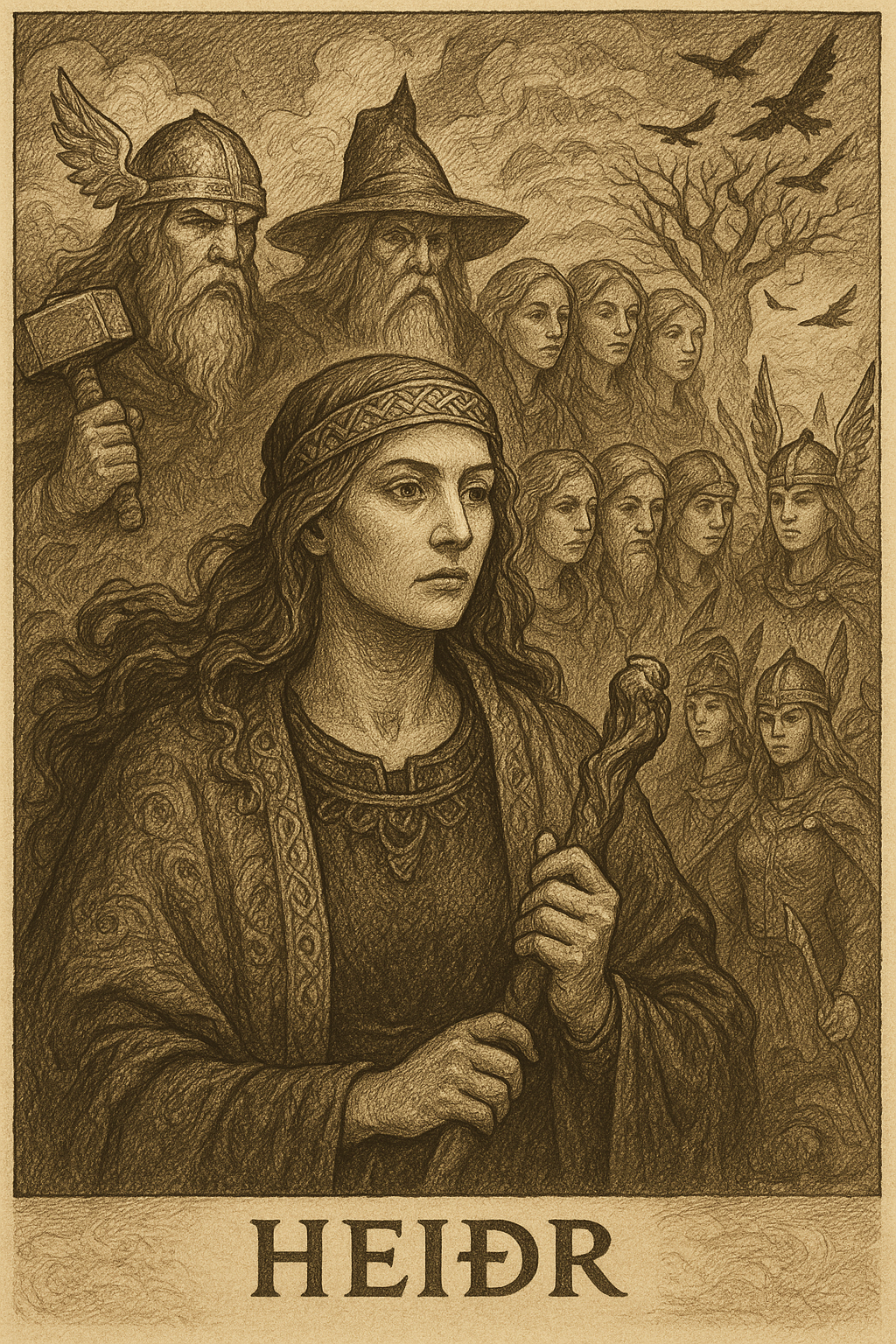
Let me introduce Völuspá — The Prophecy of the Seeress — a true all-star gathering of gods and heroes familiar even in Japan: Thor and Loki from Marvel Comics, Freyja from Is It Wrong to Try to Pick Up Girls in a Dungeon?, the Norns from Ah! My Goddess, and of course the Valkyries. This poetic masterpiece of Norse mythology is woven with irresistible, chūnibyō-esque keywords: the World Tree Yggdrasill, the Twilight of the Gods Ragnarök, the monstrous wolf Fenrir, and the world-serpent Jörmungandr.
Although the tale is often described as the words of a “seeress,” völva
simply means “female prophet” and is not her name. Her name is thought
to be Heiðr, who is sometimes regarded as identical with the goddess Freyja herself. In this poem, the seeress recounts to the chief god Odin everything from the creation of the world to the distant future where nearly all gods meet their doom. Völuspá not only condenses the vast cosmos of Norse mythology but also hints at
lost myths, making it a work of endless fascination.
For instance, the poem tells how the gods’ peaceful age ended with the appearance of three mighty giantesses—believed to be the Norns: Urd, Verdandi, and Skuld. As these three decide the fate even of the gods, they are portrayed as beings surpassing the divine order itself. Just as in modern comics, the youngest, Skuld, is quick-tempered and impulsive; her short temper even inspired the well-known tale of “Norna-Gest.”
At Ragnarök, Odin, who has been listening to the seeress’s prophecy, is devoured by
Fenrir. Thor fights Jörmungandr, and though he slays the serpent, he too
perishes. In the end, flames engulf the world, and the realm of the gods
is reduced to ashes. It is said that after hearing this prophecy, Odin
returned home with his shoulders heavy in despair.
In preparation for that final battle, Odin commands the Valkyries to gather the spirits of fallen heroes and keep them in Valhalla. The famous Ride of the Valkyries vividly evokes the scene of these maidens soaring through the sky to collect
the souls of the slain.
What intrigues me most, however, is the seeress Heiðr herself. If she truly is Freyja—the goddess of love, beauty, and passion—then perhaps Freyja possessed another forgotten side: one that knew the tragic fate of gods and men alike.
For those who wish to read The Prophecy of the Seeress in Japanese, visit
https://www.asahi-net.or.jp/~aw2t-itu/onmyth/poeticedda/volspa.htm
and for those who wish to enjoy the original Old Norse text alongside English
translations, https://books.openbookpublishers.com/10.11647/obp.0308/ch1.xhtml provides them as well.
Episode 12 Aesop
.png) Let me introduce Aesop — a real historical figure, a world-famous man whom
everyone knows, yet no one truly understands.
Let me introduce Aesop — a real historical figure, a world-famous man whom
everyone knows, yet no one truly understands.
Most people have heard the
name Aesop, the supposed author of the famous Aesop’s Fables. When you look him
up, you will likely find a portrait of an indescribable middle-aged man.
Despite his fame, almost everything about this person remains shrouded in mystery.
To begin with, Aesop was a
genuine historical figure, so well known that even Herodotus, in his Histories,
clearly recorded him as having been born a slave. The founder of all learning,
the philosopher Aristotle — who later tutored Alexander the Great — also wrote
about him. And yet, none of the so-called Aesop’s Fables can be definitively
attributed to him as their author.
Adding to the mystery, Aesop’s
lover is said to have been a beautiful woman named Rhodopis. Her existence only
deepens the enigma surrounding him. According to legend, she too rose from
slavery to become fabulously wealthy and later dedicated an astonishing number
of iron skewers to the temple at Delphi.
Aesop — a real man, surrounded
by mysteries and enigmatic figures — continues to fascinate us to this day.
Episode 11 Rugrats
This time, it’s Rugrats!
Believe it or not, babies actually understand human language — and they
even talk to each other! Up until around age three, kids can still understand
“baby talk,” so they’re basically bilingual — fluent in both Adult and
Goo-Goo-Gaa-Gaa. Rugrats is an American cartoon built entirely on this
hilarious premise.
Of course, these tiny tots
don’t have much life experience, so whenever they try to interpret grown-up
language, it often goes spectacularly wrong. One minute someone’s talking about
“having a baby shower,” and the next the babies are literally preparing an
indoor storm. But somehow, through a mix of courage, creativity, and
friendship, they always save the day — and their diapers.
The show is often filmed from a baby’s eye view, and honestly, it’s impressive
how well it captures that world. Who among us doesn’t remember when the
dining table looked like Mount Everest, and the family dog seemed like
a woolly mammoth? Rugrats brings back that sense of wonder right from the
opening sequence.
Each character has a distinct
charm that grows on you episode by episode. There’s Tommy, the brave little
leader in diapers — the youngest, yet the heart of the group. His appearance
might seem a bit unusual to those used to Japanese anime style, but before you
know it, he’s irresistibly cute. His cousin Chuckie, a bit older and battling
allergies, adds depth and empathy to the story. This kind of emotional detail
is what makes American animation so memorable — you end up caring deeply about
these characters without even realizing it.
One unforgettable scene shows
Tommy standing all alone in the middle of the schoolyard at noon — and from his
tiny perspective, it feels like he’s stranded in a vast desert of despair. It’s
surprisingly powerful for a cartoon about crawling humans.
And then there’s the scene
where Tommy’s parents prepare a nine-branched menorah.
This is a sacred symbol in Jewish tradition, used during Hanukkah to
commemorate the miracle of the oil that burned for eight days. For Japanese
viewers, the meaning may not be immediately clear, but for Western audiences,
this single moment speaks volumes about the family’s cultural and spiritual
identity.
So yes — Rugrats is a comedy about baby chaos, but maybe… just maybe… it
carries a deeper message about growing up, belonging, and understanding
the world — one diaper change at a time.
Episode 10 Sara Paretsky's V. I. Warshawski
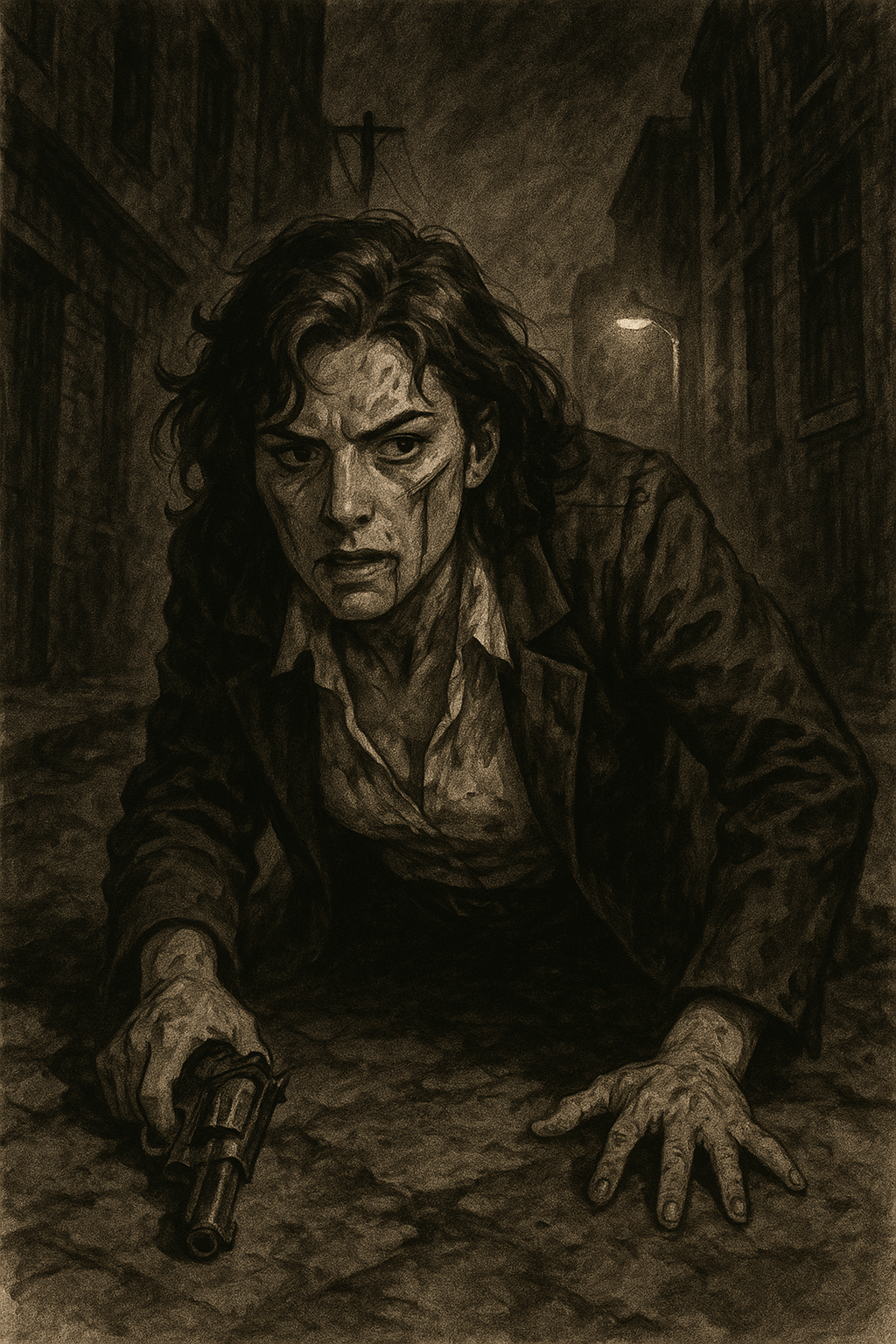 When it comes to hard-boiled women, the first person who comes to my mind is V. I. Warshawski.
If I were asked to name
hard-boiled women, I might list Grand Duchess Sofia, Caterina Sforza, and Tomoe
Gozen—but their ways of life are almost otherworldly. Compared with them, the
fictional V. I. Warshawski feels far more real, as if she were a living,
breathing person.
V. I. Warshawski, created by
Sara Paretsky, is a former lawyer and a divorced private investigator. When she
is hired to look into a case, she often finds herself entangled in outrageous
crimes and murders, ultimately confronting the culprits head-on. Armed with a
pistol, tall, and trained in karate, she is no stranger to danger—but she
frequently ends up battered and half-dead. Even so, she never bends her
principles; she always rises again to face evil, and that indomitable spirit
has won her the admiration of countless readers.
Some may say, “Well, that proves she’s fictional after all.” But it is
precisely Paretsky’s vivid portrayal that makes V. I. Warshawski seem so
real. She enjoys cooking, she’s perfectly capable of doing housework—but
she’s terrible at keeping things tidy. After a day of grueling investigations
and violent confrontations, she returns home exhausted, sighs at the sight
of the clothes and clutter scattered around her room, and carries on. She
gets disheartened after scoldings from an ex-boyfriend or her father’s
old friends.
At first glance, V. I. may seem like a brash, unapproachable, hard-boiled
detective—but through such intimate details, she becomes someone you simply
cannot dislike.
Episode 9 Runer Jonsson's Vicke Viking
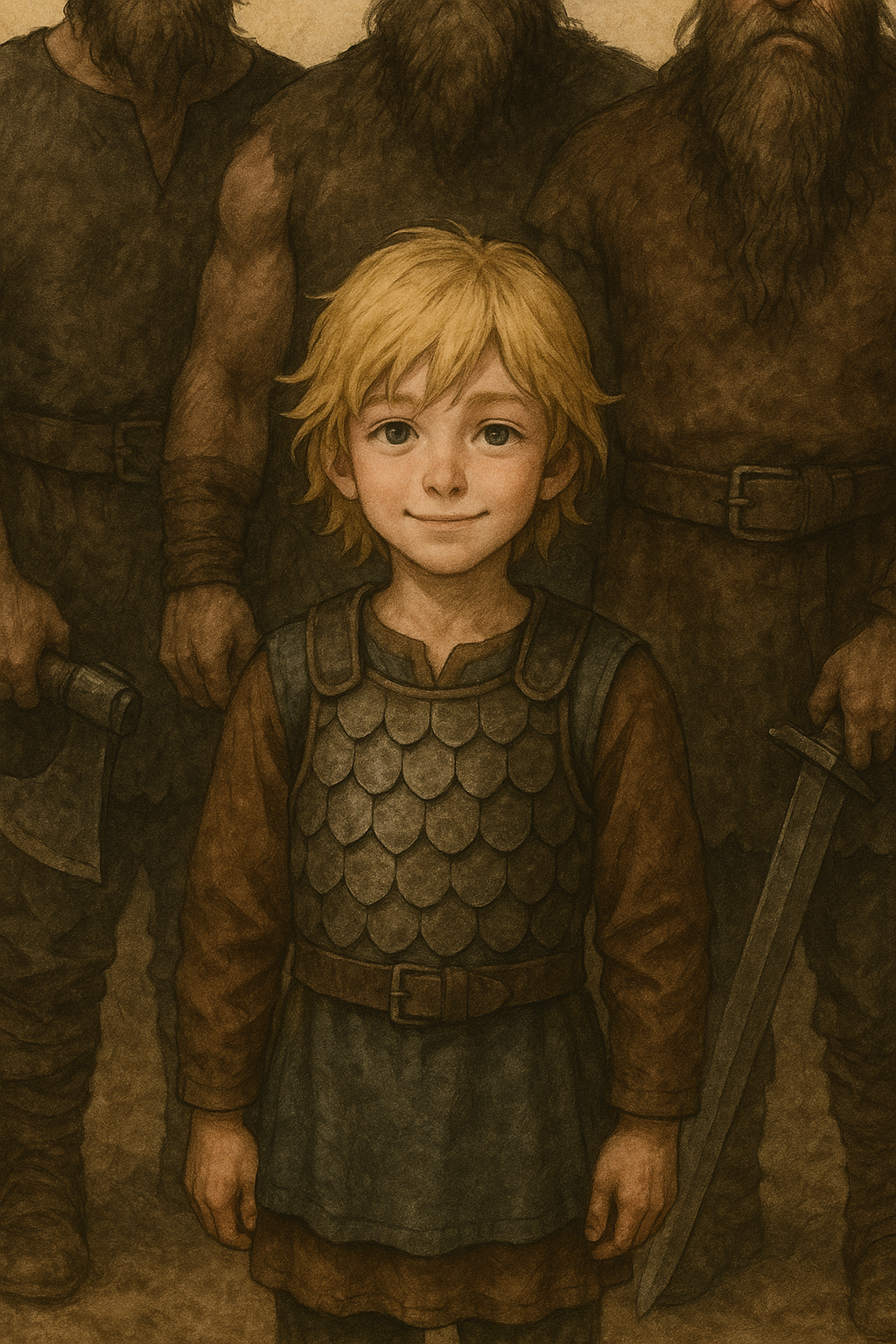 This time, I would like to introduce Vicke Viking (Vicky the Viking), written
by Runer Jonsson, a story that had a great influence on One Piece’s creator
during his childhood.
This time, I would like to introduce Vicke Viking (Vicky the Viking), written
by Runer Jonsson, a story that had a great influence on One Piece’s creator
during his childhood.
This work stands as a monumental classic of maritime adventure tales and
has been loved around the world. It is such a famous story that it hardly
needs an introduction, yet considering its historical background and lasting
impact, it remains endlessly fascinating—so I would like to revisit it
here. For overseas readers curious about the details of Vicke Viking, which
greatly influenced the creator of One Piece, I suggest simply asking ChatGPT
in your native language. Interestingly, the German–Japanese co-produced
anime version was broadcast globally, yet—curiously enough—never aired
in its country of origin, Sweden, though today they can enjoy the animation
by Netflix.
First, although Vikings are sometimes referred to as pirates, it would
be more accurate to describe them as a brave and seafaring people. With
their strong spirit of adventure, advanced navigation skills, sophisticated
ships, and extraordinary physical endurance, they built trade routes stretching
from Scandinavia to the Black Sea and Constantinople, even reaching the
Mediterranean, Greenland, Iceland, and North America. When the Vicke the
Viking series aired, I remember seeing an episode where Vicke and his crew
landed in North America and interacted with the locals. As a child, I thought,
“That can’t be true.” But I was wrong—thanks to the discovery of the L’Anse
aux Meadows site in eastern Canada in 1960, long before the show aired,
it was proven that Vikings were the first Europeans to reach the Americas—centuries
before Columbus.
Incidentally, the term “Viking” doesn’t refer to a single group. They can
be broadly divided into three: the Danes (Daner), the Norwegians (Norsemen),
and the Swedes (Sveans). Our hero Vicke is most likely one of the Sveans
from the author’s native Sweden—especially since the antagonists are Norwegian
Vikings.
True to the quality expected
of a German co-production, the anime characters were designed faithfully based
on the original book’s illustrations. Vicke is a quiet, adorable boy of
early-teen age or younger. Physically, he is weaker than other boys his age,
but his strength lies in his mind—his intelligence, ingenuity, and ability to
put his ideas into action. He is the only son of the Viking chieftain, loved
and cherished by the adults. The fact that he alone wears a scale armor shows
how precious he is to them. The adult Vikings, by contrast, are usually
depicted in ordinary clothes—even in battle scenes. That might be an
exaggeration, since in reality, even the bravest and strongest warriors wore
chain mail during combat.
Vicke and his companions embark on adventures that span territories greater
than those of the Roman Empire. They face formidable natural forces and
powerful enemies. In desperate situations, Vicke—courageous but not strong—uses
his wits and imagination to overcome crises alongside his companions. Vicke
Viking follows the grand themes of “voyage,” “friendship,” “companionship,”
and “adventure,” yet it would not exist without Vicke’s uniquely un-Viking-like
charm. Perhaps such a story could only have been conceived by someone from
a Viking nation.
Let me close by introducing one episode that I found especially interesting:
the story in which Vicke and his crew punish Viking raiders attacking Britain.
As depicted also in the film The Secret of Kells, Britain and Ireland suffered
greatly from Viking invasions. Some people from those countries might be
tempted to say, “Aren’t Vicke and his friends invaders too?” However, Runer
Jonsson likely wrote this tale based on his belief that the Swedish Vikings
(Sveans) did not raid Britain or Ireland. In fact, the Sveans are thought
to have expanded southward through Russia across the Eurasian continent,
rather than taking part in those western invasions. Those raids were mainly
carried out by the Norsemen, which is why the Norwegian Vikings are portrayed
as the villains in the story. Even in such details, one can sense the subtle
dynamics between neighboring nations—and I find that quite delightful.
Episode 8 The Eastern Campaigns of Alexander
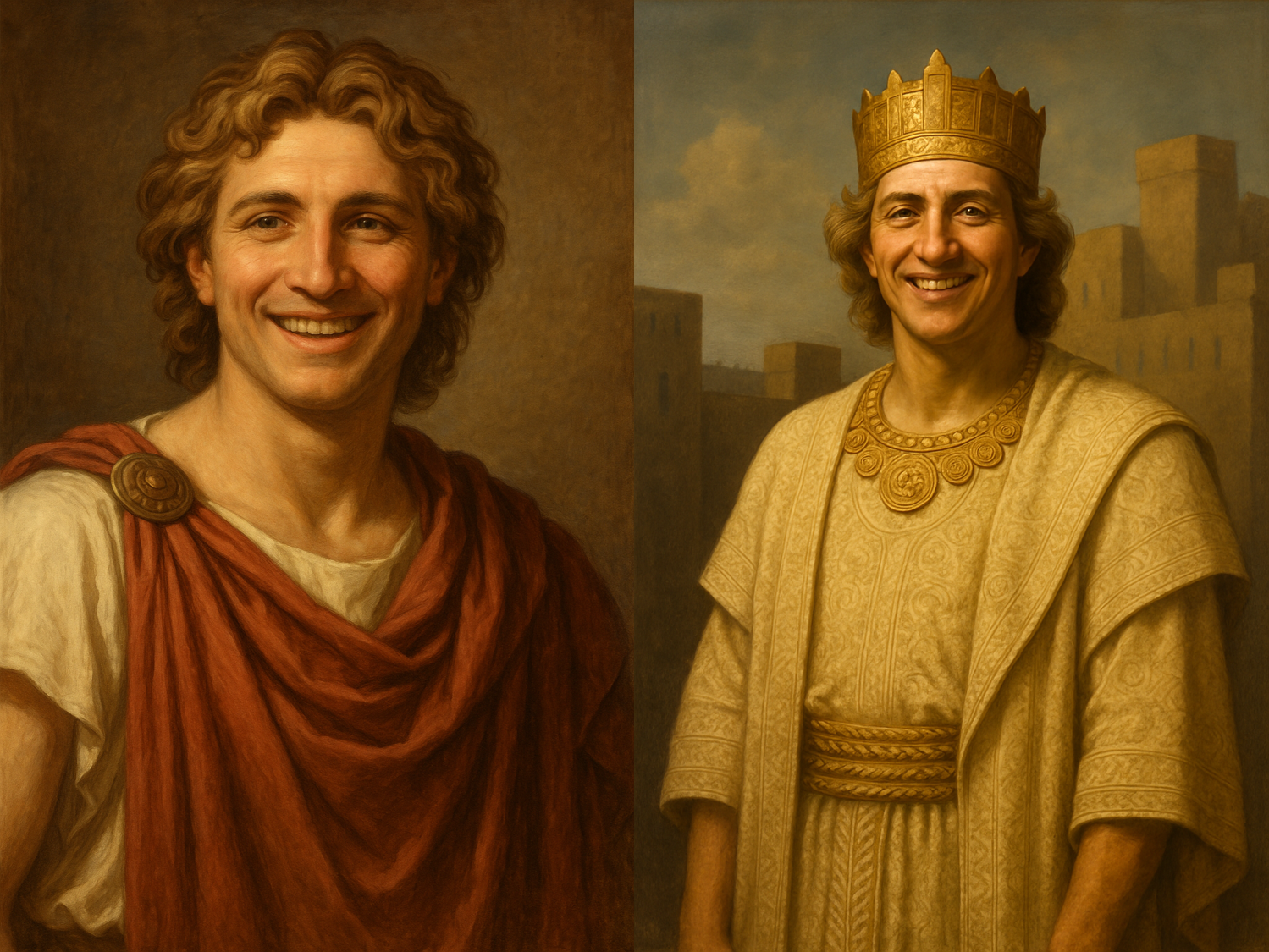
This time, let us turn to The Anabasis of
Alexander — the chronicle of a young leader who built one of the greatest
empires in human history. Though based on the records left by Alexander the
Great’s own officer, this work is far more than a simple log of military
conquests.
We have all heard stories of wise rulers
who become tyrants, or of beloved leaders who, over time, grow estranged from
those who once adored them. Many readers, upon finishing The Anabasis of
Alexander, may find themselves reflecting on that very transformation.
Enraged by the repeated Persian invasions
of Greece, the young commander Alexander resolved to unite the Greek world. He
first eliminated those who stood in the way of unity—city-states that refused
cooperation—and forged Greece into a single power. Even the Spartans, famed for
their ferocity, could not resist his advance.
Then came his campaign eastward. Alexander
swept across the Near East, tearing through territories long under Persian
control. At Gaugamela, he devised the first recorded mobile encirclement
strategy in history—defeating a Persian army of 250,000 with barely 50,000 men.
That revolutionary tactic remains a foundation of modern military doctrine,
still taught at war colleges around the world.
Driven by a dream to reach the far eastern
shores of Eurasia, Alexander continued his conquests through Western Asia and
into India. Yet there, the fatigue and disillusionment of his Greek soldiers
finally overcame him. Forced to abandon his march east, he returned to Babylon,
where he soon died—only thirty-two years old. One cannot help but wonder: had
his men not rebelled, might he have reached the eastern edge of China—or even
Japan?
This is the story preserved in The Anabasis
of Alexander. The original record, written by his general Ptolemy—founder of
the Ptolemaic dynasty of Egypt—was later compiled and restructured by Ἀρριανός, granting the work immense historical value.
(Incidentally, Ptolemy’s descendant was none other than Cleopatra VII.) Sadly,
the original History of Alexander the Great was lost when the Great Library of
Alexandria burned—a fire ignited, ironically, during the civil war between
Cleopatra and her brother, in which Julius Caesar, her ally, played a fateful
role. History, it seems, delights in such tangled ironies.
Yet the worth of The Anabasis lies not only
in its historical precision. It captures, with striking clarity, the emotional
and moral transformation of Alexander himself—his arguments with subordinates,
the defection of lifelong companions, and his increasingly volatile responses
to dissent.
As the commander of the Greeks, Alexander
led not as a distant monarch but as a comrade. He called his soldiers
“friends.” When the defeated Persian king Darius III fled the battlefield,
leaving his wife and family behind, Alexander treated them with respect and
dignity. One anecdote tells of Darius’s queen mistakenly thanking an older
general, believing him to be Alexander. When she realized her mistake and
blushed with embarrassment, Alexander laughed and reassured her, “Think nothing
of it.” Moments like these reveal the charm of a leader once tutored by
Aristotle himself.
But tragedy arose from the clash between
East and West. In Greek thought, gods and men were separate; even the children
of gods were still human, and no living man was worshiped as divine. The East,
however, followed different customs—men knelt before kings, seeing them as
gods. Midway through The Anabasis, this cultural divide becomes painfully
clear. “The defeated people,” Ἀρριανός writes bitterly, “fell to their knees
and worshiped Alexander.” And Alexander, growing accustomed to such reverence,
began to demand the same from his Greek companions. From that moment, quarrels
multiplied, blood was spilled, and plots to assassinate the king emerged.
The book mentions the infamous sack of
Persepolis only in passing: “After the burning of Persepolis, the army marched
on.” Such restraint in description chills the reader more than any detailed
account could. Thereafter came the Indian campaign, the mutinous soldiers, the
reluctant return, and the inevitable death of the conqueror. Somehow, all of it
feels tragically preordained.
The Anabasis of Alexander is, without
question, a masterpiece. The exhaustion one feels upon finishing it may well be
proof that Alexander III—conqueror, visionary, and flawed human being—was,
after all, only a man.
Episode 7 Alf Prøysen’s Mrs. Pepperpot
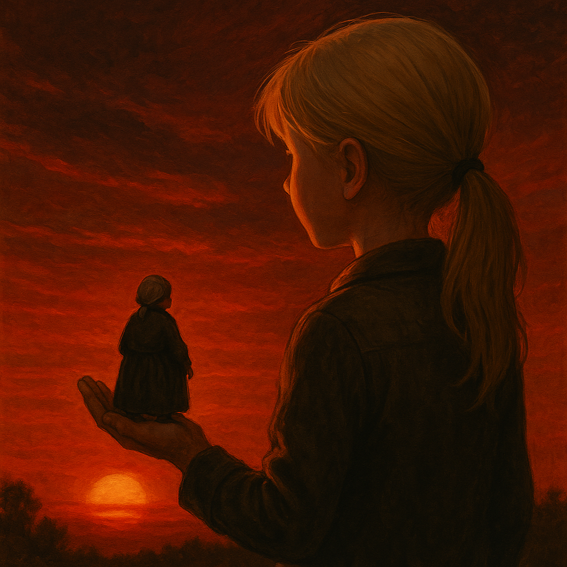
This time, I would like to introduce Alf
Prøysen’s Mrs. Pepperpot — a fairy tale that many Japanese readers know under
the title “Mrs. Spoon.” The modern Norwegian title is Teskjekjerringa,
so the Japanese translation is in fact quite accurate.
It is not often that Japanese readers have a chance to encounter Norwegian
literature. However, Mrs. Pepperpot once gained worldwide fame, and thanks
to that, Japanese children, too, were fortunate enough to enjoy it. In
recent years, the story has become less familiar, which is precisely why
I would like to reintroduce it here.
In the tale, this remarkable old lady suddenly shrinks without any warning
or reason and gains the ability to talk with animals. Since she eventually
returns to her normal size, she remains calm, thinking of it only as an
inconvenience — “Now I can’t do the housework.” Yet in that state, she
boldly faces and resolves all sorts of problems, either on her own or together
with animals. That is the indomitable Mrs. Pepperpot.
There is someone who understands and helps her—a “mysterious
girl who lives near the forest.” Throughout the entire story, the girl’s true
identity is never revealed. If you were to ask Alf about her, he might simply
smile and say, “Just as you imagine.” Incidentally, when this story was adapted
into an animated series by Japan’s national broadcaster, the girl appeared as a
semi-regular character. Yet even in the anime, her true nature was never
disclosed.
This fairy tale offers few of the usual moral lessons;
instead, it captivates the reader with the sheer delight of the old lady’s
adventures. It is a story that speaks directly to the child’s heart, pure and
unadorned.
Born into humble circumstances, Alf Prøysen went on to
achieve great success as both a writer and a singer-songwriter, yet he never
distanced himself from ordinary people. I have recorded this note in the hope
that readers will come to know and appreciate Norway’s beloved Alf Prøysen
through Mrs. Pepperpot.
Episode 6 Things That Make One Envious
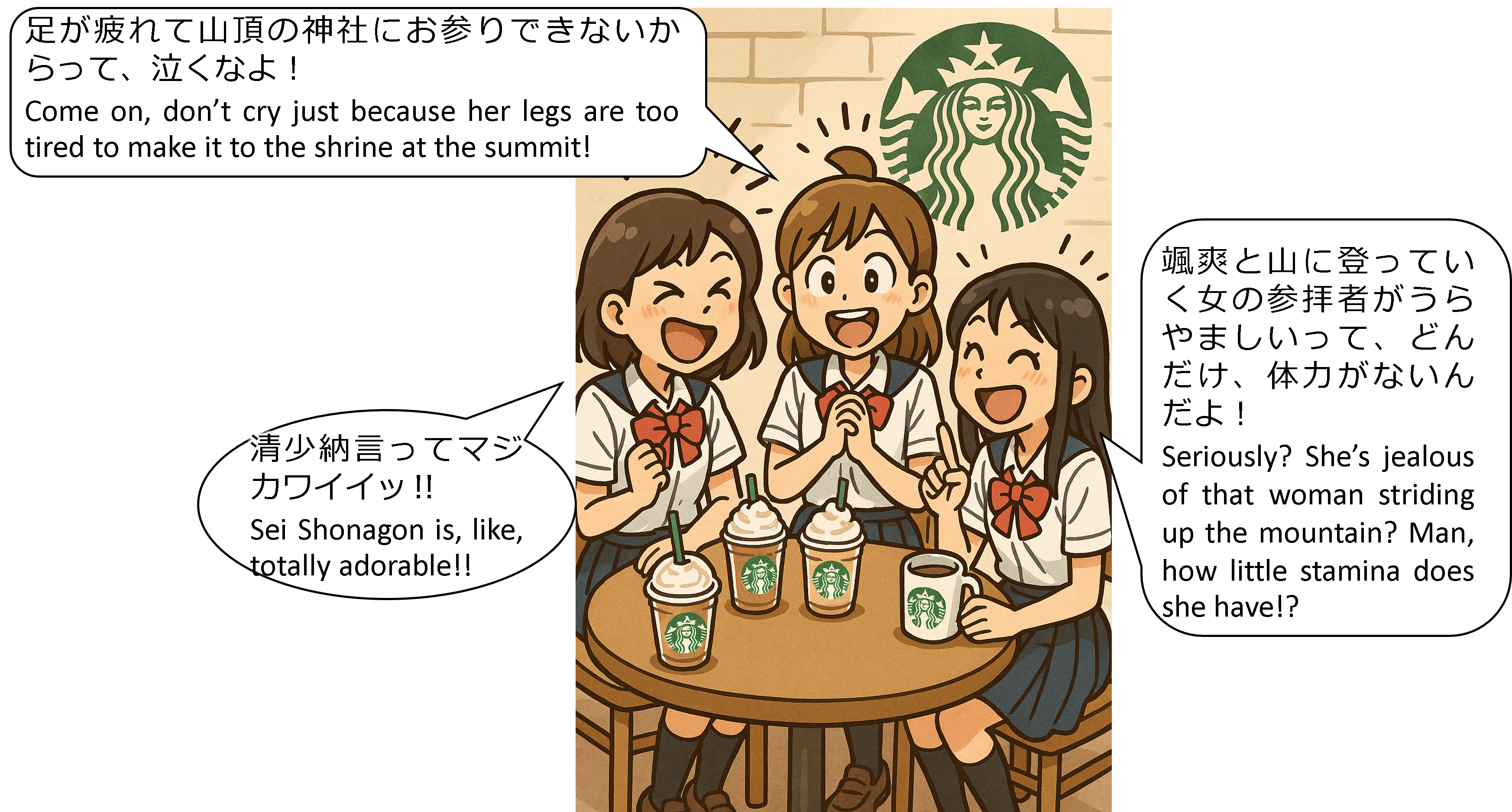
While I was taking shelter from the rain, a group of high school students
next to me was having the time of their lives. And get this—they were laughing
over a joke based on Makura no Sōshi (“The Pillow Book”), specifically
the essay called Things That Make One Envious. I mean… wow. That’s next-level
nerdy.
The Pillow Book is an essay written around
the year 1000 by Sei Shōnagon, a legendary lady-in-waiting to the Empress and
later hailed as one of Japan’s “Immortal Poets.” It’s such a cornerstone of
classical literature that Japanese high school students almost always encounter
it in their textbooks. But here’s the thing: the text isn’t exactly “light
reading.” The grammar is ancient, the vocabulary is tricky, and it’s basically
like deciphering Shakespeare while juggling kanji flashcards. And yet, these kids
are cracking up over it. Either they’re geniuses—or their teacher is.
.png)
The essay Things That Make One Envious
describes Sei Shōnagon’s personal pilgrimage to Kyoto’s Fushimi Inari Shrine,
famous for its endless rows of bright red torii gates. Even though she was part
of the imperial court, her rank was low enough that she had to go on foot. Poor
woman had no stamina whatsoever—palace life doesn’t exactly build leg muscles.
She trudged out before dawn, walked over five miles to reach the foot of the
mountain, and then started climbing toward the shrine at the summit. Of course,
faster people kept overtaking her. Exhausted and tearful, she muttered, “Why on
earth did I pick such a blazing hot day to come?” Suddenly, everyone else
looked unbearably enviable.
.png)
And here I am, chuckling at the thought:
over a thousand years later, in a crowded shrine or a crowded classroom, Sei
Shōnagon still feels so… relatable.
To finish, let me quote the famous opening
lines of her essay, the ones every Japanese student knows: “Haru ha Akebono….”
Even in English, her murmurs sound beautiful.
“In spring, the dawn — when the slowly paling mountain rim is tinged
with red, and wisps of faintly crimson-purple cloud float in the sky.” (Meredith
McKinney 2006)
Episode 5 "HEY ARNOLD!"
Today I’d like to introduce Hey Arnold!—and
especially Season 1, Episode 18, “Arnold’s Christmas.” In my opinion, this
episode is one of America’s greatest treasures, a heartwarming masterpiece that
deserves to be celebrated worldwide.
Back when I was a postdoc at Penn State,
I’d often come home in the evening, turn on the TV, and there it was:
Nickelodeon’s cartoon Hey Arnold! At first glance, the art style screams
comedy—Arnold and his quirky friends constantly stumble into trouble, get
dragged into more trouble, and somehow manage to solve it all.
But what really impressed me was the depth
of the characters. Arnold is a genuinely kind and honest kid, but he carries a
heavy backstory—his parents are missing, and he lives with his eccentric but
lovable grandparents, who run a boarding house. His best friend Gerald is the
definition of loyalty, always sticking by him no matter what. And then there’s
Helga, the queen of “tsundere” before the word even existed! (Fun fact:
“tsundere” only entered Japanese media vocabulary around 2005–2006, yet Hey
Arnold!—which debuted in 1996—was already giving us Helga, the ultimate
prototype. That’s groundbreaking!)
Now, every episode is fun, but “Arnold’s
Christmas” is something else. It’s even recognized on Wikipedia as a classic.
The story centers on Mr. Hyunh, a Vietnamese immigrant living in Arnold’s
building, who was separated from his young daughter during the war. Arnold,
together with Gerald, decides that the best Christmas gift he can give Mr.
Hyunh is the chance to reunite with her. The premise was so heavy that
production itself was difficult—but thanks to the creators’ persistence, the
episode was released and instantly became an unforgettable masterpiece.
Of course, the reunion plot is deeply
moving on its own. But the moment that elevates this episode to greatness is
Helga’s final line. With that one act, the story ascends to a level I would
compare to Violet Evergarden’s legendary Episode 10, “A Loved One Will Always
Watch Over You.”
Growing up in Japan, I knew Christmas
mostly as a time for gifts, but without the same deep cultural weight it
carries in the West. That’s why I found it so powerful: Arnold and Gerald are
overjoyed just to give Mr. Hyunh the gift of reunion, and Helga—well, she
quietly gives them the greatest gift of all. That mix of comedy, kindness, and
sacrifice? Absolutely cool.
I hear this episode is already well-known
in the U.S., but honestly—it deserves to be celebrated everywhere. It’s not
just a cartoon episode; it’s one of those rare works that proves animation can
touch the heart as deeply as any great drama.
Episode 4-3 Gaius Iulius Caesar "The Gallic War"3
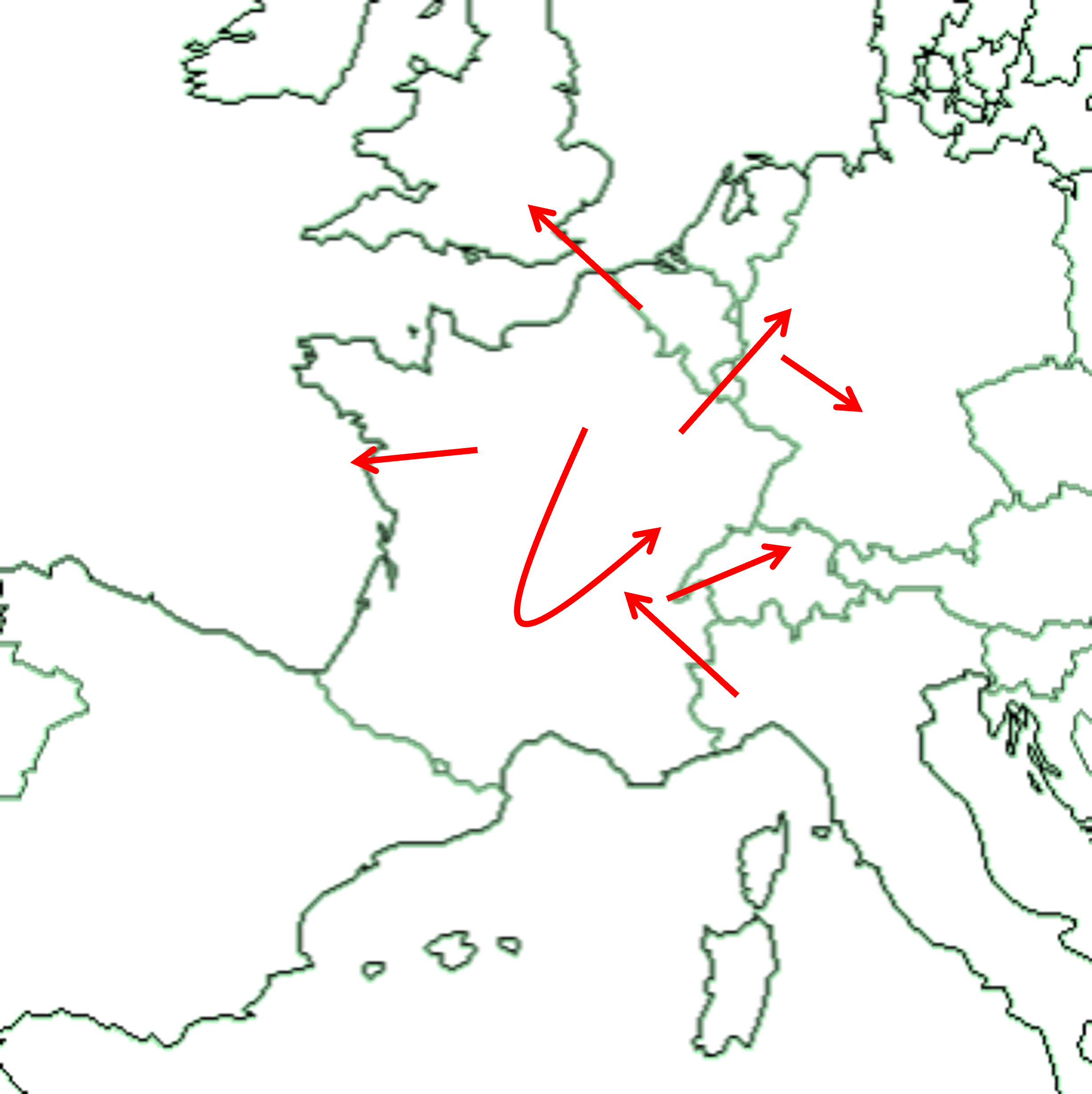
The Gallic War is also the record of Caesar, who ranged freely across Western
Europe. First, in Switzerland, Caesar resolved a conflict that had begun
as a refugee problem. Next, he fought a great war in Belgium, then suppressed
a maritime conflict on the Atlantic coast, crossed the Rhine, and sought
to intimidate the Germanic tribes. To swim or sail across the Rhine was,
in Caesar’s view, beneath the dignity of civilized Romans. Instead, by
a curious logic that “Romans should build a bridge and march proudly across
into Germanic lands,” he had an enormous bridge constructed across the
wide Rhine. Satisfied with this feat, he exulted, certain that “the Germans
must be trembling.
.png)
Afterward, he crossed the sea and landed in Britain, engaging in battles
with the Britons. During the Second World War, British Prime Minister Churchill
declared that with Caesar’s landing, the history of Britain had begun.
From these British campaigns onward, the grand spectacle—replete with countless
infantry battles, cavalry charges, chariot clashes, and naval engagements,
rivaling the scale of The Lord of the Rings—moved toward the great Gallic
revolt and its climactic finale, the “Battle of Alesia.” There, the Romans
besieged the fortified city of Alesia, where the Gallic leader Vercingetorix
had taken refuge, only to find themselves besieged in turn by the Gallic
relief forces. This became the first large-scale double-envelopment battle
in history, and it was Caesar who triumphed, holding off enemies to his
front and rear alike. The account of the battle closes with a single, stark
line: “Vercingetorix voluntarily gave himself up.” And Caesar’s own Commentaries
on the Gallic War ends in the same subdued tone: “Upon learning of the
year’s victories, Rome decreed twenty days of thanksgiving to the gods.
.png)
With this account, as if it were a grand work of fiction, we close our introduction to Caesar’s Gallic War. In the end, Caesar was assassinated, and his body was cremated on the banks of the Tiber. As the flames died down and the mourners moved to gather his ashes, a sudden, violent downpour scattered them into the Tiber, washing them away. Was he truly a man?
Episode 4-2 Gaius Iulius Caesar "The Gallic War"2
The Gallic War is, at its core, a series of reports Caesar submitted to the Roman Senate.
For this reason, he refers to himself in the third person, adopting a style
such as “Caesar judged that—” or “Caesar attacked—.” It was an unsettled
age: the Celts and the Germanic tribes were striking at Roman territory
and at allied cities across western Gaul. To stabilize the region, the
Senate dispatched Caesar. Thus, as in modern times, it was his duty to
deliver an annual report.
.png)
The default form of The Gallic War is that of a clear and orderly record: an overview of the state of Western
Europe, the causes of each disturbance, the strategy and movement of the
legions, descriptions of the battlefield, preparations for combat, the
battle itself, and the aftermath—each rendered with an exceptional, objective
style. The accounts of terrain, fortifications, and siege equipment read
almost like an academic paper: dispassionate, yet detailed. But when the
battles begin, the narrative comes alive. “Caesar, seizing a shield from
one of his own men, raised it and ran to the front line, calling out the
names of the centurions.” Soldiers cheer as two rival centurions, competing
for glory, narrowly escape disaster by joining forces. A reckless unit,
overconfident and nearly annihilated, is rescued by Caesar—who both commends
their courage and sternly rebukes their arrogance before leading them once
more into battle. Such breathless passages draw the reader in so completely
that one forgets the passage of time, until suddenly the fighting is over.
From time to time, special digressions appear: cultural and social observations
comparing Gaul and Germania, or even scientific notes such as measurements
of the length of a day on the island of Britain.
Ever calculating, Caesar knew his reports would reach the ears of the Roman people, and so he wove into them elegant strands of self-praise. They are too numerous to list, but let one example suffice: “The Senate, in recognition of Caesar’s achievements, decreed a public thanksgiving (supplicatio) of fifteen days (the longest such observance until then had been only seven days, in honor of his rival Pompey).” What Caesar truly wished to emphasize, of course, was the parenthetical—the contrast with Pompey. Yet, disdaining crude boasting, he left the comparison unwritten. On this point, I find myself in agreement with the historian Nanami Shiono.
Episode 4-1 Gaius Iulius Caesar "The Gallic War"
.png)
Episode 4 features The Gallic War, written by Gaius Iulius Caesar (BC 100-BC
44), commonly known as Julius Caesar. It is the story of a superman overflowing
with human charm, conveyed through the reports he sent to the Roman Senate.
The author of The Gallic War, Caesar himself, was a man of
inexhaustible fascination. Nanami Shiono devoted two full volumes to him in her
monumental fifteen-volume series The Story of the Romans, which traces the
twelve centuries of Rome’s rise and fall. The boy who once rode a horse bareback
down the slopes of Rome with his arms folded behind his head would later
distinguish himself brilliantly in many fields.
.png)
Debt: Caesar taught us that when one’s debts become overwhelmingly large, the
debtor effectively turns into an indispensable asset for the creditors.
Before he departed for a foreign posting, a throng of creditors besieged
him, blocking his departure until he repaid them. The one who calmed the
creditors was none other than Crassus, the man to whom Caesar owed the
greatest sum.
Romantic Affairs: Many senators’ wives were Caesar’s mistresses. Since this fact was publicly
known, it seems not to have been regarded as adultery. Remarkably, though
he had many mistresses, none are recorded to have resented him. The absence
of any scandal with the celebrated beauty of the age suggests that Caesar
was not a man who pursued every beautiful woman he encountered. Notably,
the mother of Brutus—who would later assassinate Caesar—was among his mistresses.
One wonders what feelings passed through her mind when she heard of his
death.
Politics and Institutions: Caesar managed to pass the volatile agrarian law—long a source of turmoil,
bloodshed, and regime change in Rome—through a form of bipartisan agreement.
He introduced the Julian calendar of 365 days with a leap year every four
years. He ordered the immediate publication of Senate proceedings, which
had previously been decided behind closed doors. He also laid down laws
governing public officials.
Commerce: Quite impressive. Somehow, Caesar shifted from being a debtor to becoming a creditor. At his triumphal procession, his legionaries erupted in a comical chant: “Romans, lock your doors, guard your purses if you have no money!” In triumphs, it was customary for soldiers to mock the general to prevent the gods from becoming jealous of his glory. At one point, Caesar protested, “Isn’t this too cruel?” But his devoted soldiers dismissed his complaint, claiming it was their rightful prerogative.
War: Caesar was not an undefeated general. He lost when circumstances dictated.
Yet no matter how dire the situation, at the decisive moment he always
found a way to win. At Pharsalus, though outnumbered, he defeated the “double
envelopment” tactic—first invented by Alexander the Great, rediscovered
by Hannibal, and perfected by Scipio—revealing his genius.
Literature: Before Caesar, Latin was considered rough-hewn compared to Greek, and the
upper classes and scholars often preferred to write in Greek. Caesar, however,
achieved in Latin an extraordinary blend of objective and concise narrative,
vivid descriptive power, and subtle political intent. This is The Gallic
War. Remarkably, even more than two thousand years later, this work continues
to be reprinted across the world. To fulfill not only the roles of general
and statesman but also the dreams of every writer—this was Caesar, the
superhuman.
Episode 3:Haruomi Tomotsuka "Dara-san in the Reiwa Era (令和のダラさん)"
.png)
People sometimes ask me, “Do university professors actually read manga?”
Of course we do! The only problem is, I don’t visit bookstores as often
as I used to, and when I do, the manga shelves are wrapped up tighter than
a bank vault in plastic covers. You can’t peek inside. Even with e-books,
the “free preview” usually ends just before the story gets good. Under
these tragic circumstances, stumbling upon a manga I truly enjoy feels
like winning the lottery.
That’s why I was thrilled to discover Dara-san in The Reiwa Era (令和のダラさん) by Haruomi Tomotsuka-sensei. It’s the tale of a shrine maiden who fights
a monstrous serpent—only to be tricked by the villagers she’s protecting,
lose her life, and come back as the very snake monster she once battled
(KanKanDara(姦姦蛇螺)) . Yeah, cheerful stuff. Needless to say, I felt a lingering sadness
reading about her fate. Zero happy endings in sight.
But then comes the modern-day horror-comedy spin: Reiwa no Dara-san reimagines this ex-miko monster living among us today. Sure, a few evil
humans show up, but they’re rare. Even the descendants of those treacherous
villagers appear—yet now, everyone surrounding her turns out to be absurdly
kindhearted, almost suspiciously so. Admittedly, some look shady with menacing
glares… but don’t worry, they’re all sweethearts at heart. And according
to Tomotsuka-sensei, this is a “beautiful-girl manga, drawn by a beautiful
girl, starring only beautiful girls.” ????
Anyway, I personally feel relieved that through this work, even Kankandara is finally saved.
Episode 2: Anne McCaffreey "The Ship Who Sang"

Anne McCaffrey’s The Ship Who Sang is set in an era when interstellar travel
is commonplace. In this world, parents of newborns with severe disabilities
that make natural life impossible can choose to let them live on as cyborgs.
Protected within a thick titanium shell, these infants grow up normally,
connected through terminals to sensors and actuators that allow them to
develop just like healthy children. For this reason, they are called Shell
Person. Interestingly, Shell Person tend to view non-cyborgs as “slightly
inconvenient folk.”
Helva, one such Shell Person, is a teenager who, thanks to her extraordinary
abilities and aptitude, chooses to operate as a starship for the interstellar
federated state. These starships are run as a two-person team: the Shell
Person serves as the “Brain,” while the human partner provides the “Brawn.”
Such vessels are therefore known as Brain-Brawn ships, or 2Bs. Helva quickly
falls in love at first sight with a mischievous young astronaut named Jennan,
who becomes her Brawn, and together they set out across the stars.
Helva loves to sing as she roams the galaxy, but many who intercept her
songs mock her as a strange “singing ship.” When she grows disheartened,
Jennan reassures her: “It’s beautiful. Don’t ever stop.” And when the two
of them singlehandedly defeat a band of space pirates, the ridicule turns
to admiration. Yet just as everything seems to be going well, tragedy strikes:
during a refugee transport mission, Helva loses Jennan before her very
eyes.
At this point, some may think I am giving away spoilers. Rest assured—this
is only the introduction. To help her overcome her grief, the interstellar
federation assigns Helva various temporary Brawns and a succession of missions.
This is not cold-hearted policy but rather an act of kindness. Though she
grumbles, Helva works with her Brawns, struggling alongside them and carrying
out her duties with determination. Through many incidents, encounters,
and farewells, she grows stronger.
What strikes me after finishing the novel is that it is, at heart, a pure love story of a working woman, with science fiction providing a stage and details that give the tale breadth and depth. It is one of those works that allows you to feel genuine satisfaction at the happy ending, thinking, “I’m truly glad.”
What is astonishing is how fresh the novel feels, even though it was written
between 1961 and 1969. Some may argue that science fiction is naturally
timeless, but even the works of great masters often reflect the era in
which they were composed. In The Ship Who Sang, however, there is little,
if any, sense of such period-bound elements. The saying “a masterpiece
never fades” seems perfectly suited to this novel.
The Ship Who Sang is thought to have had a major influence on Japanese
manga, anime, and light novels—especially in shaping the archetype of the
heroine with a mechanical body. Since its publication, works with similar
premises have become commonplace.
One final note: Helva’s code name is The ship who sings, while the title of the novel is The Ship Who Sang. Even in this small detail, one can sense the author’s refined sensibility. Truly, this work deserves to be counted among the proud achievements of American literature.
Episode 1 H. P. Lovecraft (1890-1937)
.png)
H. P. Lovecraft is a name known to nearly all who once passed through the
so-called “adolescent delusion” of youthful fascination with the dark and
the arcane. In a letter to a friend, he once wrote: “To me, creatures such
as Frankenstein or the werewolf do not seem truly frightening.”
Upon reading Lovecraft’s works, one recognizes him as a pioneer and a genius
who revealed how terrifying it can be to refrain from rendering the object
of fear in concrete form. His legacy resonates in the dread conveyed by
the film The Blair Witch Project and the novel Ring.
A prolific correspondent, he also confessed to a friend in another letter:
“I love to travel. Yet when I have money, my health fails me; and when
my health is strong, I have no money. Thus I cannot enjoy the journeys
I so desire.”
Lovecraft passed away in obscurity and
hardship. Yet today, his writings are read by countless people across the
world, and games inspired by his works are released almost every year. This
enduring legacy may be regarded as his ultimate solace.

.png)